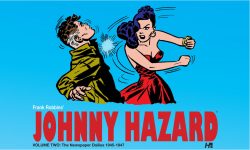
Frank Robbins’ Johnny Hazard volume Two – the Newspaper Dailies 1945-1947


By Frank Robbins with an introduction by Daniel Herman (Hermes Press)
ISBN: 978-1-61345-017-8 (HB/Digital edition)

This book includes Discriminatory Content produced in less enlightened times.

Johnny Hazard was a newspaper strip created in the style and manner of Terry and the Pirates, but in many ways this steely-eyed hero most accurately resembles – and in fact predates – Milton Caniff’s second masterwork Steve Canyon.

Unbelievably, until 2011 this influential, impressively enthralling adventure strip had never been comprehensively collected in archival volumes – at least not in English or even America’s version of it – although selected highlights had appeared in magazines like Pioneer Comics, Dragon Lady Press Presents and the Pacific Comic Club.

Boston born, Franklin Robbins (9th September 1917 – 28th November 1994) was an artistic prodigy who shone from early on. At age nine he was awarded a scholarship to the Boston Museum of Fine Arts and at 15 moved to New York City to attend the National Academy of Design on a Rockefeller grant. Skilled, inventive and prolific as both painter and graphic artist, Robbins freelanced continually, even working with Edward Trumbull on the legendary murals for the NBC building and Radio City Music Hall. He created graphics for RKO Pictures, worked in advertising and magazine illustrations but never stopped painting, with work shown at the Whitney Museum of American Art, Metropolitan Museum of Art, The Corcoran Gallery of Art and Walker Art Gallery, although he found his perfect medium of expression when invited to take over a top comic strip…

Even whilst relentlessly creating a full seven days of newspaper strips, he exhibited work at the Whitney’s Annual show and, after ceasing his comics career, retired to Mexico to end his days with a brush in his hand.

The plain truth is that comics changed Robbins’ life. He was a brilliant natural cartoonist whose unique artistic and lettering styles lent themselves equally to adventure, comedy and superheroic tales, whilst his expansive raconteur’s nature made him one of the industry’s best writers over three generations.

He first found popular fame in 1939 after taking over aviation strip Scorchy Smith from Bert (The Sandman) Christman, when he quit isolationist America to fight with the Flying Tigers in China. Robbins thrived in the role, and created a Sunday page for the strip in 1940. This groundbreaking feature had been originated by John Terry before the astounding Noel Sickles replaced him: revolutionising Scorchy Smith and – with Milton Caniff – inventing a new impressionistic style of narrative art to reshape the way all comics were drawn and perceived.

Robbins remained until 1944 and was then offered high-profile Secret Agent X-9. Instead, he devised his own lantern-jawed, steely-eyed man of action. A tireless and prolific worker, even whilst producing the daily and Sunday Hazard (crafting separate but congruent storylines for each), Robbins continued freelancing as an illustrator for The Saturday Evening Post, Look, Life and other mainstream magazines. He also tried comic books for the first time when Johnny Hazard won his own title in 1948-1949, just as costumed superheroes began losing ground to ordinary he-men, mobsters and monsters…

Robbins returned to funnybooks in 1968, quickly becoming a key contributor as both artist and writer on Superboy, The Flash and The Atom, as well as a regular contributor to humour mag Plop! and DC’s mystery, horror and war anthologies. He particularly shone on Batman, Batgirl and in Detective Comics where, with Neal Adams, he pulled the Caped Crusader out of the TV show-inspired silliness. They created Man-Bat together and Robbins followed Michael Kaluta as artist on The Shadow. Moving to Marvel in the 1970s, Robbins concentrated on drawing a variety of titles including Captain America, Daredevil, Ghost Rider, Morbius, The Man from Atlantis, Human Fly, Power Man and The Invaders – which he co-created with Roy Thomas.

When Johnny Hazard launched on Monday June 5th 1944, he was an aviator in the US Army Air Corps. When hostilities ceased, he briefly became a freelance charter pilot and spy before settling into the life of a globe-girdling, troubleshooting mystery-solver: a modern day Knight Errant. The strip folded in 1977: one more victim of diminishing panel-sizes and the move towards simplified, thrill-free, family-friendly gag-a-day graphic fodder to frame small-ads. In its time it was syndicated in nine different languages in thousands of newspapers across the world, and even scored a residency in 1950s British weekly Rocket.

This fabulous hardcover/digital series – reproduced from original King Features proofs – re-presents the definitive magnum opus in fitting form: a monochrome, landscape format archival collection. This second shot covers serialised daily thrills (spanning November 19th 1945 to August 16th 1947), to resurrect the Amazing Aviator in fans’ hearts and remind them of what we’ve all missed whilst hopefully finding a few new fervent followers.
Fully embracing noir sensibilities of the era but keeping things light, frothy, sexy and funny the globetrotting glee is preceded by Daniel Herman’s Introduction ‘A Look Back at Johnny Hazard before the preflight fun begins…

Previously we met coolly capable flyer Lt. Johnny Hazard who escaped from a German POW camp, broke into a Nazi airfield, stole a bomber and flew home. Liberated and ready-for-duty he met feisty, headstrong, utterly dedicated war photographer Brandy during an air raid and all kinds of sparks flew. A series of spectacular events constantly pushed them together and ultimately impassioned fury and disgust on both sides turned to something else amidst all the deadly missions and exploding ordnance.

The strip could not keep up with the fast-moving events after D-Day (the real world Allies invaded “Fortress Europa” the day after Johnny Hazard debuted) and third story arc ‘Sun Tan and General Mariwana’ – opening on September 11th 1944 – saw the hero’s squadron transferred to the Pacific Theatre of Operations to reinforce the battle against Japan. Brandy inveigled herself into the picture as newly promoted Captain Hazard and his crew undertook a top-secret mission couriering a Chinese resistance leader back to her people. Enigmatic, exotic, staggeringly beautiful and lethally dangerous Sun Tan was a magnet for trouble…

Foiling Japanese assassination plots while dodging Brandy’s jealous displeasure, Hazard faced baroque opponents like disfigured pilot Colonel Mariwana, Colonel Kiri, General Ishigaki and his glamorous French “assistant” Mademoiselle Touché but also found a stalwart new ally and wingman in Captain “The Admiral” Slocum: last in an unbroken line of valiant patriotic mariners, but reduced to defending his country in the skies since his debilitating sea sickness prevents him from serving afloat like a true warrior…

Across Iran, Japan, China, and the Himalayas, Hazard, Slocum and Brandy ducked death over and again and when official hostilities ended, encountered charismatic US underworld émigré, pool-addict and deal-maker Side-Pocket Sam. Debonair, charming and utterly amoral, he led Chinese bandits and vied with our heroes for possession of Japan’s failsafe game plan for World War III…
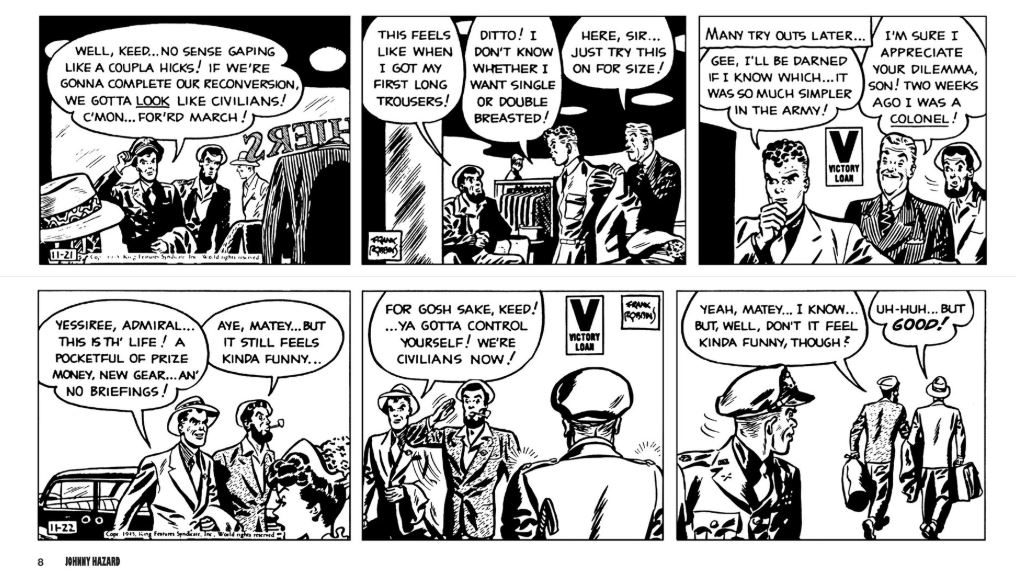
Now, in ‘Fancy Fluff’ (running from November 19th 1945 to June 15th 1946) finally and officially released from their country’s service, Hazard and Slocum barely have time to adjust to civilian life before desperate Fluff Randall recruits them to help find her missing brother. A former comrade of Hazard, “Bounce” Randall was wounded in action and shipped home, but soon disappeared. The last Fluff heard, despite a head injury that prevented him being a pilot, he was in French Guiana, flying private planes for mystery man “Dr. Fox”

Soon the brothers in arms are on the trail, securing passports, papers and a reconditioned army surplus plane which they cheerfully dub Fancy Fluff in honour of their sponsor and despite the suspicions of suddenly-arriving Brandy. Her latest assignment is investigating a wave of jailbreaks in the penal colonies of that very country and a lift would be nice…

Soon the quartet are far south and negotiating with clearly corrupt cops and customs officers, dodging murder attempts and investigating local saint/Good Samaritan Docteur Reynard. A dramatically delivered letter from brother Bounce begging them to leave does nothing to deter them and before long they have uncovered not only an underground railroad using air transport to spring savage escapees but also murderous drug dealers using terror, mesmerism and narcotics to enslave Fluff’s brother among so many other victims…

It’s as much luck as competence that saves the valiant Americans from death and disaster a dozen times over, but in the end Reynard, his leg breakers Elf and Beeg Ox and all those bribe-taking officials pay for their crimes. Bounce is wounded again but at last healed of his enslavement and debilitating head injuries. However the overall cost is high. Admiral is lost to the world of action after falling for Fluff and that sappily contagious condition almost ensnares Johnny and Brandy too. Thankfully, common sense and sheer bile on both sides brings them to their senses before it’s too late…

Each serial storyline is garnished and bookended by Robbins’ original art designs for advertising the strip and after a comforting close up of Hazard second saga ‘The Flying Freight Mystery’ (June 17th – November 2nd) sees “just friends” Johnny and Brandy heading back to the USA but stalled on take-off when Johnny is conned by deviously mysterious entrepreneur M. Côte’-Poche into delivering to neighbouring nation Estantio a cargo of “typewriters”…
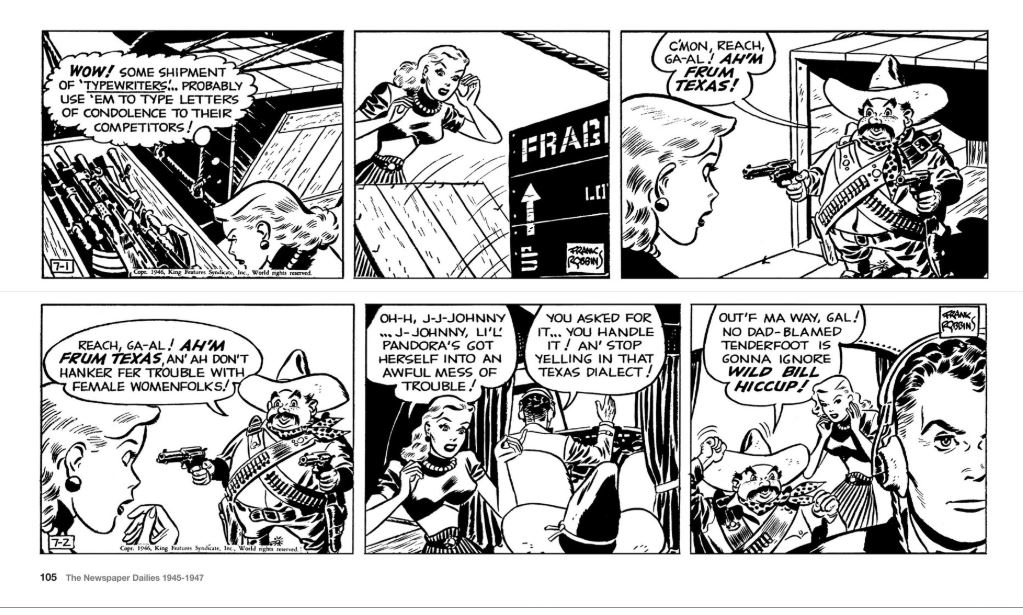
In flight, when Brandy discovers diminutive stowaway Wild Bill Hiccup and that the load is automatic weapons, an aerial ambush by “sky rustlers” leads to a less-than-longed-for reunion with Side-Pocket Sam. He is embroiled in ongoing war with ruthless river pirate Captain Gore who wants the emeralds Sam regularly ships from a mine to the coast. The baroque blubbery buccaneer is obsessed with piratical mythology and alongside fellow plunderers Mistuh Dirk and voluptuous siren Lady Mist opened a bizarre rogues gallery of foes who bedevilled Hazard over the next thirty years.

With Hazard as his air force, Sam has the upper hand until Mist infiltrates his freighter as an shipwrecked innocent: a daunting (and hilarious) job of acting that fools everyone but Brandy and leads to a spectacular display of air versus sea power, a brutal final mano-a-mano duel in the jungle and a surprise twist ending…

Another Canyon pinup segues into a yarn spanning November 4th 1946 to January 18th 1947. Hazard and Brandy arrive in tropical dump Querrero to find her journalistic colleague and Bureau Chief “Timely” Malcolm awaiting the outcome of a clash between government troops and bandit-turned-rebel ‘Major Risk’. Brandy opts to go to the story and with Johnny reluctantly flying her in, arrives at the frontline to find rival reporter “Blitz” (AKA “Loose-Lip”) Martin actively making the story happen.

With natural advantages and no scruples Brandy vamps the Government general for intel before tricking Johnny into delivering her right into the rebels’ hands. Her sharp scheme goes terribly awry and before long she is a hostage and bargaining chip between the sides and needs actual rescuing for a change. Thankfully, Hazard and Martin are willing to try it even if the shiny soldiers are not…

Back in Querrero and hired by Timely Martin as a ferry pilot for his reporters, Hazard faces unlikely danger in penultimate yarn ‘The Stout Man’ (January 20th to March 29th 1947). Repairs and search for spare parts sees the ex-airman as a passenger on a flight to San Tomayo, but the departure is interrupted by rude, rowdy and very bulky Brit Mr. Am and late-arriving Blitz Martin.
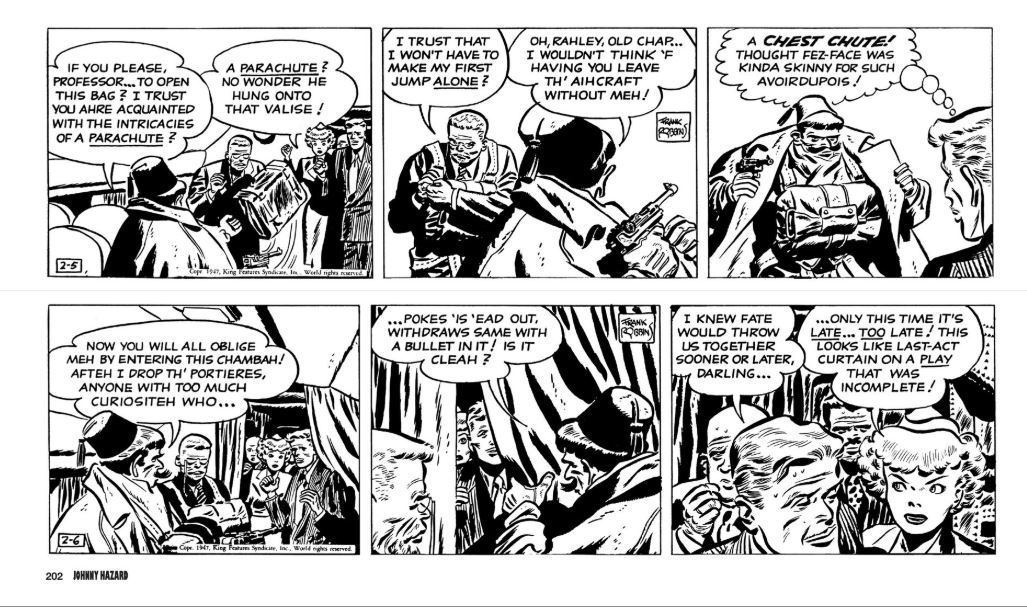
Away at last, Johnny befriends fellow traveller and prestigious nuclear boffin Noble Caldwell until Am hijacks the plane and sends it into a death-spin and crash. However, as Am escapes with Caldwell using parachutes hidden under his coat, Hazard manages to crash land the plane. Lost, starving and dying of thirst, the survivors are accidentally saved when Am returns in a helicopter to clear up loose ends and stupidly lets Johnny get the drop on him…

A deadly impasse ensues with both sides holding out against attrition and deprivation, but the balance of power shifts after indigenous tribesmen arrive, pointing their deadly blowpipes indiscriminately at all the unwelcome intruders…

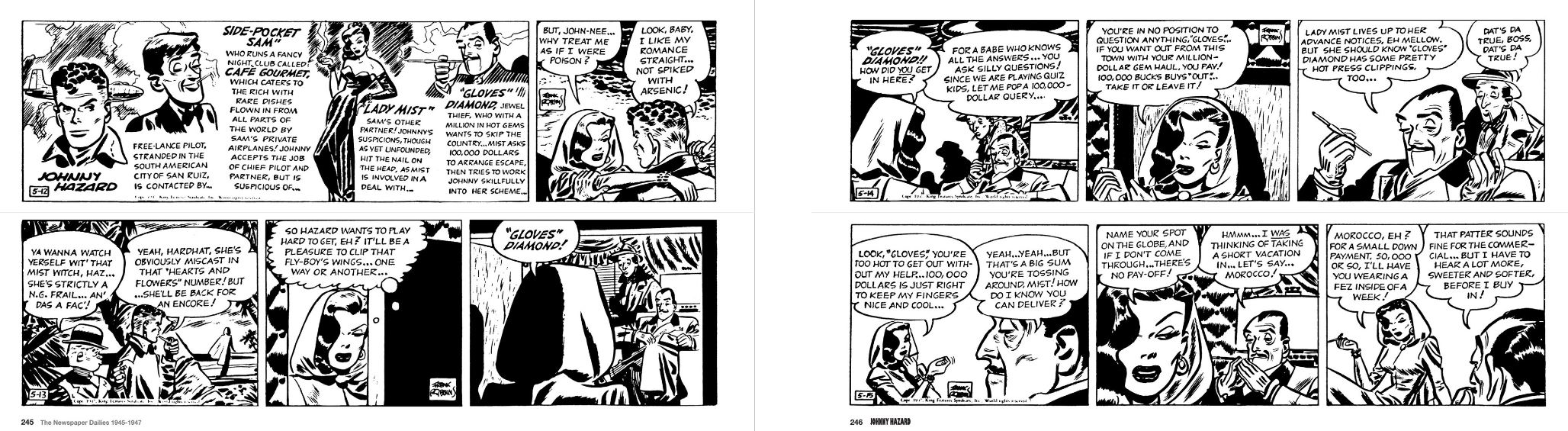
A Vava Lavoum pinup segues into closing yarn ‘Danger À La Carte’ (March 29th – August 16th 1947) as freshly-fired Hazard is stranded in San Ruiz, catching the attention of jewel thieves Gloves Diamond and Mellow as well as their criminal competitors Side-Pocket Sam and Lady Mist. Before long Hazard and Blitz are bemused, befuddled and bamboozled, buffeted between opposing nefarious forces and unable to understand how a gourmet café delivering meals by jet plane can possible be profitable…

Not knowing all the facts doesn’t stop Johnny hiring on as a pilot and becoming an unwittingly accomplice, transporting human contraband to the heart of Casablanca’s wicked underworld. When he seeks to rectify his mistake, the fur, fists, knives and bullets start to fly but in the end justice wins again…
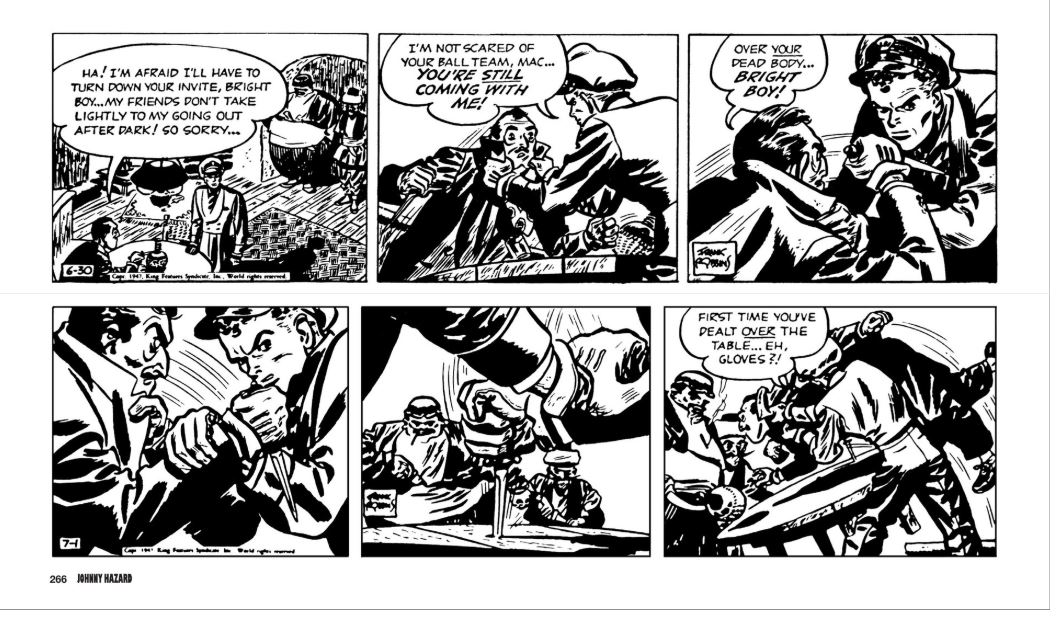
Ending with more advertising pinups – Kitty Hawkes, Sabina Eden, Baroness Flame and Sequinthis is another fast-paced, sharp-tongued and utterly gung-ho roster of romps starring a charming, happy-go-lucky lout, insouciantly ruthless and ever ready to risk his own life and limb to help the little guy and distressed damsels.

Sharp, snappy and devilishly funny repartee in the style of movies like Howard Hawks’ His Girl Friday and Frank Capra’s It Happened One Night are a hallmark of these rapid fire yarns, some of the greatest comic strips in history, but that can present a few problems for modern readers. Contemporary attitudes to sexuality, gender and particularly race are far from what we find acceptable – or should even tolerate – today. We know better now – at least most of us do – but must accept and understand that hurtful and unjust as such terms are, they did exist and we’re doing history and our society a hugely dangerous disservice by ignoring, downplaying or worst of all self-censoring those terms and the attitudes that fed them.

In truth, Johnny Hazard was far less egregious than most: Robbins may have used visual shortcuts and slang but all characters were portrayed fairly and did not unnecessarily suffer from the worst propagandist nonsense used by the Allies to bolster a united war spirit and vilely resurrected by modern populists today.

All ethnicities are treated with the full dignity of different but equal cultures and depicted as competent comrades in arms, not ignorant primitives needing white men’s saving graces. However, arch comedian Robbins clearly couldn’t resist playing mischievous games with accents, names and speech patterns that would do Benny Hill, Hogan’s Heroes or Charlie Chan (the opposite of) proud, so if you don’t think you’re capable of remaining historically detached, best to forgo those delights that have transcended time…

To be continued…

These exotic all-action intrigues and romances perfectly capture the mood and magic of a distant yet incredibly familiar time; with cool heroes, hot dames and exceedingly intemperate baddies encountering exotic locales and stunning scenarios, all peppered with blistering tension, slyly mature humour and vivid, visceral excitement.

Johnny Hazard is a brilliant two-fisted thriller-strip too long forgotten, and this is your chance to remedy that.
© 2013 King Features Syndicate, Inc. ® Hearst Holdings Inc. All rights reserved.

Today in 1914 Aquaman creator Paul Norris was born, followed two years alter by George Tuska (Iron Man, Crime Does Not Pay), Belgian national treasure Victor Hubinon (Buck Danny, Redbeard) in 1924 and Marty Greim in 1942. In 1954 Kerry Gammill joined the party as did Brad W. Foster one year later and François Schuiten (Les Cités Obscures) in 1956, with John Paul Leon checking in in 1972.

Today in 1969 the last issue of the first iteration of Eagle was published.
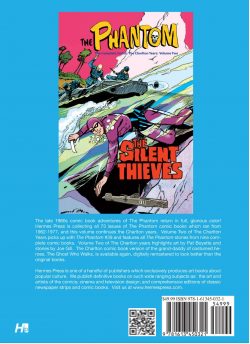
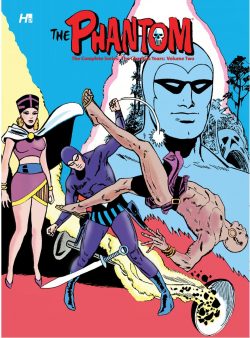
The Phantom – The Complete Series: The Charlton Years Volume Two


By Pat Boyette, Joe Gill, D. J. Arn
eson
& various (Hermes Press)
ISBN: 978-1-61345-032-1 (HB/Digital edition)

This book includes Discriminatory Content produced in less enlightened times.

In the 17th century a British sailor survived an attack by pirates, and, washing ashore on the African coast, swore on the skull of his murdered father to dedicate his life and that of all his descendants to destroying all pirates and criminals. The Phantom fights crime and injustice from a base deep in the jungles of Bengali, and throughout Africa is known as the “Ghost Who Walks”…

His unchanging appearance and unswerving war against injustice have led to him being considered an immortal avenger by the credulous and the wicked. Down the decades one hero after another has fought and died in an unbroken family line, and the latest wearer of the mask, indistinguishable from the first, continues the never-ending battle.

Lee Falk created the Jungle Justice dealer at the request of his syndicate employers who were already making history, public headway and loads of money with his first strip sensation Mandrake the Magician, and although technically not the first ever costumed hero in comics, The Phantom’s astounding popularity made him the prototype paladin: wearing the later demi-compulsory skintight bodystocking and mask with opaque eye-slits.

He debuted on February 17th 1936 (Yep! Ninety nonstop years!!) in an extended sequence pitting him against a global confederation of pirates called the Singh Brotherhood. Falk wrote and drew the daily strip for the first two weeks before handing over the illustration side to artist Ray Moore. A hugely successful Sunday feature began in May 1939. However, for such a long-lived and influential series, in terms of compendia or graphic collections, The Phantom has been very poorly served by the English language market – except in Australia where he has always been accorded the status of a pop culture god.

Numerous companies had begun releasing books of the strips – one of the longest continually running adventure serials in publishing history – but in no systematic or chronological order and never with any sustained success, but, even if only of historical value (or just printed for Australians), surely the mysterious Mr. Kit Walker was worthy of a definitive chronological compendium series?

Happily, and perhaps because of the tights and mask, his comic book adventures have fared slightly better – especially in recent times. From November 1962 through July 1966, all new adventures were published by West Coast giant Gold Key Comics after which King Features Syndicate dabbled with a comic book line of their biggest stars – including Popeye, Blondie, Flash Gordon, Mandrake and The Phantom – between 1966 and 1967. When they gave up the ghost (see what I did there?), plucky dependable, cheap Charlton Comics were there to pick up the slack…

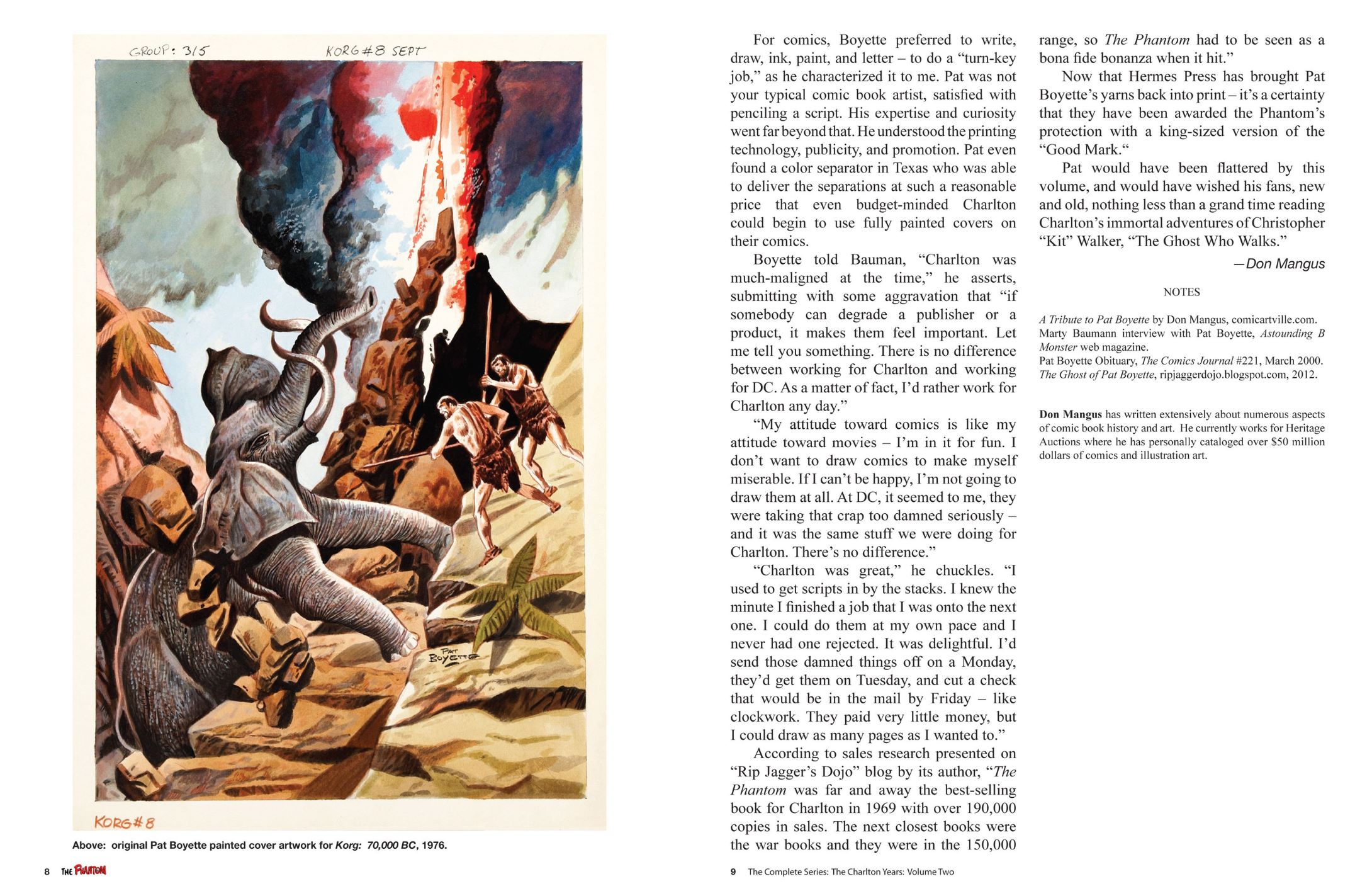
The Phantom was no stranger to funnybooks, having appeared since the Golden Age in titles like Feature Book and Harvey Hits, albeit only as reformatted newspaper strip reprints. Gold Key’s efforts were tailored to a big page and a young readership, a model King Features maintained for their own run, but which was carefully tweaked when Charlton acquired the license. This splendid full-colour tome gathers the contents of The Phantom #39-47 (originally released between August 1970 and December 1971) and opens with an erudite Introduction and appreciation from Don Mangus who reveals everything of the history and involvement of a much-sidelined star in ‘Sworn to the Oath of the Skull – Pat Boyette’.

San Antonio born on 27th July 1923, Aaron P. Boyette was pure mythical Texan: self-taught in everything that mattered and unstoppably confident. A true and tireless entrepreneur, he was a key component of the development of commercial radio in Texas: a journalist who researched, wrote, broadcast, managed, and presented shows. If you’ve read Golden Age Green Lantern, everyman hero Alan Scott – who did all the jobs – could have been patterned on Pat…

Boyette forsook burgeoning stardom to become a cryptographer during WWII. Coming out, he performed the same do-it-all trick with early television and later moved into making movies. After anchoring TV news, he abruptly moved sideways again, and took to comics: writing, editing, lettering, painting and illustrating as Pat Boyette, Sam Swell, Alexander Barnes & Bruce Lovelace.

Working for Charlton, DC, Warren, Archie, Acclaim; a host of eighties indie outfits and as a self-publisher, he produced newspaper strip Captain Flame; drew prestigious DC title Blackhawk; and found a lasting home at Charlton Comics. Here Boyette co-created The Peacemaker and assumed creative duties on Pete (“PAM”) Morisi’s Peter Cannon: Thunderbolt. As the superhero boom faded he increasingly output on their anthological lines, crafting hundreds of genre short stories for romance, war, western horror, science fiction, fantasy and other titles. Boyette also handled Charlton’s biggest and most high-profile licensed features including The Six Million Dollar Man; Space: 1999; Korg: 70,000 B.C; Flash Gordon; Jungle Jim and the company’s runaway top seller: The Phantom. Boyette’s work was continually published at Charlton until at least 1986 when the outfit was being wrapped up. He readily adapted to the growing indie market, with his last work appearing in DC/Paradox Press’s The Big Book of the Weird Wild West in 1998.

Pat Boyette died of oesophageal cancer on January 14th, 2000 in Fort Worth, Texas.

The majority of the bi-monthly yarns here are scripted by Boyette, backed up by Joe Gill in #40, 41 & 45 (and also perhaps occasionally by predecessor scripter D.J. Arneson?): utterly workmanlike and hitting all the expected bases, with each issue offering a pictorial Contents Page teaser and terse, spartan, stripped-back action; mystery yarns with themes and plots that readers of newspapers and dyed-in-the-wool superhero fans could appreciate equally. There are plenty of mad scientists, aliens, monsters, war criminals, brutal beasts, sadistic potentates, thieves & pirates and many admiring women, but no costumed villains…

We open with The Phantom #39 as ‘A Small War!’ sees a ruthless filmmaker provoke conflict between old tribal friends until the Ghost-Who-Walks steps in, after which the hero foils thinly-disguised Nazis seeking to recover lost gold from the ‘Canyon of Death!’, and scuppers ‘The Silent Thieves!’ using their U-Boat to raid a river-adjacent diamond mine…

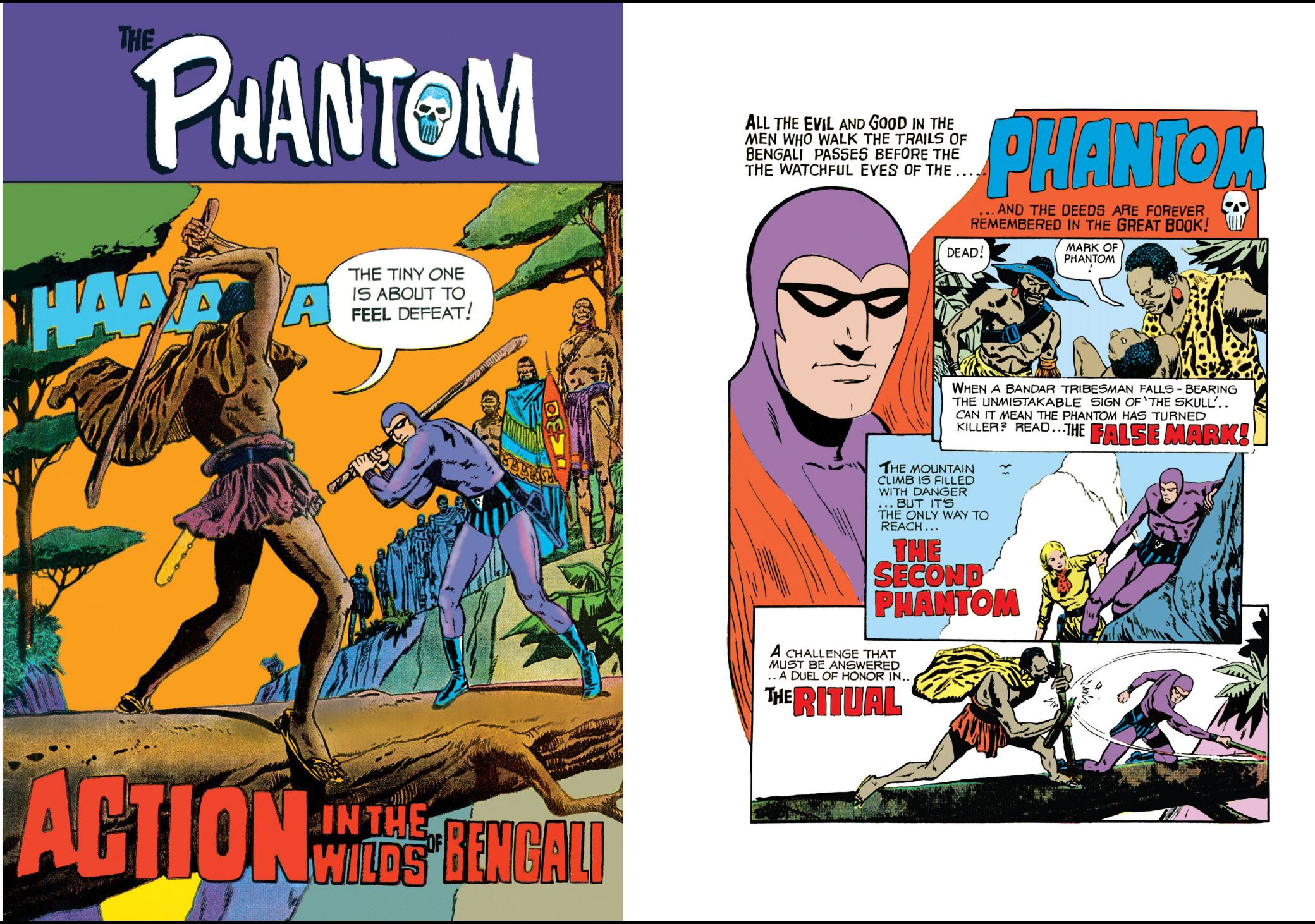
Boyette and his associates often sagely left their time period vague and unconfirmed, allowing creative anachronism to play out in tales that could often be starring earlier Phantoms of the undying dynasty. In #40, following a sample of original art pages, a wryly fond homage to earlier legends sees the masked marvel battle once again a giant warrior with quarterstaffs over a river crossing in ‘The Ritual’, before a vengeful criminal frames the Phantom for multiple murders with a diabolical device leaving his death’s head signature – ‘The False Mark’ – on native victims. The issue closes with a distraught heiress seeking her long-missing father and momentarily gulled by ‘The Second Phantom’ until the true titan turns up…

Scripted by Joe Gill, #41’s opener ‘Slave of Beauty’ sees our hero captured by an immortal queen resurrecting her fallen desert empire through slavery. However, Hegara is not all she seems and the Jungle Juggernaut readily crushes her dream before chasing a stolen Bandar treasure across the world. Savagely seized by murderous white hunter Waldo Brunn, ‘The Idol’ is only ultimately recovered after a bizarre alliance, and is followed by a devious clash with a ‘Deadly Foe’ developing viruses in the wilderness who proves to be anything but…

The Phantom #42 opens with a cruel high-tech attack on elephants perpetrated by plutocratic monster Rama Jahn and requiring all the ingenuity of the Ghost-Who-Walks to save the ‘Keeper of the Herd!’, before a simple good deed generates chaos in ‘Who Needs Enemies?’ Seeking to repay his debt, multi-millionaire E.R. Randall bombards the Bengali villagers with gifts and money that disrupt their lives. Moreover, he’s extremely unhappy when they begin to reject his unwanted largesse…

‘Prey of the Hunter’ then reveals what must be done when hunter Hugo Lusk becomes addicted to killing and the Judge of the Jungle must stop the slaughter, Sadly, that involves first becoming Lusk’s latest trophy…

Up front in #43 ‘Test of an Idol!’, finds fabulously attractive, utterly spoiled screen star Iris Benton attempting – and initially succeeding – in beguiling the hero and making The Phantom her latest conquest. Thus he permits a movie of his exploits and even participates but is tragically unprepared when her allure crosses the species barrier and leads to her abduction by apes!

A clever use of the hero’s historical longevity drives ‘Paid in Full’ when the descendent of a long-dead British victim of jungle larceny (saved by a Ghost who Walked in 1653) demands reparations – and compound interest – on a sum of money that went missing at the time. Happily Edward Cowper-Smythe is reasonable man…

The issue closed with a clash against most modern witchdoctor Medugli, who refused to follow the Phantom’s Peace and returned to torment the Bandari with a technological terror-weapon provided by colonising secret allies. Happily, ‘The Rain Stopper!’ was no mystery to the hero and ecological catastrophe was averted in the nick of time

In #44, ‘To Right a Wrong!’ sees marauding Achmid Raj successfully plunder the fabled Skull Cave only to be hunted down by the Ghost Who Walks, after which ‘Danger in Bengali’ reintroduces the contemporary hero’s true love Diana Palmer who regrettably arrives at the Cave just as a diabolical, piratical impostor is plundering it. Taken hostage she soon learns that her man – and his wolf Devil – are not dead, but in hot pursuit and really, really angry…

When replacement Bandari witch-man Zulanga proves just as nefarious as his predecessor, The Phantom again exiles him, and almost pays a fatal price as the wily rogue covertly returns with serpents and poisons to inflict ‘Death from Far Away!’ Almost…

A rare Phantom failure is rectified after 105 years in #45’s opening saga ‘Return of the Ruby!’ as the descendent of the hero who lost an unparalleled gem to bandits locates the precious prize. Now he must solve the moral dilemma of depriving its current – honest and innocent – owner to restore it to the family of the original ones…

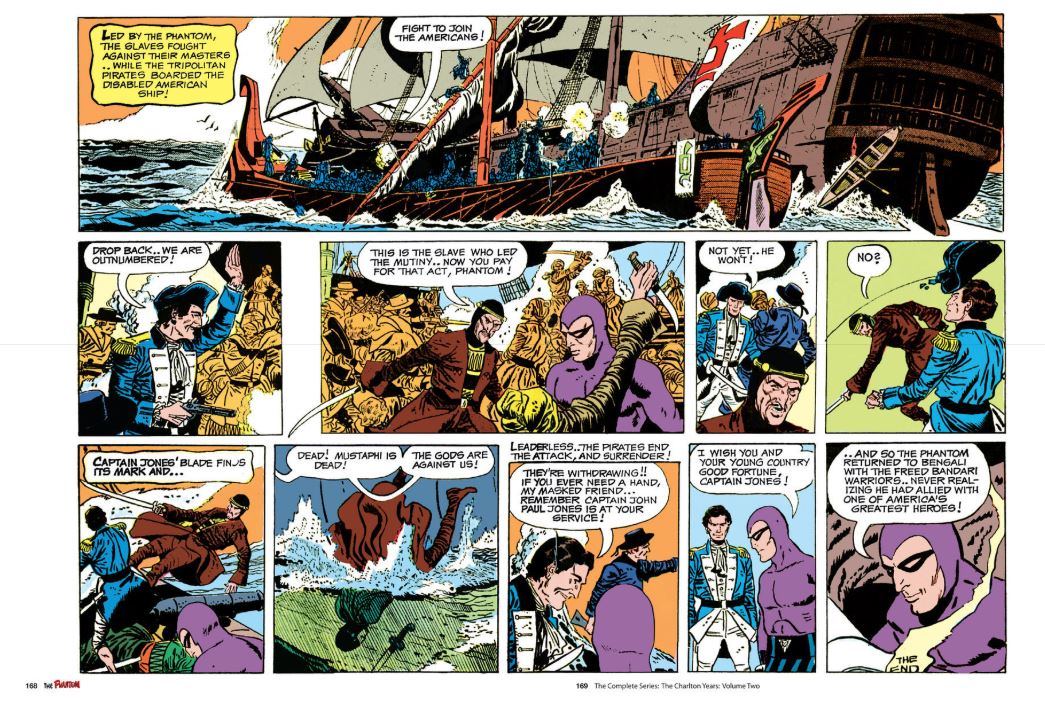
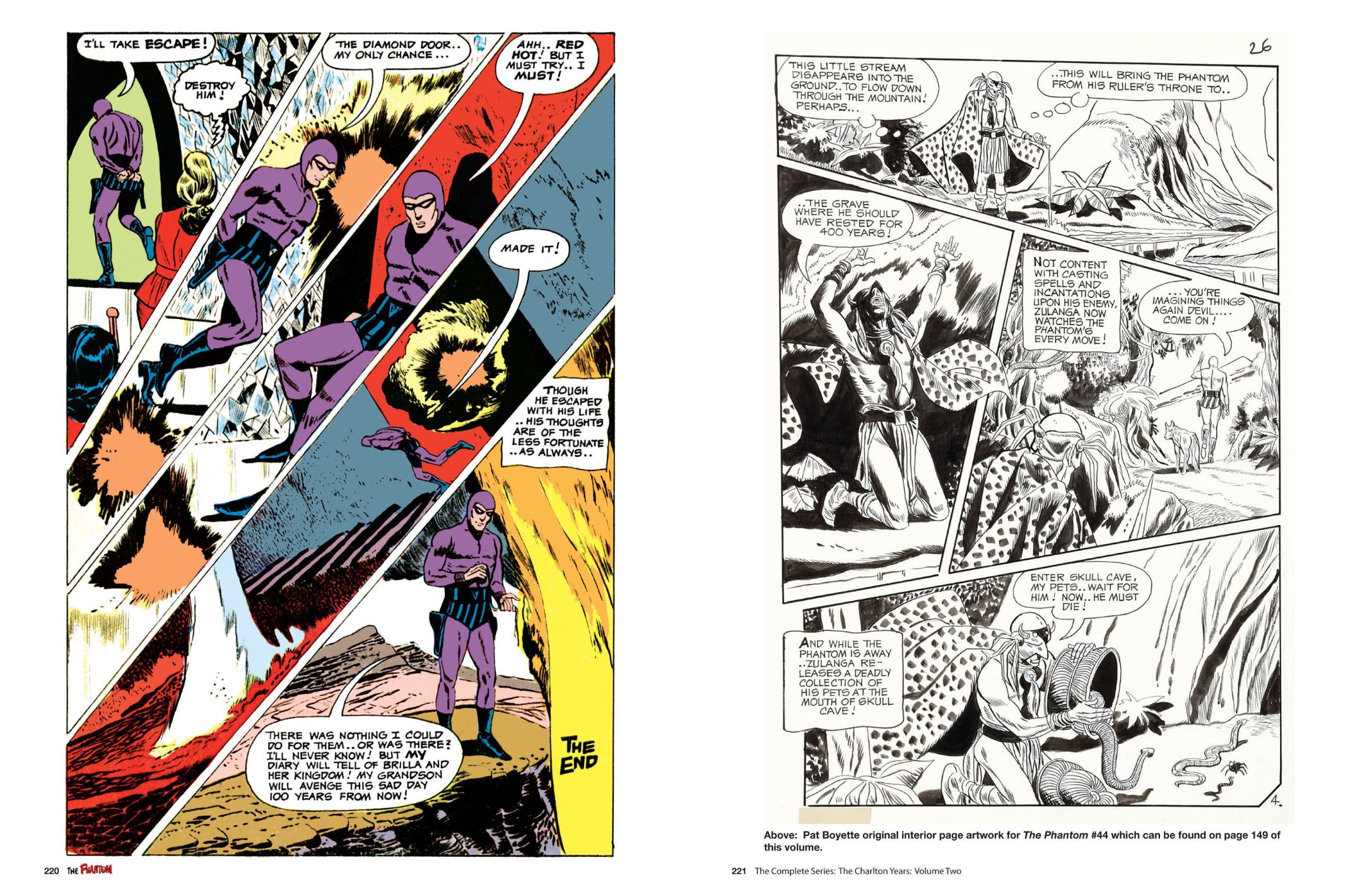
In 1777, as tyrannical Captain Mustaphi ravaged the seas around Tripoli, an alliance to scuttle the slavers’ schemes paired an earlier Ghost Guardian with a Revolutionary War icon in ‘Phantom and John Paul Jones’ before a return to the present sees the death of the Bandar monarch and a vigil in the ‘Cave of Kings’. Happily The Phantom is paying his respects when hostile blood-enemies the Yumyu attempt to slaughter the grieving subjects and steal the incomparable grave goods…

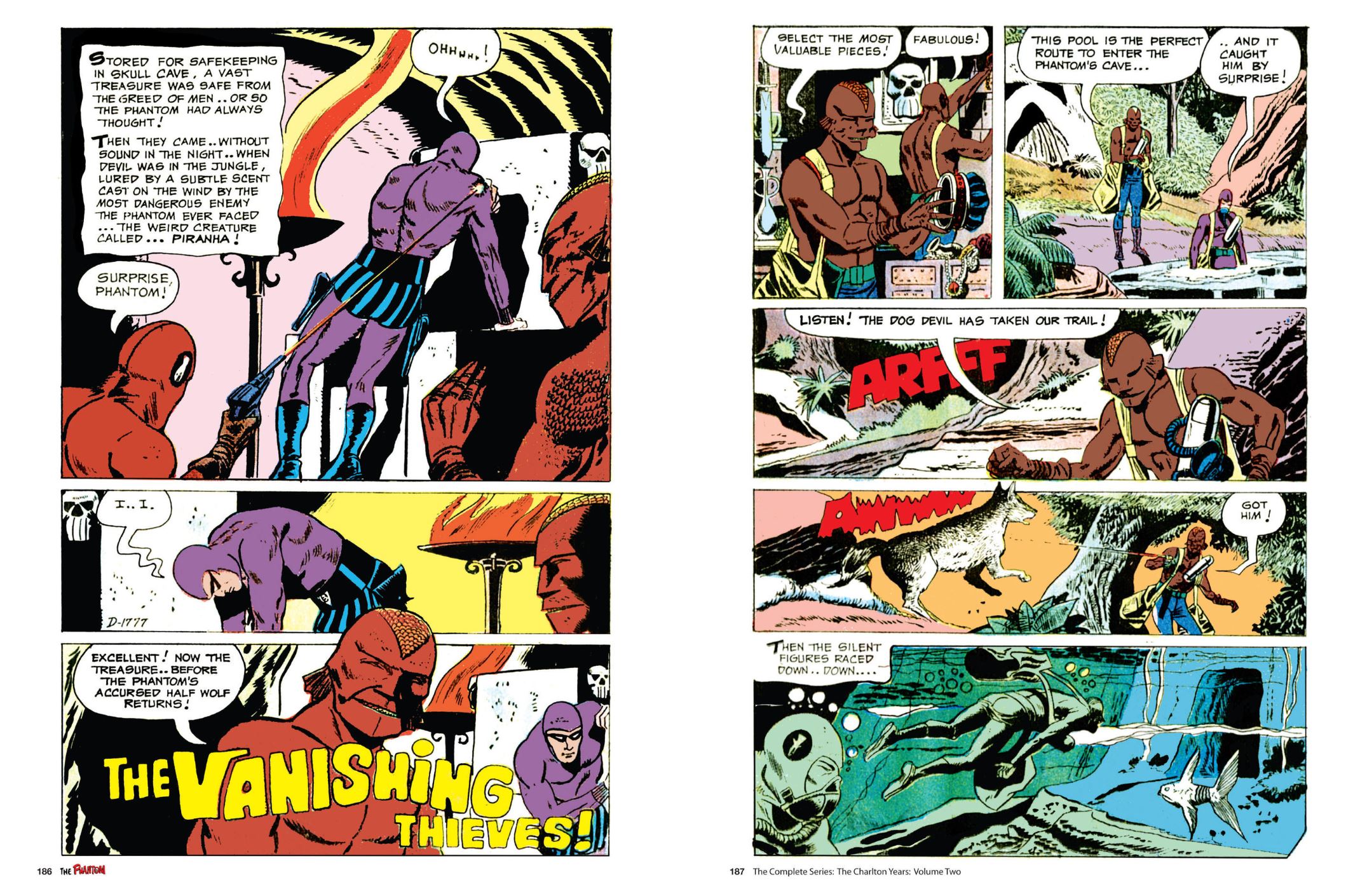
The Phantom and Diana face devilish duplicates and legendary cult terrors the Leopardmen in #46’s lead yarn ‘Last of the Cat’, only to learn that vengeful old enemy Felix Cattmann is out of jail and behind all the Leopard-y jeopardy (sorry not sorry!) after which fantasy blends with larceny as Piranha Men raid the Skull Cave from the lakes and rivers beneath it. Of course, ‘The Vanishing Thieves!’ grievously underestimated the hero’s lung capacity and resolve, and their defeat lonely led to the Ghost Who Walks daring a deadly mountain peak to rescue abducted princess Inja from slave-raider Kruug and the eagles defending the ‘Nest of the Man-Eaters’

Last issue in this tome of thrills and terrors, The Phantom #47 offered another trio of wild adventures beginning with entry into ‘The False Skull Cave’ constructed after avaricious Busas used government spy-plane systems to map vast “undiscovered” Bengali and ferret out the location of the world’s greatest treasure store. Of course, finding either cave or escaping alive were entirely different matters…

In ‘Soundless Voices!’ another cunning attempt to replace the Ghost with a diabolical doppelganger is foiled by the hero’s ferocious will to live and the long-range communications net of whale song, before the episodes pause after exposure to ‘The Vapors of Vulcan’. When Morpheus Negri, the mostly-dormant volcano in a remote corner of Bengali erupts again, the incredible immortals who live within it again plunder and ravage the land, seeking slave-prospects from the fittest of surface dwellers Who could they possibly pick this millennium?

Undying ruler Brilla has faced a Phantom long before and this one also rejects her offer of eternal “companionship” and escapes her alternate tactic of being consumed to sustain her energies for another century…

Packed and peppered throughout with pages of Boyette original art, this is another riveting, nostalgia-drenched triumph: straightforward, stripped down, nonstop rollicking action-adventure that has always been the staple of comics fiction and the Ghost Who Walks. If that sounds like a good time to you, this is a traditional action-fest you must not miss…
The Phantom® © 1970-1971 and 2013 King Features Syndicate, Inc. ® Hearst Holdings, Inc. Reprinted with permission. All rights reserved.

Today in 1946 horror story mangaka Hideshi Hino (Hell Baby, Hino Horrors, Panorama of Hell) was born, whilst strip debuts include Russell MyersBroom Hilda in 1970 and Aaron McGruder’s The Boondocks in 2006. We lost crucial Disney animator Milt Kahl in 1987, DC cartoonist Henry Boltinoff in 2001 and Mexican creator/founder of their Academy of Arts Alberto Beltrán a year later.

Daily Mail Nipper Annual, 1940 Facsimile Edition


ISBN: 978-0-90080-431-1 (TPB)

This book includes Discriminatory Content produced in less enlightened times.

As we apparently stumble into another global conflagration sparked by hatred and steered by greedy, needy raving lunatics, why not return with me again to the early days of World War II and experience the charm and creativity of the English in the face of impending disaster and unfolding calamity? Or perhaps I should say try and find this wonderful reproduction of one of those war years’ most popular strips, now all but forgotten…

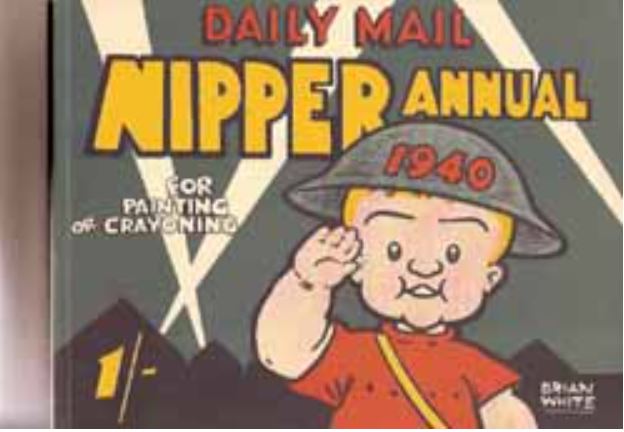
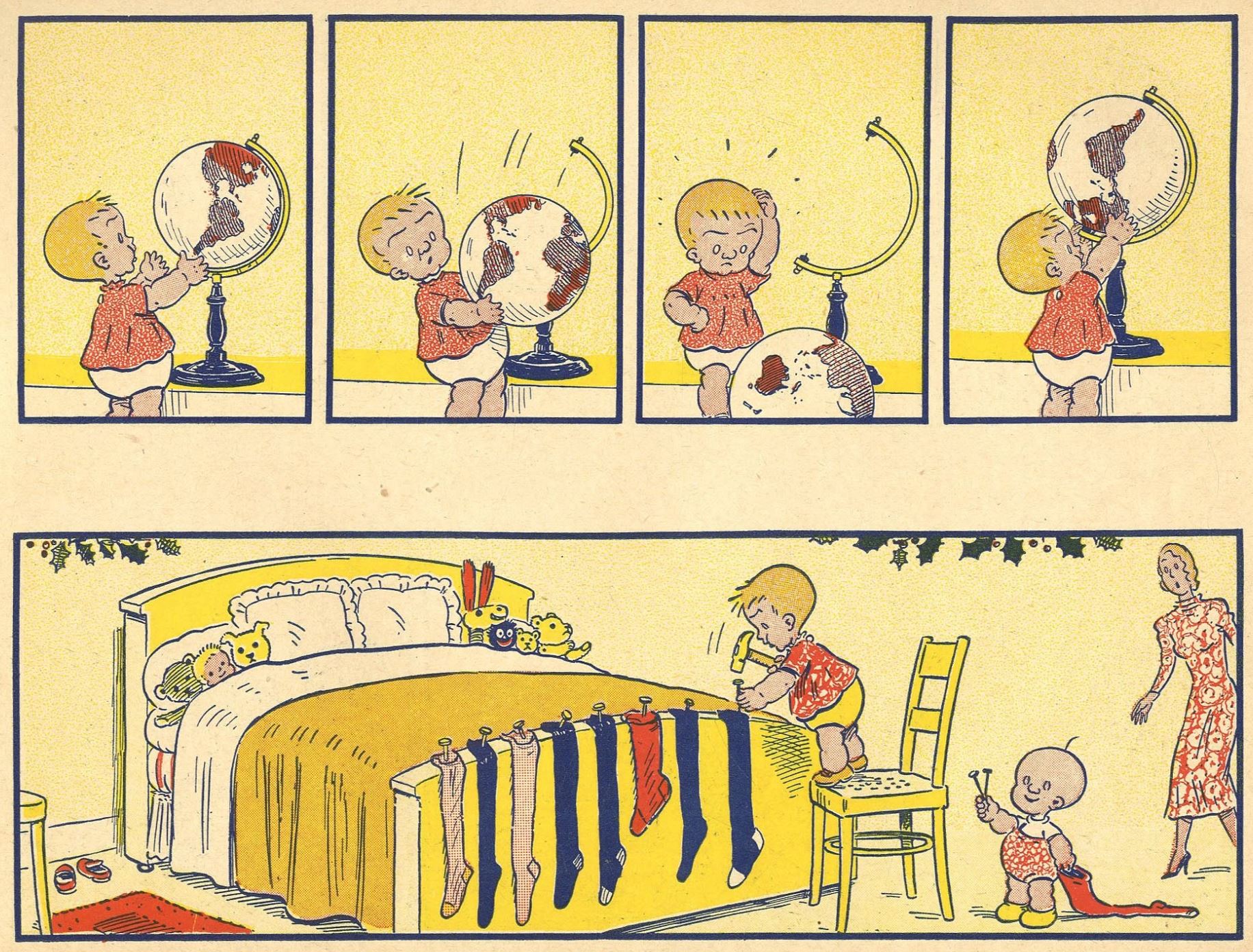
Cartoonist, comics creator and celebrated animator Brian White first created this roguish charmer of a toddler in 1933 and he outlasted the Nazis by a good margin, only putting down his toys in 1947. However the bonny lad’s pantomimic antics – most strips were slapstick gags without dialogue – were loved by children and adults in equal measure. The feature ran in The Daily Mail and even with wartime restrictions, seasonal annuals were a foregone conclusion. The public demanded it.

Brian “H.B.” White was born in Dunstable in 1902 and divided his artistic gifts between moving pictures and cartooning for comics and papers. His other strip success included Dare-a-Day Danny and Little Tough Guy in Knockout; Keyhole Kate in Sparky; Plum Duffy in The Topper and Double Trouble for the London Evening Standard.

His film work was as impressive and far-reaching, beginning with cartoon short Jerry the Troublesome Tyke in 1925 and ending with the Halas & Batchelor team that created the landmark animated film Animal Farm in 1954.

HB died in 1984, but his work is timelessly accessible and deserves to be re-discovered.

Bold, vivid and ingenious, The Nipper Annuals were a part of British life for almost two generations, but in this splendid revived and resurrected edition topics of Wartime utility played the foremost part of the morale-boosting process in strips and features actually produced in the earliest weeks of the war.

As well as the superb bold line artwork, there are plenty of fascinating advertisements of the period for the grown-ups; dedicated pages for the kids to draw their own strips (ready-ruled with panels and borders – always the worst job, as any cartoonist will tell you!) and a handy calendar for 1940. Please recall, British Annuals were released around autumn to be on sale during Christmas time and were always forward-dated for the following year.

And to top it off the entire package also doubles as a colouring book! What Larks!

Kidding aside, this was a wonderful look back offering insight into our comic strip past from a master craftsman. That it has such entertainment and socio-historical value is a blessed bonus, but the real treasure is the work itself. All credit to those responsible for re-releasing it, and I fervently wish more companies would make similar efforts to keep our cultural history accessible.
© 1995 B&H Publications/White Crescent Press Ltd. (I presume.)

Today in 1927 Spanish comics master Victor de la Fuente (Haggarth, Los gringos, Tex Willer, et al) was born, followed by Portuguese star Carlos Roque (Wladimyr) in 1936; Cuban raconteur Eduardo Muñoz Bachs (El Cuento); Kirby-trained US journeyman Steve Sherman in 1949 and controversial Italian megastar Tanino (RanXerox) Libertore in 1953.

Latterday leading lights include US Manga trailblazer Toren Smith of Studio Proteus, arriving today in 1960; amazing Amanda Conner (Batgirl, Power Girl, Harley Quinn) in 1967; J. Scott Campbell (Gen 13, Danger Girl) in 1973 and Rafael Albuquerque (Blue Beetle) in 1981. In 1999, Argentine scripting powerhouse Ricardo Barreiro (Bárbara, Slot Barr, As de Pique, Ciudad, Estrella Negra, Parque Chas, El Eternauta: Odio cósmico) died today.

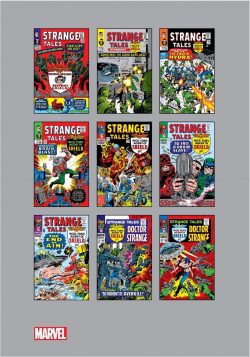
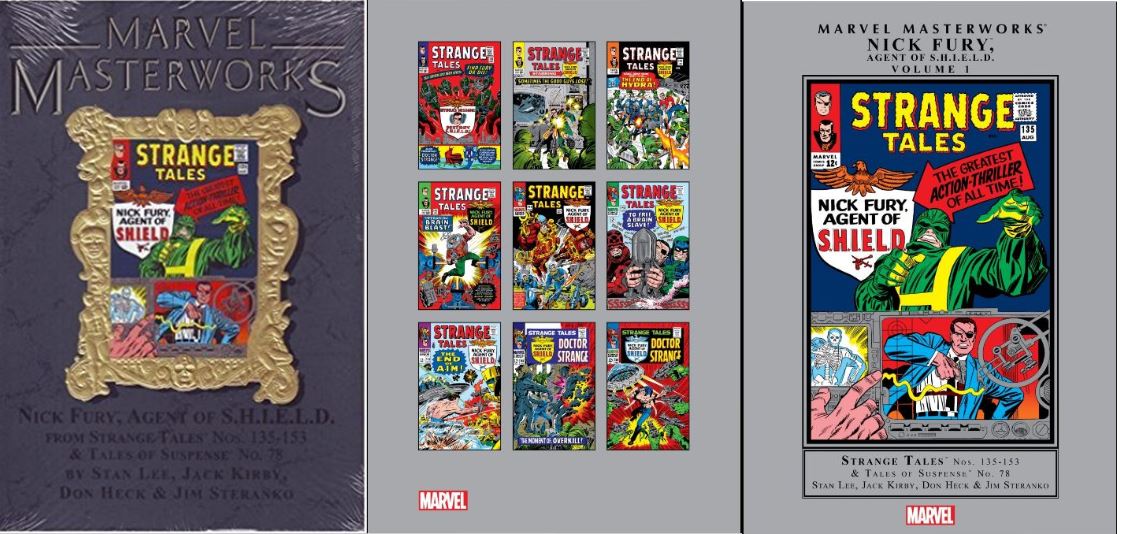
Nick Fury, Agent of S.H.I.E.L.D. Marvel Masterworks volume 1


By Stan Lee, Jack Kirby, Dennis O’Neil, Roy Thomas, John Severin, Joe Sinnott, Don Heck, Howard Purcell, Ogden Whitney, John Buscema, Joe Sinnott, Frank Giacoia, Mike Esposito, Jim Steranko & various (Marvel)
ISBN: 978-0-7851-2686-7 (HB)

This book includes Discriminatory Content produced in less enlightened times.

Veteran war-hero and superspy Nick Fury debuted in Fantastic Four #21 (cover-dated December 1963): a grizzled, world-weary and cunning (but innately Good) CIA Colonel at the periphery of the really big adventures in a fast-changing world.

What was odd about that? Well, the gruff, crudely capable combat everyman was already the star of the reemergent publisher’s only war comic, set twenty years earlier in – depending on whether you were American or European – the beginning or middle of World War II. Sgt. Fury and his Howling Commandos was an improbable, decidedly over-the-top and raucous combat comics series, similar in tone to later movies such as The Wild Bunch or The Dirty Dozen and had launched in May of that year.

Nevertheless, Fury’s latterday self became a big-name star as espionage yarns continued guiding a global zeitgeist in the wake of popular TV sensations like Danger Man and The Man From U.N.C.L.E. and Bond movies (and many imitators) so the contemporary iteration was granted a second series. It began in Strange Tales #135 (cover-dated August 1965).

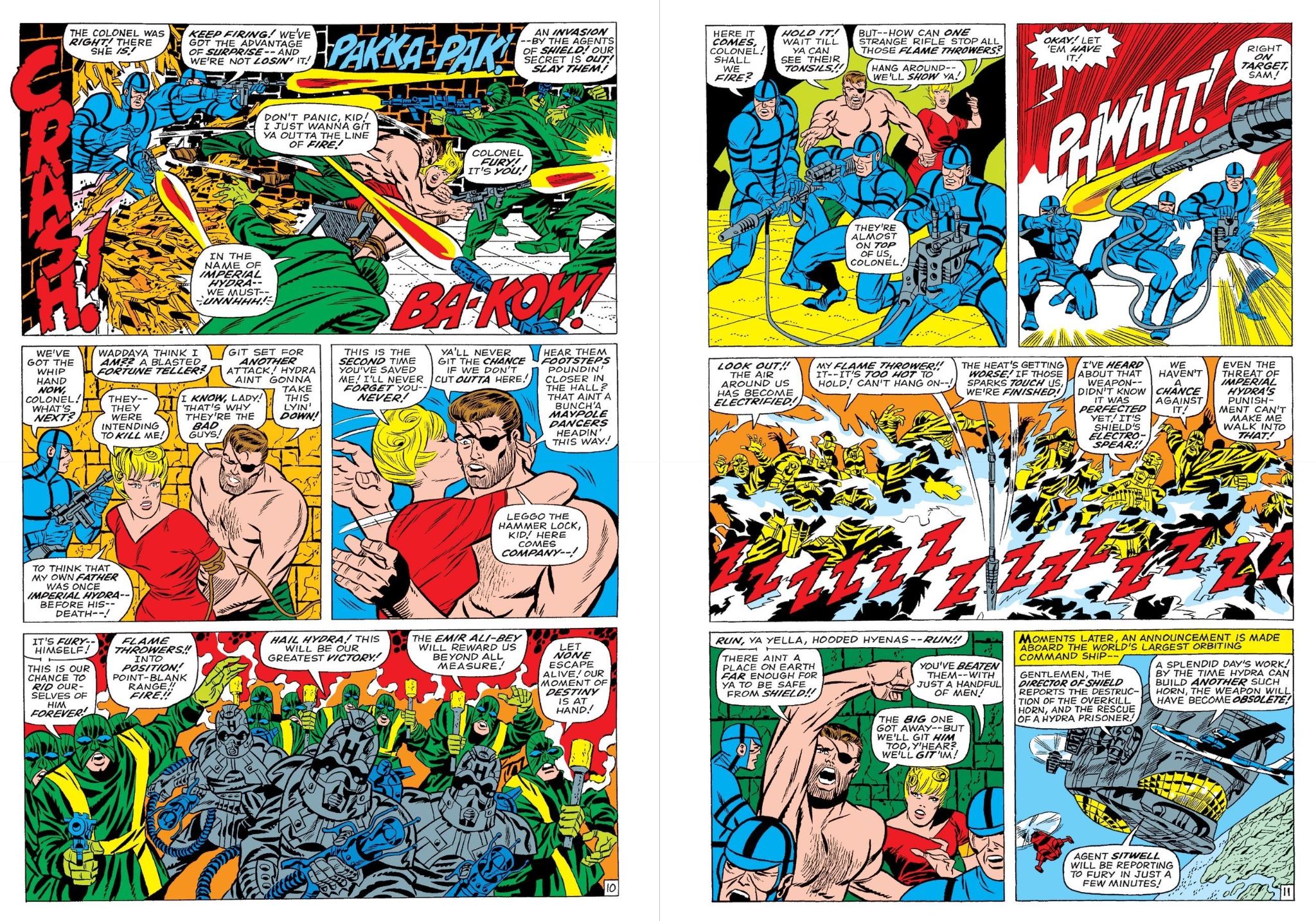
Nick Fury, Agent of S.H.I.E.L.D. combined Cold War tensions with sinister schemes of World Conquest by a subversive, all-encompassing, hidden enemy organisation. The ever-unfolding saga came with captivating Kirby-designed super-science gadgetry and – eventually – iconic, game-changing imagineering from Jim Steranko, whose visually groundbreaking graphic narratives took the comics art form to a whole new level…

For those few brief years with Steranko in charge, the S.H.I.E.L.D. series was one of the best strips in America (if not the world) but when the writer/artist left just as the global spy-fad was giving way to supernatural mystery and horror stories, the whole concept faded into the fundamental background architecture of the Marvel Universe…

This astounding full-colour compendium (available in hardcover and digital editions) deals with the outrageous, groundbreaking, but still notionally wedded-to-mundane-reality iteration which set the scene.

Here Jack Kirby’s genius for graphic wizardry and gift for dramatic staging mixed with Stan Lee’s manic melodrama to create a tough and tense series which the new writers and veteran artists that followed turned into a non-stop riot of action and suspense, with Steranko’s late arrival only hinting at the magic to come…

These epic early days of spycraft encompass Strange Tales #135-153 and Tales of Suspense #78, collectively covering August 1965 – February 1967 and guaranteeing timeless thrills for lovers of adventure and intrigue. Following a history lesson from Kirby scholar John Morrow in his Introduction, the main event starts in at full pelt in ST #135 as the Human Torch solo feature was summarily replaced by Nick Fury, Agent of S.H.I.E.L.D. (which back then stood for Supreme Headquarters International Espionage Law-enforcement Division). In the rocket-paced first episode, Fury is asked to volunteer for the most dangerous job in the world: leading a new counter-intelligence agency dedicated to stopping secretive subversive super-science organisation Hydra. With assassins dogging his every move, the Take-Charge Guy with the Can-Do Attitude quickly proves he is ‘The Man for the Job!’ in a potent 12-page thriller from Lee, Kirby and inker Dick Ayers.

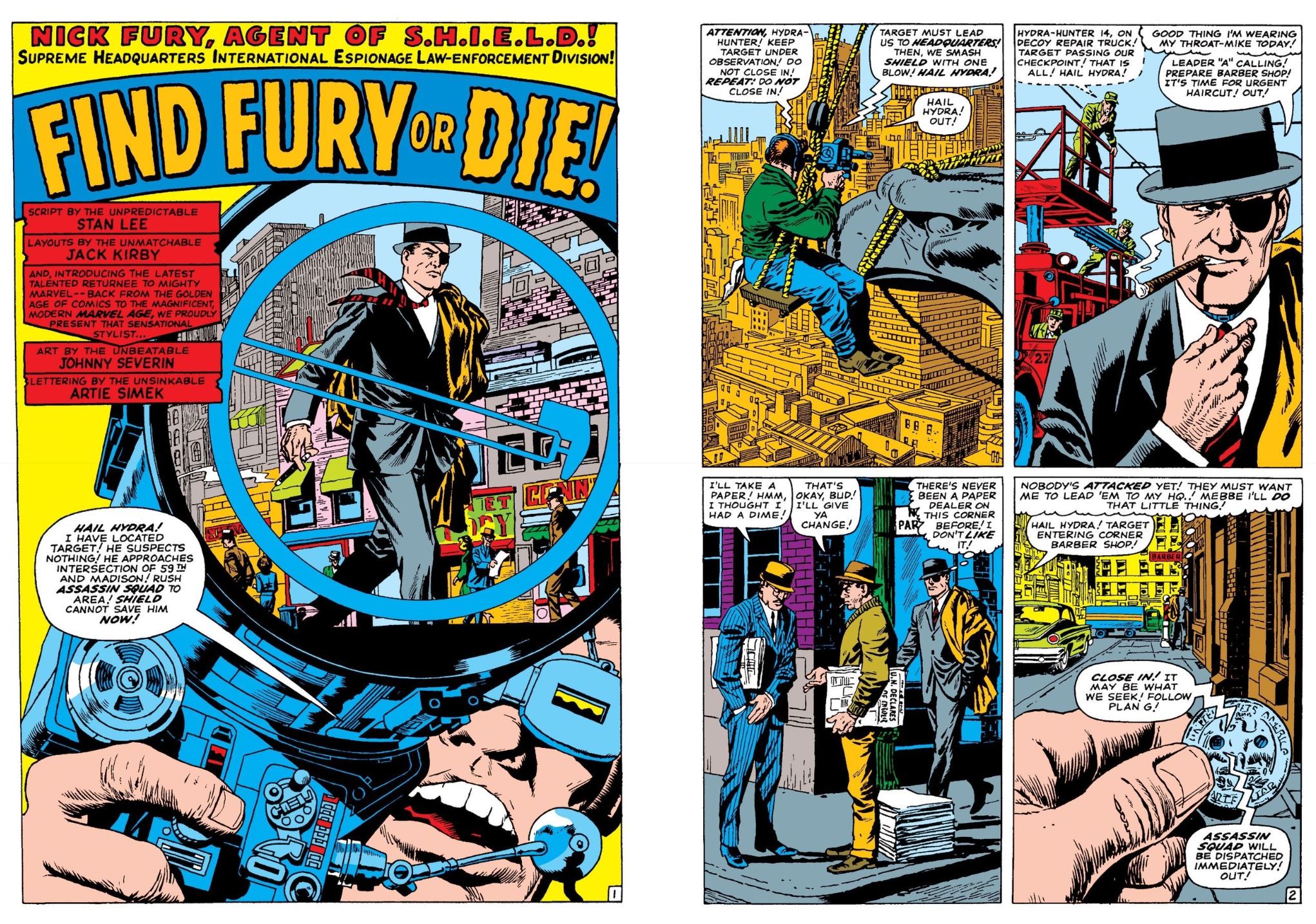
Even an artist and plotter of Kirby’s calibre couldn’t handle another strip at that busiest of times, so from the next issue “The King” cut back to laying out episodes, allowing a variety of superb draughtsmen to flesh out the adventures. Happily, however, there’s probably a stunning invention or cool concept on almost every page that follows so the Kirby Touch was fully upon the unfolding suspense and intrigue. ‘Find Fury or Die!’ brought veteran draughtsman John Severin back to the company that used to be Atlas. He pencilled and inked Jack’s blueprints as – aided and abetted by full-on patriotic weaponsmith Tony Stark – the new Director of the latest spy-agency becomes the target of incessant assassination attempts as we meet mysterious masked maniac the Supreme Hydra

The tension ramps up for the next instalment as a number of contenders are introduced – any of whom might be the obscured overlord of evil – even as S.H.I.E.L.D. strives mightily but fails to stop Hydra launching its deadly Betatron Bomb in ‘The Prize is… Earth!’ Despite the restrictions of the Comics Code, these early S.H.I.E.L.D. stories were bleakly grim and frequently carried a heavy body count. Four valiant agents died in quick succession in #137 and the next issue underscored the point in ‘Sometimes the Good Guys Lose!’, with further revelations of Hydra’s inner workings.

Fury and fellow WWII era Howling Commando stalwarts Dum-Dum Dugan and Gabe Jones meanwhile played catch-up after Hydra assassins invade S.H.I.E.L.D., almost eliminating Fury and Stark – the only man capable of destroying an atomic sword of Damocles hanging over the world. Although Fury saves the munitions genius, he is captured in the process…

Tortured by Hydra in #139’s ‘The Brave Die Hard!’ (with Joe Sinnott replacing Severin as finisher), Fury latches on to an unlikely ally in Laura Brown, the Supreme Hydra’s daughter and a young woman bitterly opposed to her father’s megalomaniacal madness. Even with only half a comic book per month to tell a tale, creators didn’t hang around in those halcyon days, and #140 promised ‘The End of Hydra!’ (Don Heck & Sinnott over Kirby) as a S.H.I.E.L.D. squad invades the enemy’s inner sanctum to rescue the already-free-&-making-mayhem Fury. In the meantime, Stark travels into space to remove the orbiting Betatron Bomb with his robotic Braino-Saur system. The end result leaves Hydra temporarily headless…

Strange Tales #141 sees Kirby return to full pencils (inked by pseudonymous Frank Giacoia, moonlighting as Frank Ray) for the mop-up, prior to ‘Operation: Brain Blast!’ introducing Mentallo – a mutant and career criminal renegade from S.H.I.E.L.D.’s ESP division. He joins technological savant The Fixer to assail the organisation as their first step in an ambitious scheme to rule Earth. The momentous raid begins in ‘Who Strikes at… S.H.I.E.L.D.?’ (illustrated by Kirby & Mike Demeo – AKA Mike Esposito) with the ruthless rogues hitting hard and fast: seizing and mind-controlling Fury before strapping him to a mini H-bomb. With Howard Purcell & Esposito embellishing Kirby’s layouts, Dum-Dum and the boys come blasting in ‘To Free a Brain Slave’ in #143. A new and deadly threat emerges in #144’s ‘The Day of the Druid!’ as a mystic-seeming charlatan targets Fury and his agents with murderous flying techno-ovoids. Happily, new S.H.I.E.L.D. recruit Jasper Sitwell is on hand to augment the triumphant fightback in ‘Lo! The Eggs Shall Hatch!’ (finished by Heck & Esposito).

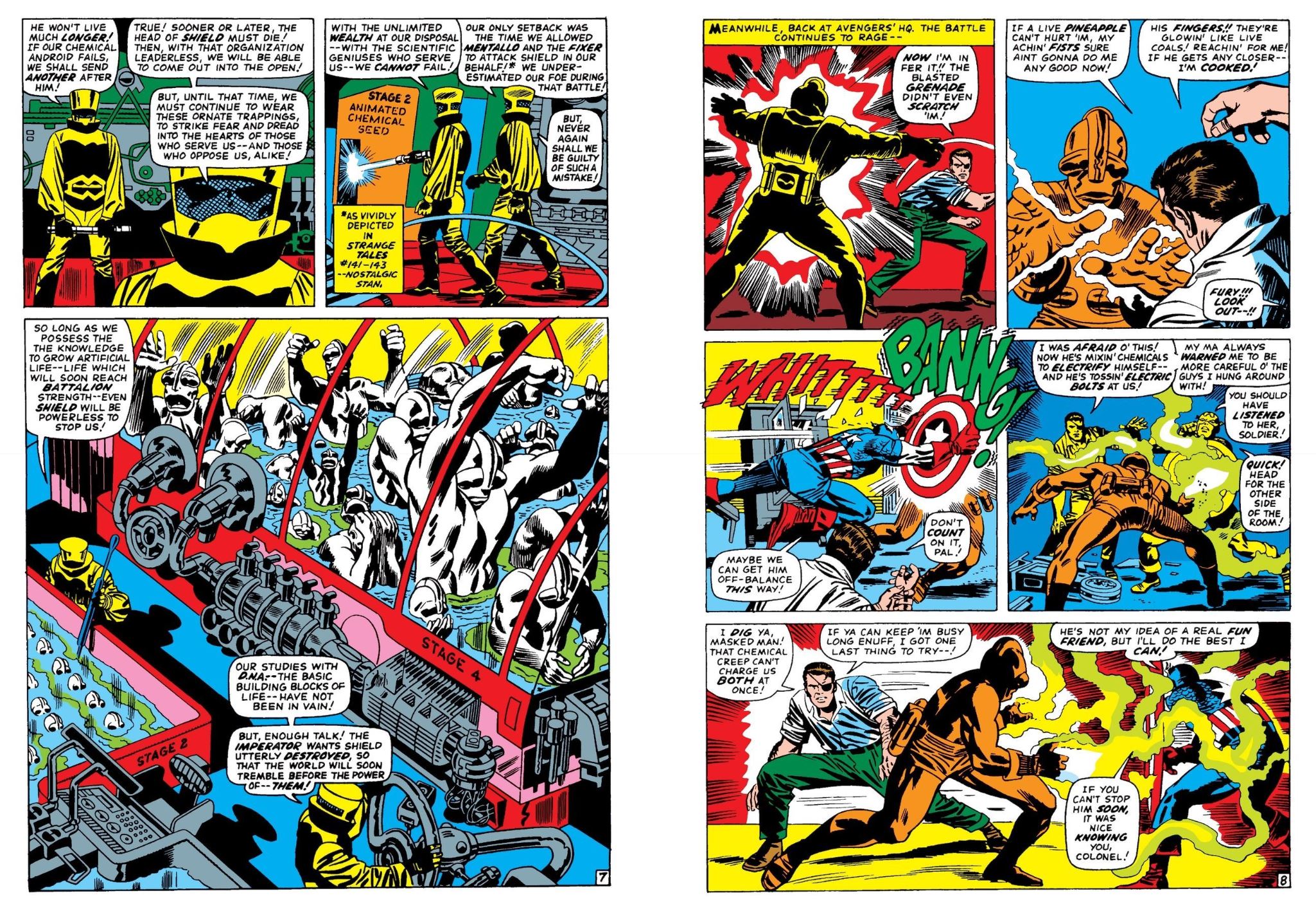
As Marvel continuity grew evermore interlinked, ‘Them!’ details a Captain America team-up for Fury in the first of the Star-Spangled Avenger’s many adventures as a (more-or-less) Agent of S.H.I.E.L.D. Taken from Tales of Suspense #78 (June 1966): scripted by Lee with Kirby on full pencils and Giacoia inking, the story depicts the WWII wonders battling an artificial assassin with incredible chemical capabilities, after which Nick seeks the creature’s mysterious makers in ST #146, ‘When the Unliving Strike!’(Kirby, Heck & Esposito).

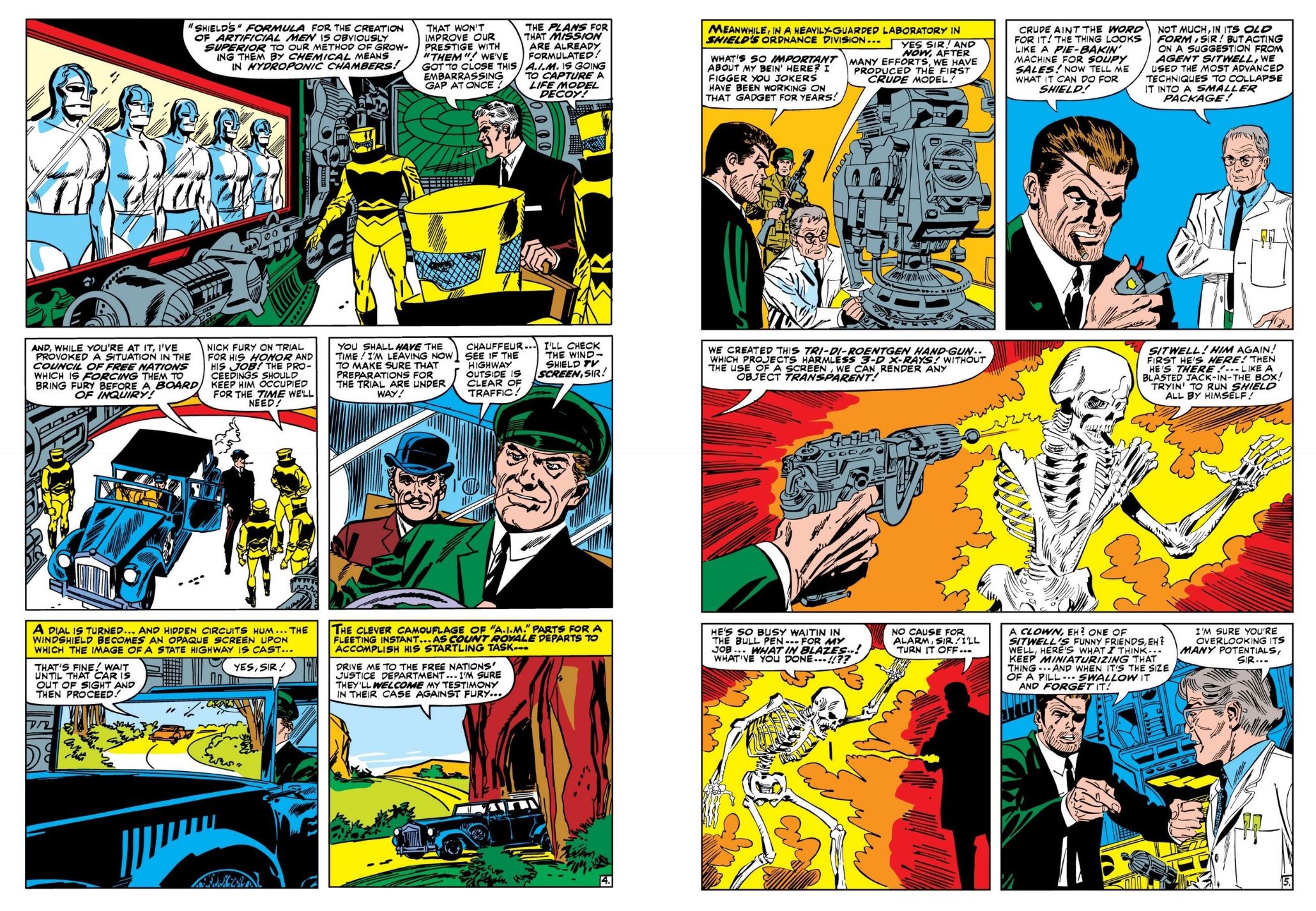
Proclaiming themselves a technological Special Interests group, Advanced Idea Mechanics courts S.H.I.E.L.D.’s governmental and military masters (and contracts), promising potent and incredible new weapons if only they would sack that barbaric slob Fury. However, the surly supremo is getting close to exposing A.I.M.’s connection to “Them” …and an old enemy thought long gone.

A concerted whispering campaign and briefing-against seemingly sees Fury ousted in ‘The Enemy Within!’, before being put on trial in ‘Death Before Dishonor!’ (scripted by Kirby with Heck & Esposito finishing his layouts), but it’s all part of a cunning counterplan which delivers a shattering conclusion and ‘The End of A.I.M.!’ (ST #149, dialogued by Denny O’Neil with art by Kirby & Ogden Whitney). Then, revealed by Lee, Kirby, John Buscema & Giacoia, a malign, devilishly subtle plan is finally exposed in Strange Tales #150 as Fury’s team compares clues from all the year’s past clashes to come to one terrifying conclusion… ‘Hydra Lives!’

The shocking secret also hints at great events to come as newcomer Steranko assumes the finisher’s role over Lee & Kirby for ‘Overkill!’ with Fury targeted by the new – true – Supreme Hydra who devises a cunning scheme to infiltrate America’s top security agency and use his enemy as the means of triggering global Armageddon…

Although the Good Guys seemingly thwart that scheme, ‘The Power of S.H.I.E.L.D.!’ is actually helpless to discern the villain’s real intent as this initial dossier of doom pauses on a cliffhanger after ‘The Hiding Place!’ (ST #153, scripted by Roy Thomas) closes with the archvillain comfortably ensconced in Fury’s inner circle and ready to destroy the organisation from within.

To Be Continued…

Although the S.H.I.E.L.D. saga stops here, there’s an added bonus still to enjoy: the aforementioned FF #21. This depicted Fury as a wily CIA agent seeking the team’s aid against a sinister demagogue ‘The Hate-Monger’ (Lee & Kirby, inked by George Roussos, under protective nom-de-plume George Bell) just as the 1960s espionage vogue was taking off. Here Fury craftily manipulates Marvel’s First Family into invading a sovereign nation reeling in the throes of revolution in a yarn crackling with tension and action…

Fast, furious and fantastically entertaining, these high-octane vintage yarns from a time when the US were global Good Guys and “World Police” are a superb snapshot of early Marvel Comics at their creative peak and should be part of every fanboy’s shelf of beloved favourites.

Don’t Yield! Back S.H.I.E.L.D.!

© 1965, 1966, 1967, 2018 Marvel Characters, Inc. All rights reserved.

Today in 1907, Belgian artist Jacques Laudy (Le Journal de Tintin) was born, as was occasional Green Lantern scripter Henry Kuttner in 1915 and Canadian cartoonist Jacques Boivin (Melody) in 1952. In 2007, B,C. creator Johnny Hart died.

Today in 1935 Dr. Seuss launched his short lived but influential strip Hejji and, in 1992, Art Spiegelman received a Special Pulitzer Prize for Maus.

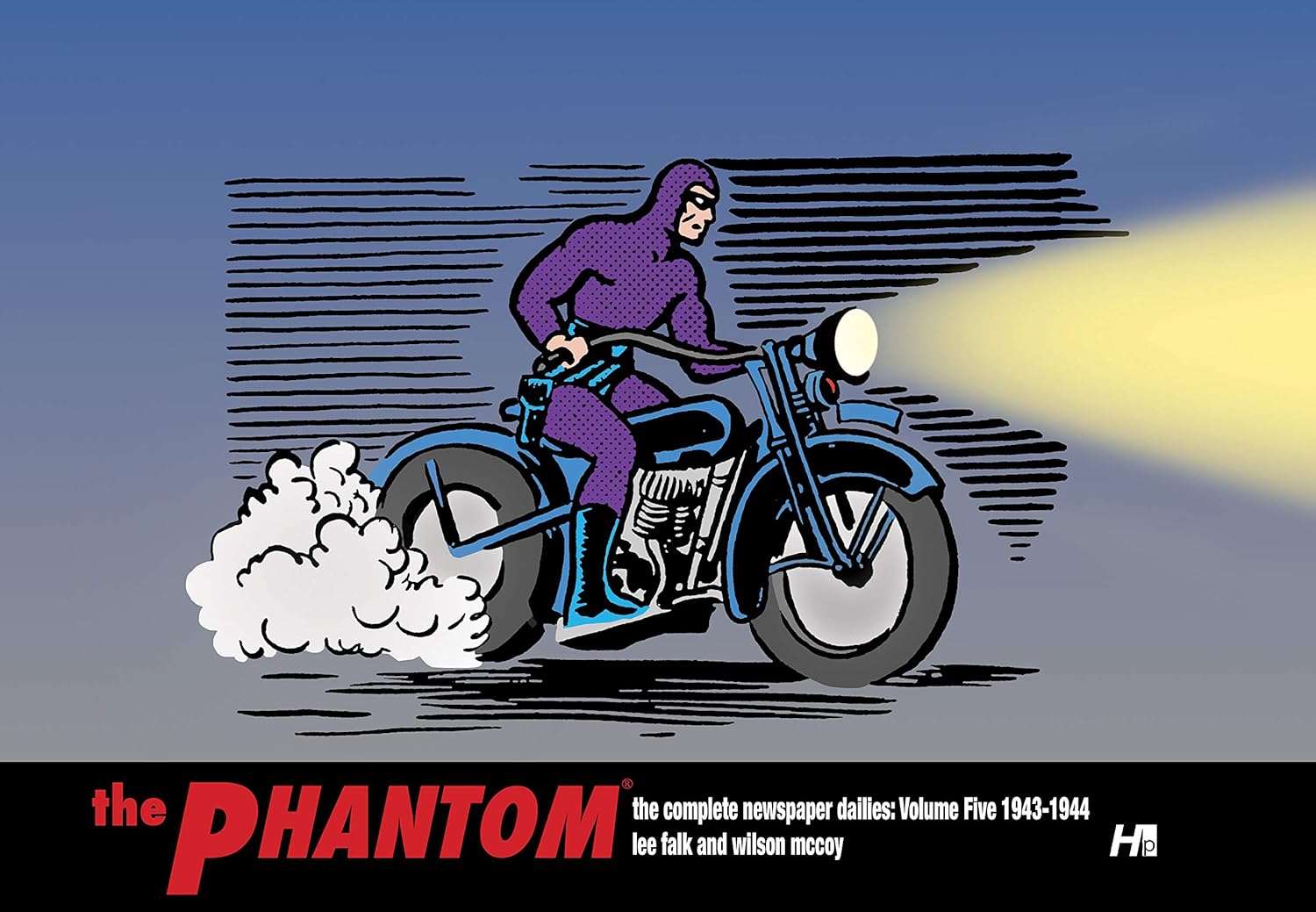
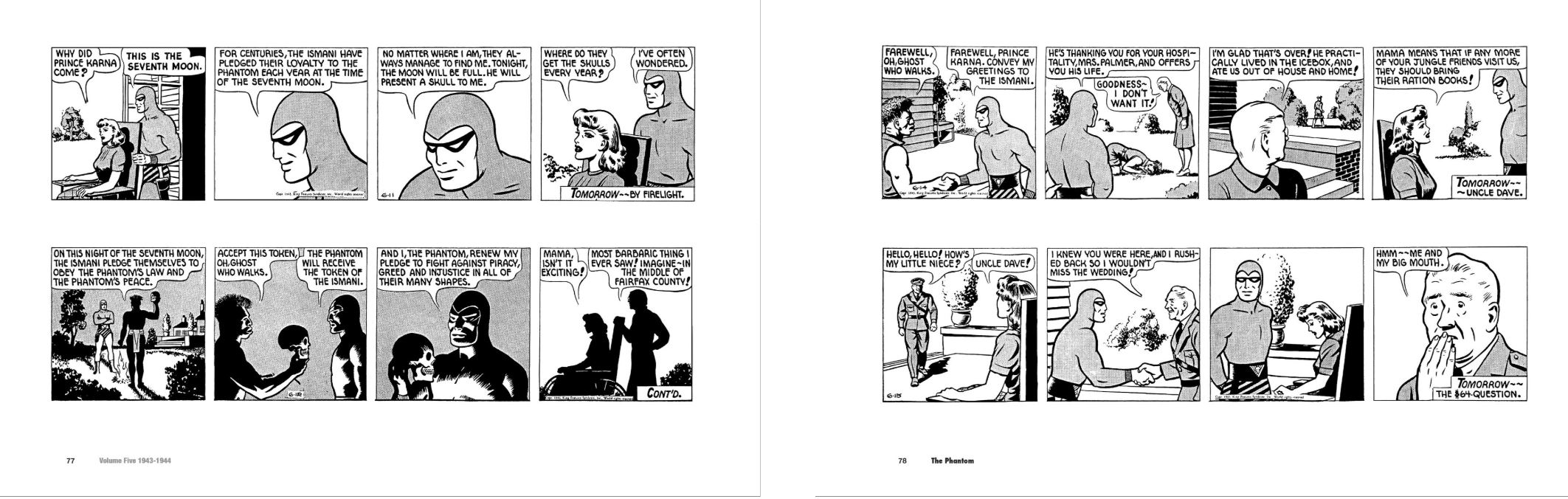
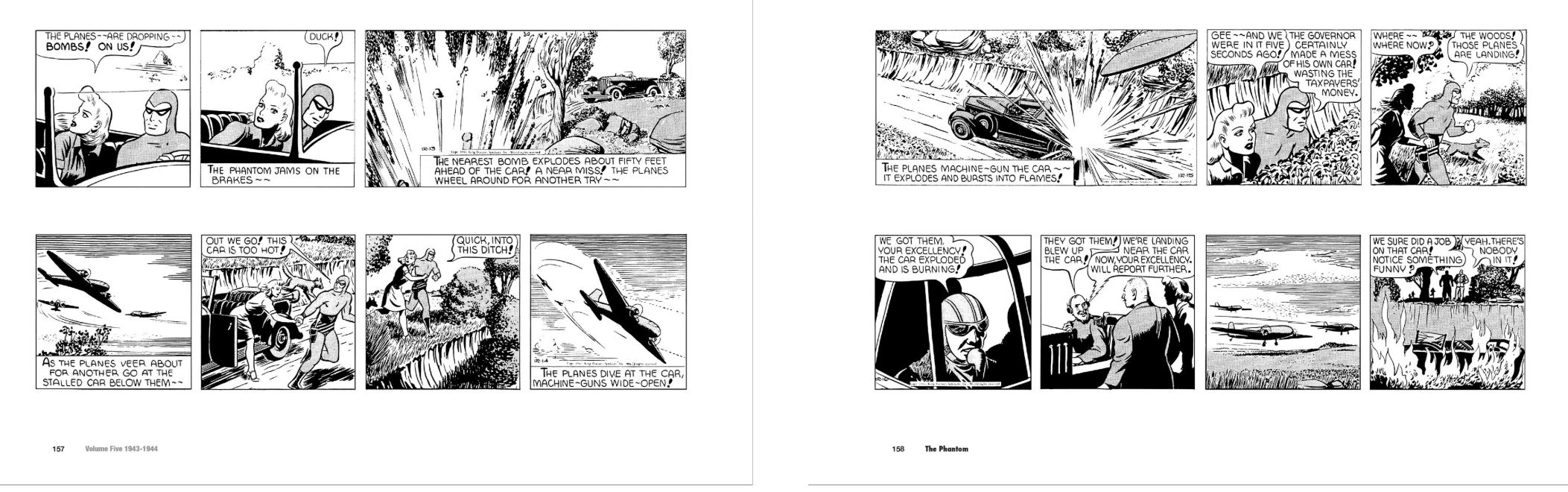
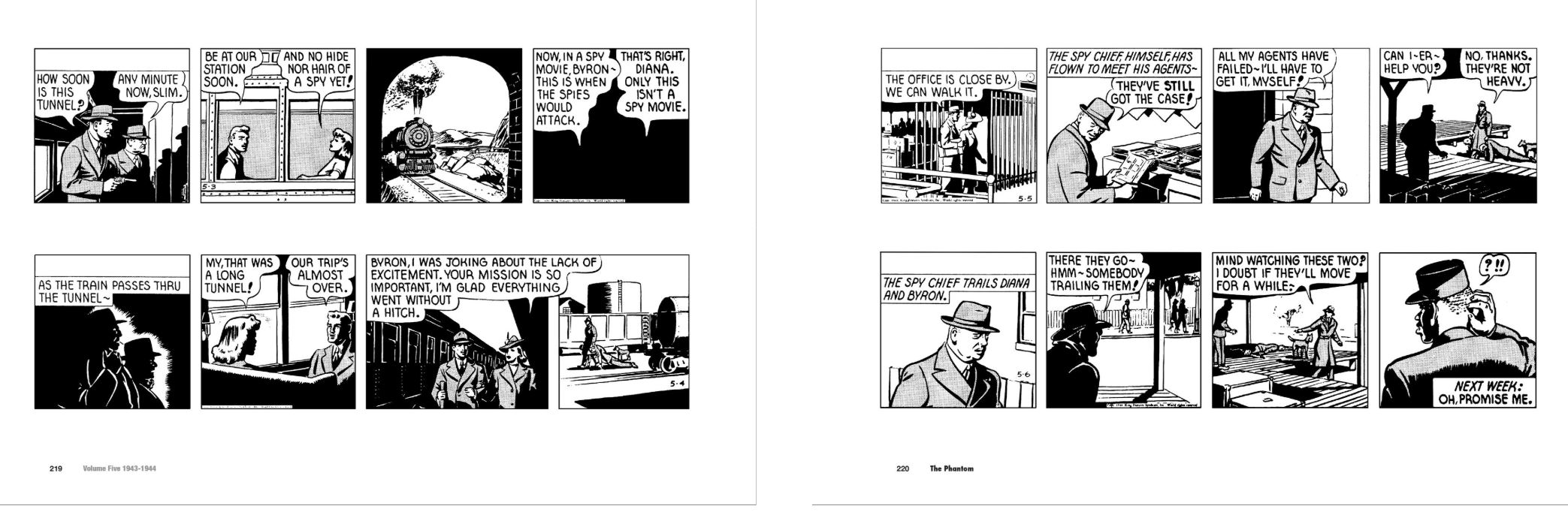
The Phantom – the complete newspaper dailies: volume Five 1943-1944


By Lee Falk & Wilson McCoy: introduction by Ed Rhoades (Hermes Press)
ISBN: 978-1-61345-030-7 (HB/Digital edition)

This book includes Discriminatory Content produced in less enlightened times.

Born Leon Harrison Gross, Lee Falk created the Ghost Who Walks at the request of his King Features Syndicate employers who were already making history, public headway and loads of money with his first strip sensation Mandrake the Magician. Although technically not the first ever costumed champion in comics, The Phantom became the prototype paladin to wear a skin-tight body-stocking and the first wearing a mask with opaque eye-slits…

The undying, generational champion debuted on February 17th 1936, in an extended sequence pitting him against an ancient global confederation of pirates. Falk wrote and drew the daily strip for the first two weeks before handing over illustration to artist Ray Moore. The equally enthralling, hugely influential Sunday feature began on May 28th 1939. Both are still running.

For such a long-lived, influential series, in terms of compendia or graphic collections, “the Ghost Who Walks” was quite poorly served in the English language market (except in the Antipodes, where he’s always been accorded the status of a pop culture god). Lots of companies have sought to collect strips from one of the longest continually running adventure serials in publishing history, but in no systematic or chronological order and never with any sustained success. That has been mostly rectified recently by archival specialists Hermes Press who launched curated collections in 2010, making nearly all the various canonical iterations accessible to the devoted.

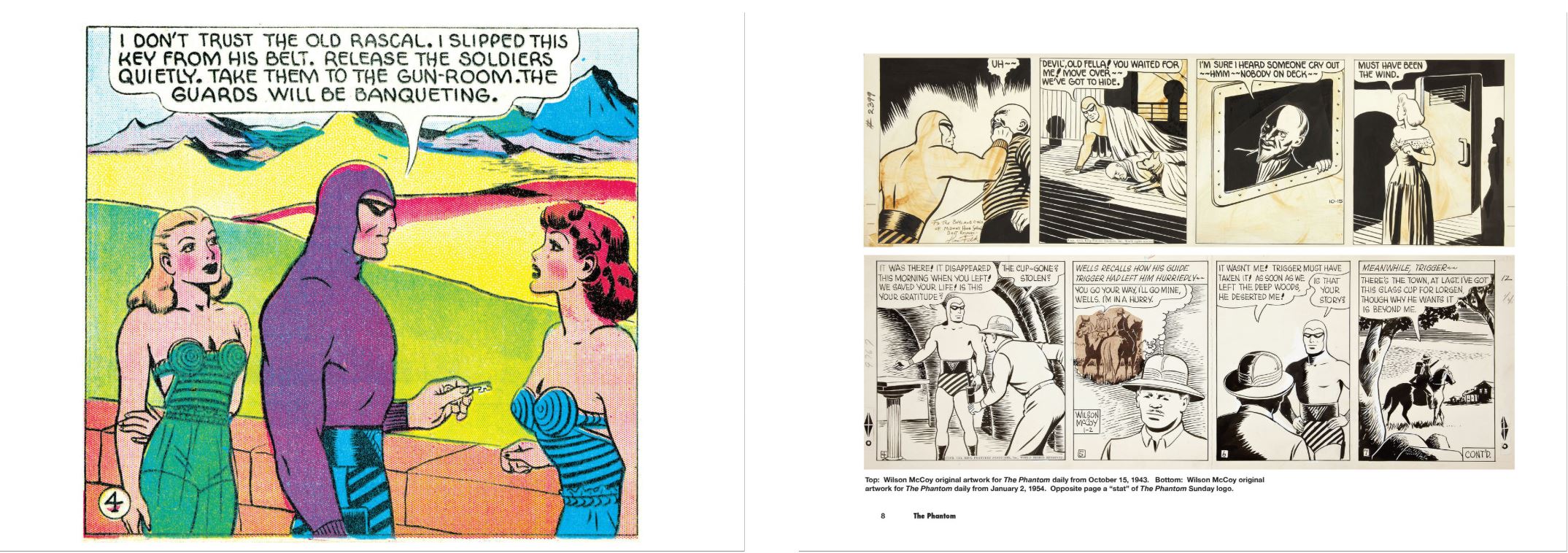
This fifth landscape Dailies edition is currently only available digitally. Released in 2013, its pages are stuffed with sumptuous visual goodies like panel and logo close-ups, covers and lots of original art, and opens with ‘Introduction: Passing the Torch’: a memories-rich text feature stuffed with sumptuous visual goodies from much-missed uber-fan Ed Rhoades, after which we resume the never-ending story in progress…

Previously – and in a volume STILL agonisingly unavailable: a colossal war campaign in the African jungles catapulted the reclusive do-gooder into global headlines as the “masked commander of Bengali” and the triumphant “Hero of The Oolan”: unwanted attention which made The Phantom an unhappy but extremely well known heroic public figure. During the siege his adored Significant Other Diana Palmer was gravely wounded. As she recuperates in the USA, attended by faithful failed-suitor Captain Byron, the Ghost who walks is being flown to the Land of the (currently) Free for pointless military bombast and tedious morale-boosting backslapping. It’s a situation he plans on escaping ASAP …

The vintage blood-&-thunder fun begins with brooding, tension-packed thriller ‘Bent Beak Broder’ (originally running Mondays to Saturdays, January 11th to May 22nd 1943) wherein Phantom – and faithful wonder-wolf companion Devil – duck the escorts and parades to head for Diana’s home and sickbed. It involves a tedious cross country hitchhiking stint and lands the hero-in-mufti in the middle of a prison break. When ruthless rogue Bent Beak kidnaps a young girl and goes on a rampage, our seasoned crimebuster is duty-bound to postpone his romantic reunion and hunt down the monstrous malcontents in a stunning display of psychological warfare and thundering fists, leaving the convicts mentally scarred for life and marked with the Phantom’s signature Death’s Head ring brand…

Neatly segueing into soap opera romance with a side order of comedy, ‘The Phantom’s Engagement’ (24th May – 24th July) at last finds him at her doorstep and bedside just as Byron makes one more play for her heart. Gently rebuffed and at last accepting that she will never be his, the captain prepares to leave. However, pushed by Diana’s family – and especially her Uncle Dave – the uncharacteristically nervous masked marvel girds himself to propose but is briefly distracted by the arrival of terrifying African emissary Prince Karna of the Ismani and a religious rite that cannot be deferred. Renewal rite wrapped up, The Phantom perseveres and pops the question.

Everything seems fine (and funny to all observing) until Diana, who initially accepts his proposal to extend the Phantom line unto a another generation, abruptly changes her mind and turns him down, saying that she is promised to Byron. Baffled and broken, The Phantom is unaware that Diana mistakenly believes herself unable to walk ever again…

Upon learning that her paralysis was temporary, Diana tries to follow The Phantom back to Africa, with the reluctant but big-hearted help of Byron, but by now “Kit Walker” and Devil are far out at sea and facing the opening gambits of epic yarn ‘High Seas Hijackers’ (26th July 1943 – 26th February 1944). Here the Jungle Judge renews his eternal war on pirates against a wicked band employing a diabolical new gimmick…

Across oceans still wary of submarine attacks, glamorous, eye-catching agent provocateur/fifth columnist Suzie is fascinated by enigmatic never-seen fellow passenger Mr. Walker. Not so much her snooty superior Mrs J who isn’t, but won’t let it stop them preparing the freighter conveying them all – the S.S. Harvey – for capture by sea marauders. Not far away, the sinister General has devised a tactic for scaring away crews and taking ships without a struggle, but this stratagem almost founders when a masked maniac is found haunting the current target. Eventually, The Phantom is captured and the General, a pirate to his core, recognizes the undying nemesis of his kind. As he starts to unravel, Suzie interrogates the prisoner and finds her own merciless worldview shifting, but cannot stop her terrified boss throwing the captive overboard tied to tons of machinery…

His escape and subsequent pursuit brings him to a tropical island nation where the villainous General is actually the richest, most respected and second most powerful man there. However with Suzie switching sides The Phantom and Suzie dismantle his powerbase as Governor, before exposing him to the far distant politically isolated President. This involves a sustained struggle employing a war of nerves, guerilla tactics and sheer fortitude after the villain sets the entire military on their trail… all to no avail. In the end justice is served but the cost is shockingly high and deeply personal…

Saddened by his loss, The Ghost Who Walks decides on one last (secret) glimpse of Diana before losing himself in the Jungles of Bengali and returns to America just in time to become embroiled in ‘The Spy Game’ (28th February – 20th May). Byron and Diana are “Just good friends” now, and when the Captain is ordered by Uncle Dave (a big deal in US Military Intelligence) to courier a briefcase of secrets to a specific location at a certain time, Diana adds cover as his wife. Unfortunately the couple are under surveillance already, by a deadly ring of spies: a certain masked hero and his wolf who get the wrong idea. When Kit Walker notices their other shadows, he gets involved behind the scenes, safeguarding them on a spectacular and mindbending Hitchcock-like odyssey of peril and intrigue involving planes, trains and automobiles, and non-stop action, that ends with The Phantom and Diana reunited and engaged again. However Byron, already despatched on another mission, has extracted a promise that she will marry no one else until his return…

It’s back to crime and the public’s growing fascination with gangsterism for closing adventure ‘The Crooner’ (22nd May – 26th August 1944). This felonious mastermind’s grand idea is to frame the Phantom by committing brutal crimes all “signed” with his Death’s Head mark, but soon learns the power of that symbol when the hero dismantles his operation with chilling efficiency…

Short on actual jungle tales but stuffed with chases, cruises, air clashes, assorted fights, torture, action antics, daredevil stunts and many a misapprehension in the-then modern milieu of America and a war-torn contemporary world, this is sheer pulp-era excitement that still packs a breathtaking punch and many sly laughs. Rollercoaster thrills delivered at rocket pace, these pared-down, gripping episodes display artist Wilson McCoy developing his craft and honing skills on every panel, making the strip visually his until his untimely death in 1961, after which Carmine Infantino and Bill Lignante filled in until Sy Barry took over.
© 2013 King Features Syndicate, Inc.: ® Hearst Holdings, Inc.; reprinted with permission. All rights reserved.

Yesterday in 1902 British cartoonist Brian White was born. His greatest contrition to world peace and global morale was Nipper. Just as important – to me at least – are the arrivals of letterer Sam Rosen in 1922, and multitasking comics maestro Joe Orlando in1927. Barely less important, scripter, editor and “DC Answer Man” Bob Rozakis arrived in 1951 as did cover artist Dave Johnson in 1966.

In 1991 we lost legendary EC horror and romance artist Graham Ingels, whilst 1997 saw the passing of trailblazing African American comics creator Billy Graham (Vampirella, Eerie, Creepy, Luke Cage, Black Panther, Sabre).

Today in 1916, writer/artist/editor/publisher Bernard Baily (The Spectre, Hourman, Gilda Gay, Frankenstein) was born, and in 1941 so was Archie Comics mainstay Victor Gorelick. Mangaka Akira Toriyama (Dragon Ball) arrived in 1955; cartoonist Dan Perkins – AKA Tom Tomorrow (This Modern World) – in 1961 and “Legend”-ary creator Art Adams (Longshot, X-Men, Superman, Batman, Monkeyman & O’Brien, Gumby and practically everyone else) in 1963.

And also today in 2005 we lost glass-ceiling shattering cartoonist Dale Messick, first woman to create her own syndicated newspaper strip: Brenda Starr, Reporter.

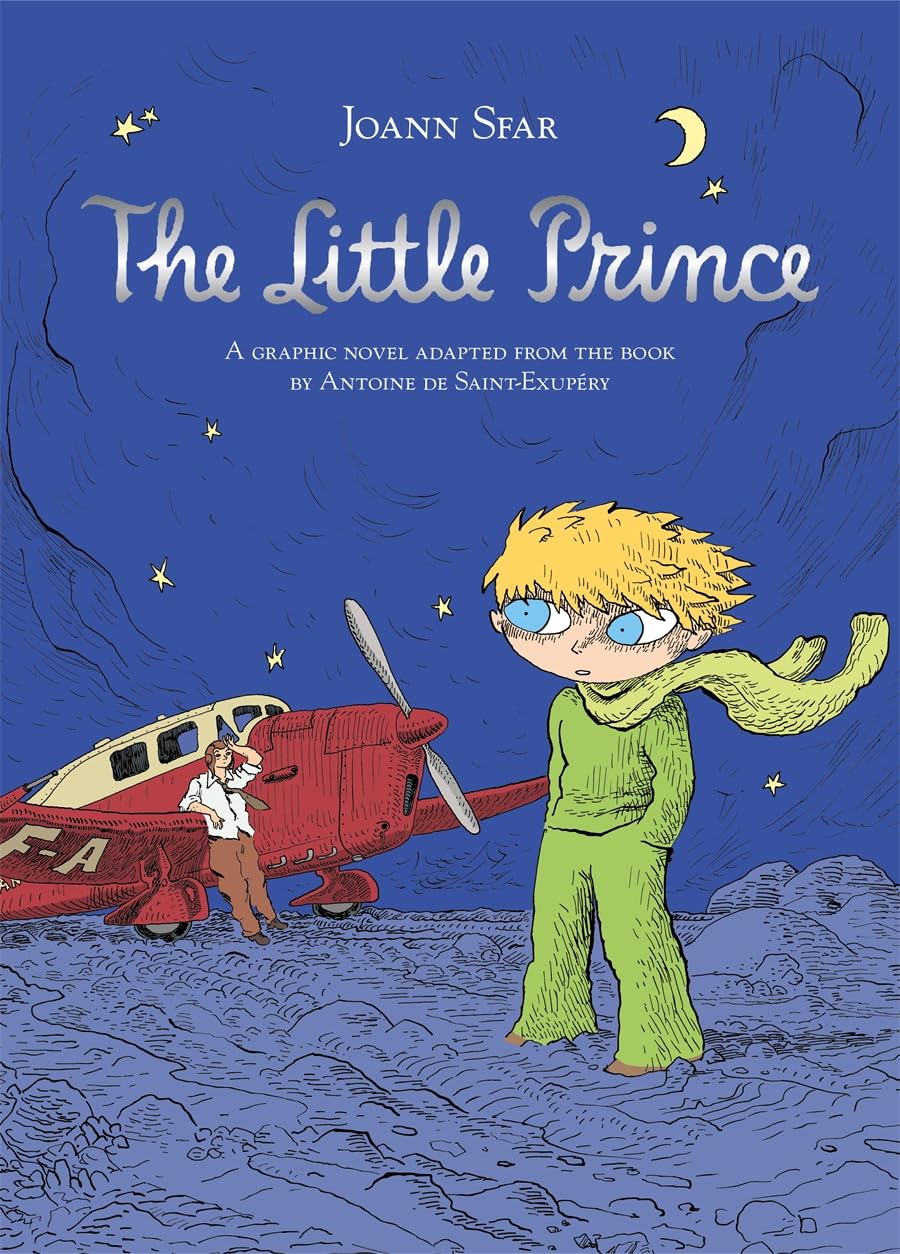
The Little Prince – A Graphic Novel adapted from the book by Antoine de Saint-Exupéry


By Joann Sfar, with colours by Brigitte Findakly, translated by Sarah Ardizzone (SelfMadeHero)
ISBN: 978-1-914224-46-1 (HB)

This book includes Discriminatory Content included for dramatic effect.

The Little Prince was written by warrior, aeronaut, aristocrat, illustrator and auteur Antoine de Saint-Exupéry, Published in 1943 in the US in French & English, and again posthumously in1946 (as the pilot/writer had been Missing; Presumed Dead for two years), it became a glabally popular classic. You should read it in the language of your choice. It’s been adapted into every form of human expression and never failed to impress or deeply move.

In 2008 Joann Sfar adapted it to his preferred medium, and Le Petit Prince: d’après d’oeuvre d’Antoine de Saint-Exupéry was published by Gallimard Jeunesse. In the 80th anniversary year since the original book took off, SelfMadeHero celebrate the event with a fabulous, augmented edition to simply wallow in.

As well as fully re-presenting Sfar’s bold interpretation this tome also offers a fully updated translation and includes a ‘Timeline’ for Antoine de Saint-Exupéry and his creations, and from Ardizzone herself a concluding ‘Translator’s Note – The Reader Perched on Your Shoulder’ to accompany the now-traditional creators’ biographies as closing ‘Authors’ section.

You’ve heard this before and its’s still utterly true, some things you don’t talk about, you just do, and this mesmerising adaptation is the very epitome of that. Here’s all you get from me…

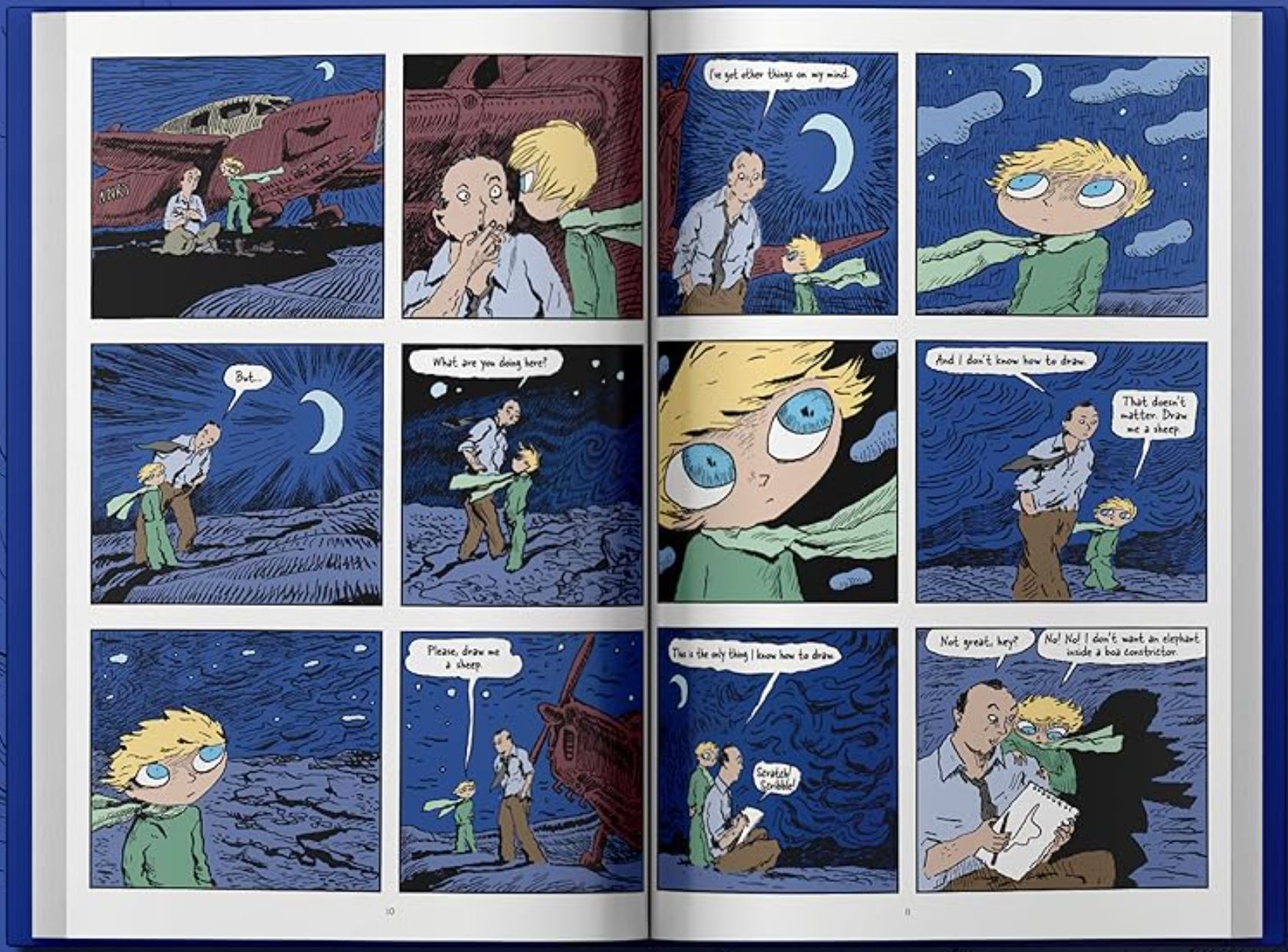
In the African desert an aviator strives to repair his downed plane. The work is hard, his head hurts and he doesn’t really know what he’s doing. He always wanted to be an artist, not a flier doomed to die of thirst and loneliness in blistering heat…

Abruptly his prospects change as a strange, golden-haired boy asks him to draw a sheep…

Soon the politely engaging lad is keeping him company as he works: telling of the strange small planet he came from, the oddly toxic relationship that compelled him to leave, and the bizarre individuals he met in his travels through space to Earth. Companionship is welcome, even if the shared tales are dolorous and often painful and distressing to hear, but as the aviator adapts to the fact that he probably won’t make it, he increasingly fears for the mournful child. The Little Prince claims to be preparing to return to his small world and lost inamorata, but only seems to be courting the company of the deadly, poisonous reptiles that abound in the arid wastelands…

In a place most folks don’t visit anymore, there’s a secret list of all the books and stories one needs to read to be considered a human being. This is on it (quite near the top, in fact) and, even as radically re-imagined as it was been here by Sfar, demands your attention and consideration.

So go do that then. Vite! Vite!
© Gallimard Jeunesse, 2008. English translation © Sarah Ardizzone, 2010, 2026. All rights reserved.

Yesterday in 1962 Swedish comics maven Joakim Lindgren was born, but in 1957, we lost Jack Butler Yeats, creator of Chublock Holmes in Comic Cuts (arguably the first comic book serial), Underground Commix mega-star Dave Sheridan in 1982, Italian comics stalwart Nicola Del Principe (Le Justicier Masqué, Tom and Jerry) in 2002 and in 2013 Spanish/Argentine artist, cartoonist, animator and publisher Manuel García Ferré.

Yesterday in 1991, iconoclastic UK all-star comic Toxic began: running until October 24 of that year and introducing many cool characters such as Accident Man, The Bogie Man and Marshal Law.

Today in 1901, foundational Croatian comics artist Andrija Maurovi? (Empress of the Netherworld, Beware the Hand from Senj) was born, as was Mark Trail cartoonist Jack Elrod in 1924, and UK scribbler David Austin (Hom Sap) in 1935. Trail-blazing Wayne Howard (first US creator to be cover-credited for a strip series) was born in 1949, Val Mayerik (Howard the Duck co-creator) one year later, Marc Silvestri in 1958 and Jim Mahfood (Clerks, Grrl Scouts, Spider-Man, The Further Adventures of One Page Filler Man, Carl, The Cat That Makes Peanut Butter Sandwiches) in 1975. In 1983, Gene Ahern’s 60-year run on legendary strip Our Boarding House ended with its cancelation. Two years later Kerry Drake creator Alfred Andriola died, followed in 2007 by writer Leslie Waller, co-creator (with Arnold Drake & Matt Baker) of the “first US Original Graphic Novel” It Rhymes with Lust (St John Press Picture Novel, 1950).

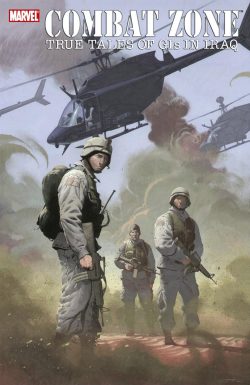
Combat Zone: True Tales of GIs in Iraq


By Karl Zinsmeister, Dan Jurgens & Sandu Florea (Marvel Comics)
ISBN: 978-0-7851-1516-8 (TPB)

This book includes Discriminatory Content produced in less enlightened times.

As someone brilliant just said, what is it about the USA and countries that start with Ira….

It’s always good to see a company venture outside its self-constructed ghetto of Proprietary Characters, rather than endlessly re-hash names it’s already trademarked, and doubly so when it is to venture into genres that it has previously abandoned. Sadly, in some cases the question then becomes one of seeking new markets as opposed to simply looking for new resources to exploit. Comics have had a long and chequered history when it comes to militarism, ideological witch-hunting and band-wagon hopping.

Combat Zone features “real-life accounts” of US combatants in the 2003-2004 Iraq War, although – as you’d expect – “some incidents have been combined to make for a more condensed read”, and of course names have been changed to protect, etc. etc.

Writer Zinsmeister was an embedded reporter during the conflict so I’m sure the events are as true as he saw them but the overall feeling after reading the book was one of tedious detachment. Maybe modern military life is one of immense boredom, spent talking to buddies and telling everyone how cool your ordnance is, interlaced with the occasional skirmish, but if such is the case it shouldn’t be in a drama-oriented comic book.

It’s hard not to compare this with the excellent Real War Stories produced in the late 1980s by Eclipse or even such personal visions as Sam Glanzman’s many collections or Don Lomax’s gruelling, compelling and, above all, informative Viet Nam Journal, perhaps because all of these take the part, and the authorial voice, of the ordinary soldier, and there is an implicit understanding that, though necessary, the job at hand is neither easy or fun. Even Robert Kanigher’s Sgt. Rock tales had greater verisimilitude than what’s on offer here.

In Combat Zone even when a character eventually dies, the response is so anodyne that we know nobody really cares. There is more than the hint of the Press Release about it. Often it feels like the entire comic has passed through the same Pentagon ‘fact-checker’ that news reports do. A far cry, then, from Real War Stories #1, which a previous US government actually attempted to suppress.

On a purely dramatic level, the problem is one of heroic stature. When two desperate guys give their lives in a dramatic, doomed attempt to stop an onslaught of high-tech juggernauts from crushing their homeland, with nothing more than an old pick-up truck and a machine gun, those ought to be the heroes, not the bad guys!

There’s nothing but platitudes in each character’s mouth here to show the reader how justified the war might be, and no mention of the disastrous early days of allied blunders or numerous friendly fire incidents. ‘Those didn’t happen where I might see them’ is not an excuse in a documentary which has been subjectively edited “to make for a more condensed read”. You don’t get to pick and choose between Dramatic Authenticity and Journalistic Veracity at will, and not expect a few hits for it. Unless you are the incumbent administration, of course.

With lacklustre art masquerading as realism from comic super-star Dan Jurgens adding to the overall dullness of the mix (is it me or are all US soldiers darned good looking fellers?) the overall response to this was and remains one of disappointment. It felt as if the neither the creators nor the characters were in the least bit emotionally engaged. I certainly wasn’t. And I can’t wait to see what any legitimate comic publisher will do with the ongoing fracas under the sun…
© 2005 Marvel Characters Inc. All Rights Reserved.

Today in 2012, the Royal Mail issued stamps celebrating British comics landmarks The Beano, Dandy, Eagle, Topper, Roy of the Rovers, Bunty, Buster, Twinkle, Valiant and 2000 AD.

Tomorrow in 1895 was born real life comics villain Dr. Fredric Wertham: pop psychologist and figurehead of anti-comics witch hunts in the 1950s.

In 1922 Out Our Way debuted, care of J. R. Williams, and a bunch of births began in 1925 with The Phantom artist Bill Lignante, Italy’s Giancarlo (Martin Mystère) Alessandrini in 1950 and our very own David Hine (Sticky Fingers, Mambo, Silent War, The Bulletproof Coffin, District M, Spawn) in 1956

We lost Spanish comics pioneer Ramón Cilla in 1937, America’s Nervy Nat cartoonist Arthur Lewis in 1957 and Norwegian Anders Bjørgaard, renderer of Jens von Bustenskjold in 1967.

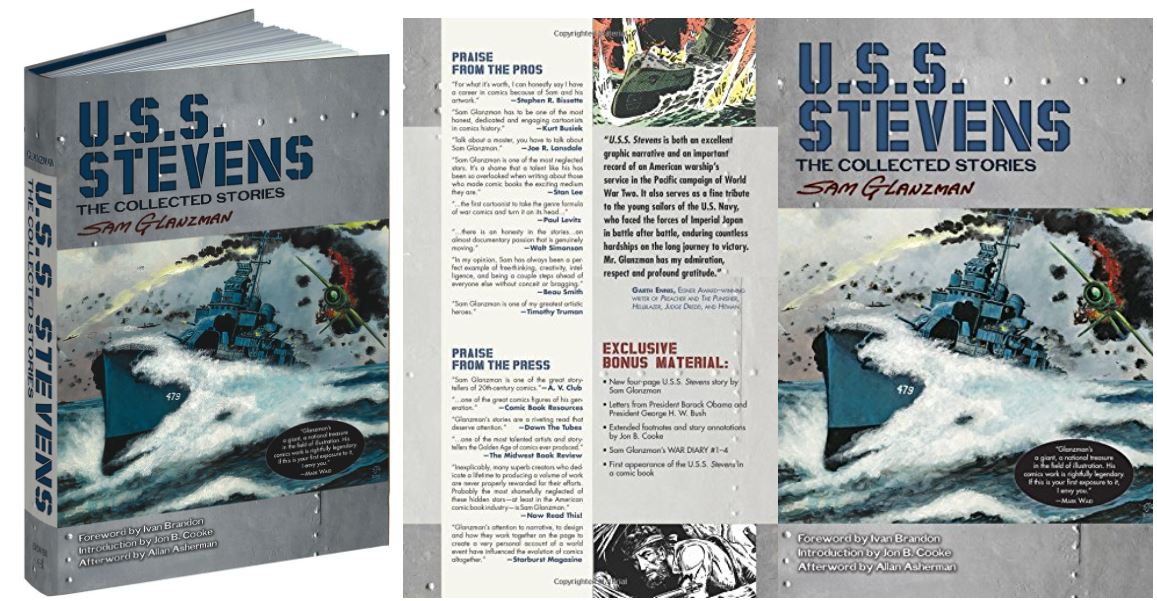
U.S.S. Stevens – The Collected Stories


By Sam Glanzman (Dover Comics & Graphic Novels)
ISBN: 978-0-486-80158-2 (HB/Digital edition)kuno

This book includes Discriminatory Content produced for dramatic and comedic effect.

To the shame and detriment of the entire comics industry, for most of his career Sam Glanzman was one of the least-renowned creators in American comic books. Despite having one of the longest careers, most unique illustration styles and the respect of his creative peers, he just never got the public acclaim his work deserved. Thankfully that all changed in recent years and he lived long enough to enjoy the belated spotlight and bask in some well-deserved adulation.

Glanzman drew and wrote comics since the Golden Age, most commonly in classic genres ranging from war to mystery to fantasy, where his work was – as always – raw, powerful, subtly engaging and irresistibly compelling. On titles such as Kona, Monarch of Monster Island, Voyage to the Deep, Combat, Jungle Tales of Tarzan, Hercules, The Haunted Tank, The Green Berets, The Private War of Willie Schultz, and especially 1980s graphic novels A Sailor’s Story and Wind, Dreams and Dragons – which you should buy in a single volume from Dover – Glanzman produced magnificent action-adventure tales which fired the imagination and stirred the blood. His stuff always sold and at least won him a legion of fans amongst fellow artists, if not from the small, insular and over-vocal fan-press.

In later years, Glanzman worked with Tim Truman’s 4Winds outfit on high-profile projects like The Lone Ranger, Jonah Hex and barbarian fantasy Attu. Moreover, as the sublime work gathered here attests, he was also one of the earliest pioneers of graphic autobiography; translating personal WWII experiences as a sailor in the Pacific into one of the very best things to come out of DC’s 1970s war comics line.

U.S.S. Stevens, DD479 was a peripatetic filler-feature bobbing about between Our Army at War, Our Fighting Forces, G.I. Combat, Star Spangled War Stories and the other anthological battle books; quietly backing-up the cover-hogging, star-attraction glory-boys. It provided wry, witty, shocking, informative and immensely human vignettes of shipboard life, starring the fictionalised crew of the destroyer Glanzman had served on. It was, in most ways, a love story and tribute to the vessel which had been their only home and refuge under fire. In 4- or 5-page episodes, the auteur recaptured and shared a kind of comradeship we peace-timers can only imagine and, despite the pulse-pounding drama of the lead features, us fans all knew these little snippets were what really happened when the Boys went “over there”. Just like now…

A maritime epic to rank with Melville or Forester – and with stunning pictures too – every episode of this astounding unsung masterpiece is housed in one stunning hardback compilation (also available digitally for limp-wristed old coots like me) and if you love the medium of comics, or history, or just a damn fine tale well-told, you must have it.

That’s really all you need to know, but if you’re one of the regular crowd needful of more of my bombastic blather, a much fuller description follows.

As I’ve already stated, Glanzman belatedly enjoyed some well-earned attention, and this tome opens by sharing Presidential Letters from Barack Obama and George Herbert Walker Bush for his service and achievements. Then follows a Foreword from Ivan Brandon and a copious and informative Introduction by Jon B. Cooke detailing ‘A Sailor’s History: The Life and Art of Sam J. Glanzman’. Next comes a brace of prototypical treats; the initial comic book appearance of U.S.S. Stevens from Dell Comics’ Combat #16 (cover-dated April-June 1965) and the valiant vessel’s first cover spot from Combat #24, April 1967.

The first official U.S.S. Stevens, DD479 appeared after Glanzman approached Joe Kubert, who had recently become Group Editor for DC’s war titles. He commissioned ‘Frightened Boys… or Fighting Men’ (appearing in Our Army at War #218, April 1970), depicting a moment in 1942 as boredom and tension were replaced by frantic action when a suicide plane targeted the ship…

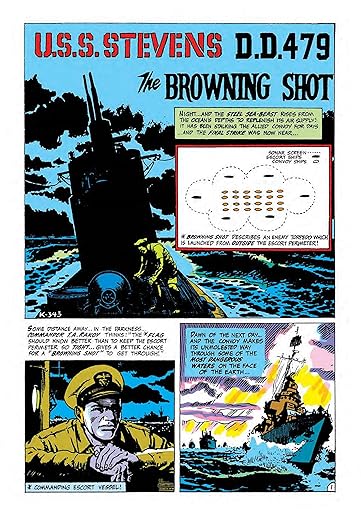
A semi-regular cast was introduced slowly throughout 1970; fictionalised incarnations of old shipmates including skipper Commander T. A. Rakov, who ominously pondered his Task Force’s dispersal, moments before a pot-luck attack known as ‘The Browning Shot’ (Our Fighting Forces #125, May/June) proved his fears justified…

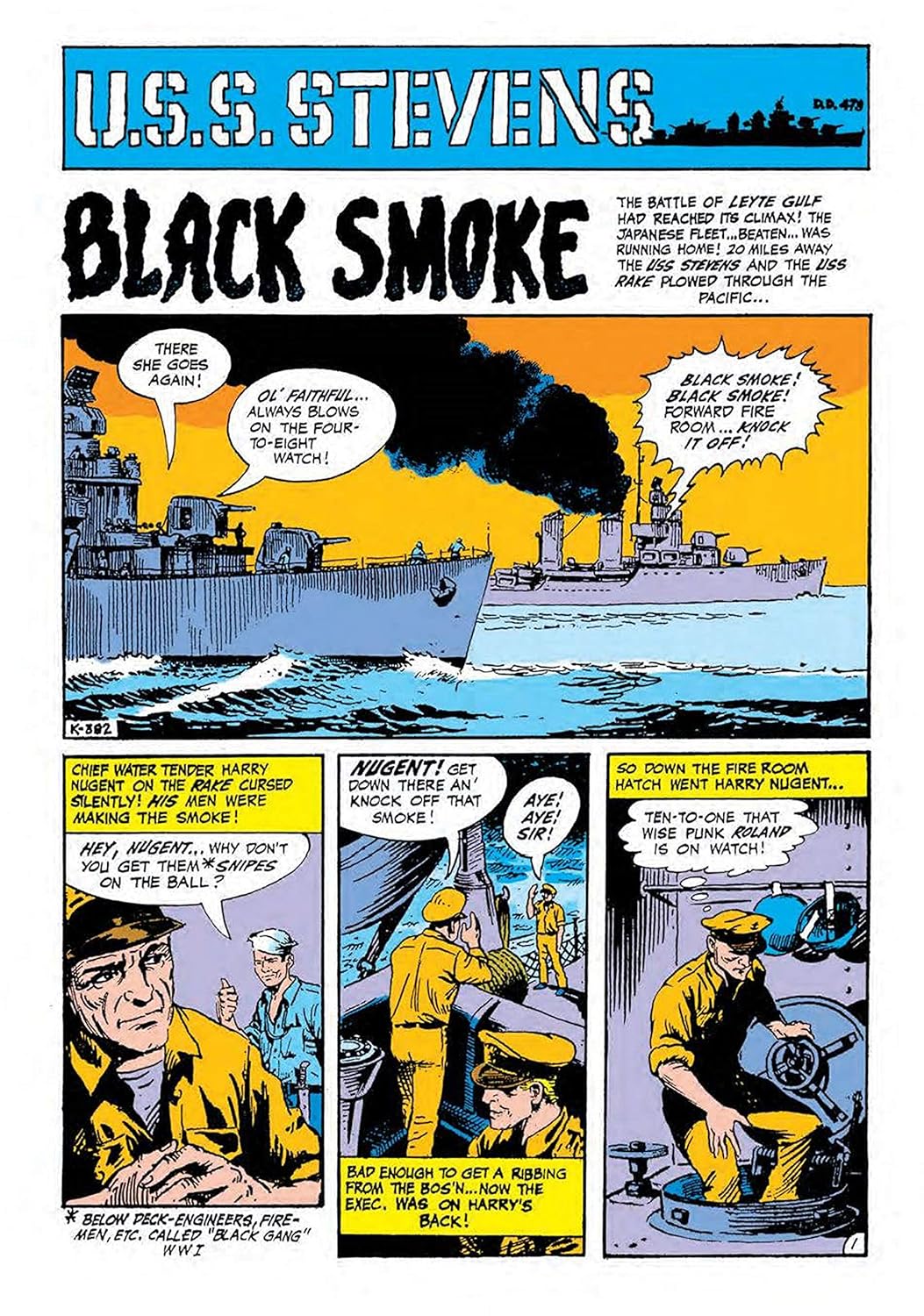
Glanzman’s pocket-sized tales always delivered a mountain of information, mood and impact and ‘The Idiot!’ (OAaW#220, June) is one of his most effective, detailing in 4 mesmerising pages not only the variety of suicidal flying bombs the Allies faced, but also how appalled American sailors reacted to them. Sudden death was everywhere. ‘1-2-3’ (OFF #126, July/August) details how quick action and intuitive thinking saves the ship from a hidden gun emplacement whilst ‘Black Smoke’ (Our Army at War #222, from the same month) shows how a know-it-all engineer causes the sinking of the Stevens’ sister-ship by not believing an old salt’s frequent, frantic warnings. All aboard ship were regularly shaken by the variety of Japanese aircraft and skill of the pilots. ‘Dragonfly’ (OFF #127, September/October) shows exactly why, whilst an insightful glimpse of the enemy’s psychological other-ness is tragically, graphically depicted in the tale of ‘The Kunkō Warrior’ (OAaW #223, September).

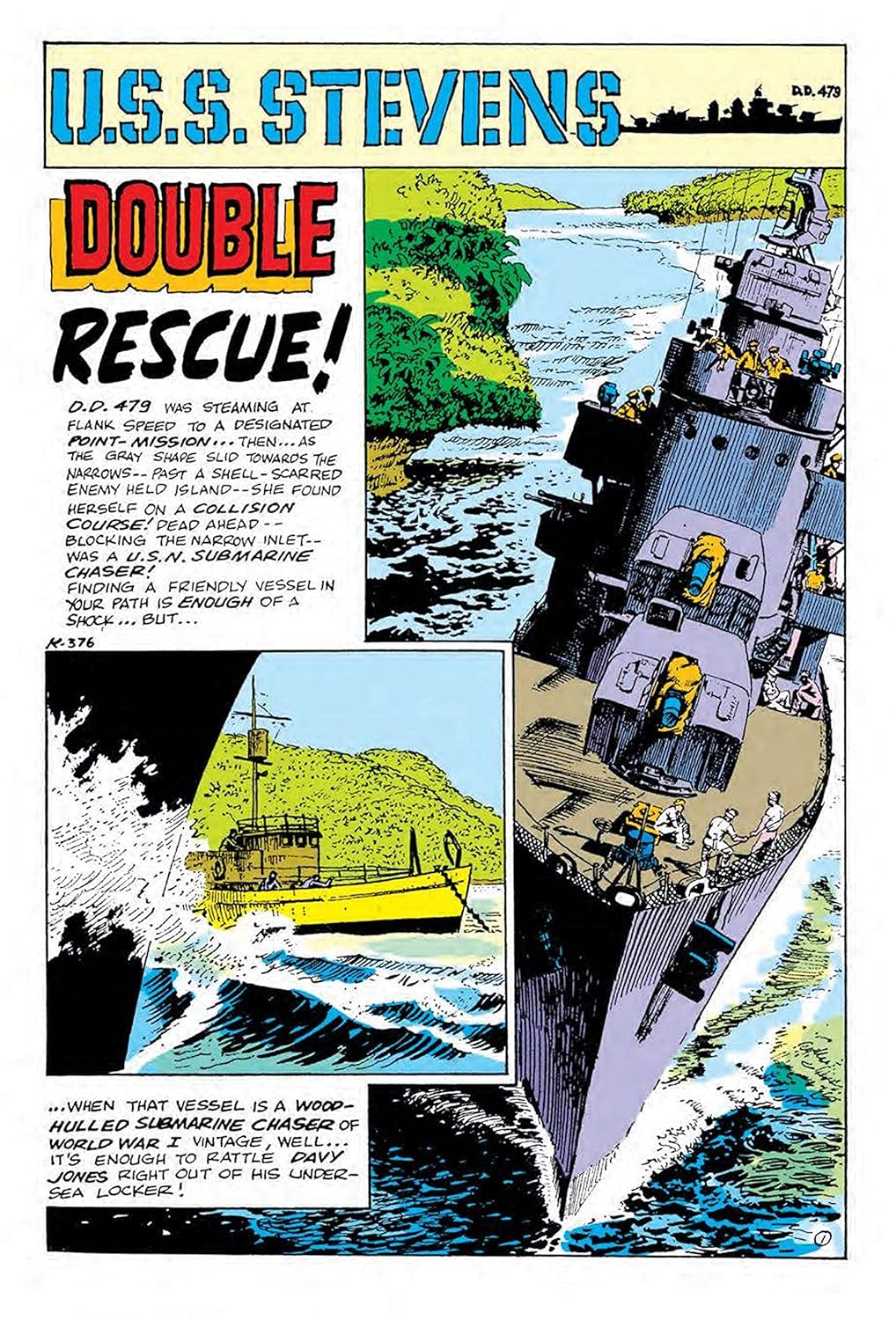
A weird encounter with a wooden WWI vessel forces a ‘Double Rescue!’ (Star Spangled War Stories #153, October/November) before OFF #128’s (November/December) ‘How Many Fathoms?’ again counts the human cost of bravery with devastating, understated impact. ‘Buckethead’ (OAaW #225, November) then relates one swabbie’s unique reaction to constant bombardment before ‘Missing: 320 Men!’ (G.I. Combat #145, December 1970-January 1971) debuted Glanzman-avatar Jerry Boyle, who whiled away helpless moments during a shattering battle by sketching cartoons of his astonished shipmates.

‘Death of a Ship!’ (OAaW #227, January 1971) deals with classic war fodder as submarine and ship hunt each other in a deadly duel. A military maritime mystery was solved by Commander Rakov in ‘Cause and Cure!’ Our Army at War #230, March) whilst next issue (April 1971) posed a different conundrum as the ship lost all power and was stuck ‘In the Frying Pan!’

The vignettes were always less about warfare than its effect – immediate or cumulative – on ordinary guys. ‘Buck Taylor, You Can’t Fool Me!’ (OAaW #232) catalogues his increasingly aberrant behaviour but posits some less likely reasons, after which old school hero Bos’n Egloff saves the day during the worst typhoon of the war in ‘Cabbages and Kings’ (OFF #131, July/August) whilst ‘Kamikaze’ (OAa #235 August) boldly and provocatively tells a poignant life-story from the point of view of the pilot inside a flying bomb.

An informative peek at the crew of a torpedo launch station in ‘Hip Shot’ (G.I. Combat #150 October/November) segues seamlessly into the dangers of shore leave ‘In Tsingtao’ (OFF #134, November/December) whilst ‘XDD479’ (OAaW #238 November) reveals a lost landmark of military history. The real DD479 was one of three destroyers test-trialling ship-mounted spotter planes. This little gem explains why that experiment was dropped…

Buck bounces back in ‘Red Ribbon’ (G.I.C #151 December 1971-January 1972), sharing a personal coping mechanism for making shipboard chores less “exhilarating”, whilst ‘Vela Lavella’ (OAaW #240, January 1972) captures the claustrophobic horror of nighttime naval engagement before ‘Dreams’ (G.I.C #152 February/March) peeps inside various heads to see what the ship’s company would rather be doing. ‘Batmen’ (OAaW #241, February) uses a lecture on radar to recount one of the most astounding exploits of the war…

Every episode was packed with fascinating fact and detail, culled from the artist’s letters home and service-time sketchbooks, but those invaluable memento belligeri also served double duty as the basis for a secondary feature. The debut ‘Sam Glanzman’s War Diary’ appeared in Our Army at War #242 (March 1972): a compendium of pictorial snapshots sharing quieter moments, such as the first passage through the Panama Canal, sleeping arrangements or K.P. duties peeling spuds, and precedes an hilarious record of the freshmen sailors’ endurance of an ancient naval hazing tradition inflicted upon every “pollywog” crossing the equator for the first time in ‘Imperivm Neptivm Regis’ (OFF #136 (March/April 1972).

A second ‘Sam Glanzman’s War Diary’ (OAaW #244, April) reveals the mixed joys of ‘Liberty in the Philippines’ after which a suitably foreboding ‘Prelude’ (Weird War Tales #4 (March/April 1972) captures the passive-panicked tension of daily routine whilst a potentially morale-shattering close shave is shared during an all-too-infrequent ‘Mail Call!’ (G.I. Combat #155, April/May)…

A thoughtful man of keen empathy and insight, Glanzman often offered readers a look at the real victims. ‘What Do They Know About War?’ (OAaW #244, April) sees peasant islanders trying to eke out a living, only to discover far too many similarities between Occupiers and Liberators, whilst the next issue focussed on sailors’ jangling nerves and stomachs. ‘A Funny Thing Happened on the Way to the War!’ (#245, May) reveals what happened when DD479 was mistakenly declared destroyed and, thanks to an administrative iron curtain, found it impossible to refuel or take on food stores. Cartoonist Jerry Boyle resurfaced in a ‘Comic Strip’ (OFF #138, July/August) after which Glanzman produced one of the most powerful social statements in an era of tumultuous change.

Our Army at War #247 (July 1972) featured a tale based on decorated Pearl Harbor hero Doner Miller who saved lives, killed the enemy and won medals, but was not allowed to progress beyond the rank of shipboard domestic because of his skin. ‘Color Me Brave!’ was an excoriating attack on the U.S. Navy’s segregation policies and is as breathtaking and rousing now as it was then.

‘Ride the Baka’ (OAaW #248 August) revisits constant near-miss moments sparked by suicide pilots after which Glanzman shares broken sleep in ‘A Nightmare from the Beginning’ (OFF #139, September/October) whilst ‘Another Kunkō Warrior’ (OFF #140, November/December) sees marines taking an island and encountering warfare beyond their comprehension…

1973 began with a death-dipped nursery rhyme detailing ‘This is the Ship that War Built!’ (G.I.C #157 December 1972-January 1973) before ‘Buck Taylor’ (OFF #141 January/February) delivers an impromptu lecture on maritime military history. Glanzman struck an impassioned note for war-brides and lonely ships passing in the night with ‘The Islands Were Meant for Love!’ (Star Spangled War Stories #167 February). Terror turns to wonder when sailors encounter the ‘Portuguese Man of War’ (OAaW #256 August), a shore leave mugging is thwarted thanks to ‘Tailor-Mades’ (OFF #143 June/July) and letters home are necessarily self-censored in ‘The Sea is Calm… The Sky is Bright…’ (OAaW #257 June), but shipboard relationships remain complex and bewildering, as proved in ‘Who to Believe!’ (SSWS #171, July).

The strife of constant struggle comes to the fore in ‘The Kiyi’ (OAaW #258 July) and is seen from both sides when souvenir hunters try to take ‘The Thousand-Stitch-Belt’ (SSWS #172 August), but, as always, it’s noncombatants who truly pay the price, just like the native fishermen in ‘Accident…’ (OAaW #259, August). Even the quietest, happiest moments can turn instantly fatal as good-natured pilferers swiping fruit at a refuelling station discover in ‘King of the Hill’ (SSWS #174, October). An unlikely tale of a kamikaze who survives his final flight but not his final fate, ‘Today is Tomorrow’ (OAaW #261, October) precedes a strident, wordless plea for understanding in ‘Where…?’ (OAaW #262 November 1973) before our sombre mood is briefly lifted with a tale of selfishness and sacrifice in ‘Rocco’s Roost’ from OAaW #265, February 1974.

The following issue provided both a gentle ‘Sam Glanzman’s War Diary’ covering down-time in “The Islands” and a brutal tale of mentorship and torches passed seen in ‘The Sorcerer’s Apprentice’, after which a truly disturbing tale of what we now call gender identity and post-traumatic stress disorder is recounted in the tragedy of ‘Toro’ ( April/May Our Fighting Forces #148)…

‘Moonglow’ from OAaW #267 (April 1974) reveals how quickly placid contemplation can turn to blazing conflagration, whilst – after a chilling, evocative ‘Sam Glanzman’s War Diary’ (OAaW #269 June) – ‘Lucky… Save Me!’ (OAaW #275, December 1974) shows how memories of unconditional love can offset the cruellest of injuries. ‘Heads I Win, Tails You Lose!’ (OAaW #281, June 1975) explores how both friend and foe alike can be addicted to risk, after which the next issue’s ‘I Am Old Glory…’ sardonically transposes a thoughtful veneration with the actualities of combat before ‘A Glance into Glanzman’ by Allan Asherman (Our Army at War #284, September 1975) takes a look at the author’s creative process.

Then it’s back to those sketchbooks and another peep ‘Between the Pages’ (OAaW #293, June 1976) before ‘Not Granted!’ (OAaW #298, November 1976) discloses every seaman’s most fervent wish…

Stories were coming at greater intervals at this time and it was clear that – editorially at least – the company was moving on to fresher and more fantastical fields. Glanzman, however, had saved his best till last as a stomach-churning visual essay displayed the force of tension sustained over months in ‘…And Fear Crippled Andy Payne’ (Sgt. Rock #304, May 1977) before an elegy to bravery and stupidity asked ‘Why?’ in Sgt. Rock #308 (September 1977).

And that was it for nearly a decade. Glanzman – a consummate professional – moved on to other ventures. He was, however, constantly asked about U.S.S. Stevens and eventually returned to his spiritual stomping grounds in expanded tales of DD479: both in his graphic novel memoirs and comic strips. The latter appeared in anthological monochrome Marvel magazine Savage Tales (#6-8, spanning August-December 1986) under the umbrella title ‘Of War and Peace – Tales by Mas’.

First up was ‘The Trinity’ blending present with past to detail a shocking incident of a good man’s breaking point, whilst a lighter tone informed ‘In a Gentlemanly Way’, as Glanzman recalled different means by which officers and swabbies showed pride for their ships. ‘Rescued by Luck’ than concentrated on a saga of island survival for sailors whose ship had sunk. Next comes a hauntingly powerful black-&-white tale of then and now entitled ‘Even Dead Birds Have Wings’ (created for the Dover Edition of A Sailor’s Story from 2015), after which a chronologically adrift yarn (from Sgt. Rock Special #1, October 1992) evokes potently elegiac feelings, describing an uncanny act of gallantry under fire and the ultimate fate of old heroes in ‘Home of the Brave’

Some years ago, by popular – and editorial – demand, Glanzman returned to the U.S.S. Stevens for an old friend’s swan song series; providing new tales for each issue of DC’s anthological 6-issue miniseries Joe Kubert Presents (December 2012 – May 2013). More scattershot reminiscences than structured stories, ‘I REMEMBER: Dreams’ and ‘I REMEMBER: Squish Squash’ recapitulate unforgettable moments seen through eyes at the sunset end of life; recalling giant storms and lost friends, imagining how distant families endured war and absence and, as always, balancing funny memories with tragic, like that time when the stiff-necked new commander…

‘Snapshots’ continues the reverie, blending a veteran’s war stories with cherished times as a kid on the farm whilst ‘The Figurehead’ delves deeper into the character of Buck Taylor and his esoteric quest for seaborne nirvana…

Closing that last hurrah were ‘Back and Forth 1941-1944’ and ‘Back and Forth 1941-1945’: an encapsulating catalogue of war service as experienced by the creator, mixing facts, figures, memories and reactions to form a quiet tribute to all who served and all who never returned…

With the stories mostly told, ‘Afterword’ by Allan Asherman details those heady days when he worked in DC Editorial, and Glanzman would unfailingly light up the offices by delivering his latest strips, after which this monolithic milestone offers a vast and stunningly detailed appendix of ‘Story Annotations’ by Jon B. Cooke.

This is a magnificent collection of comic stories based on real life and what is more fitting than to end it with ‘U.S.S. Stevens DD479’ (coloured by Frank M. Cuonzo & lettered by Thomas Mauer): one final, lyrical farewell from Glanzman to his comrades and the ship which still holds his heart after all these years?

This is an extraordinary work. In unobtrusive little snippets, Glanzman challenged myths, prejudices and stereotypes – of morality, manhood, race, sexuality and gender – decades before anybody else in comics even thought to try. He also brought an aura of authenticity to war stories which has never been equalled: eschewing melodrama, faux heroism, trumped-up angst and eye-catching glory-hounding to instead depict how brothers-in-arms really felt and acted and suffered and died.

Shockingly funny, painfully realistic and visually captivating, U.S.S. Stevens is phenomenal and magnificent: a masterpiece by one of the very best of “The Greatest Generation”. I waited over 40 years for this and I couldn’t be happier that ten years later this is one comics classic that is still available to all: a sublimely insightful, affecting and rewarding graphic memoir every home, school and library should have and one every reader will return to over and over.
Artwork and text © 2015 Sam Glanzman. All other material © 2015 its respective creators.

Today in 1920. US Dennis the Menace originator Hank Ketcham was born as was Funky Winkerbean cartoonist Tom Batiuk in 1947, and comics horror god Stephen R. Bissette in 1955. In 1973 we mourned Blondie creator Chic Young.

Giant


By Mikaël, translated by Matt Maden (NBM)
ISBN: 978-1-68112-253-3 (HB) eISBN: 978-1-68112-254-0

As a purported land of promises and untapped opportunity, America has always fascinated storytellers – especially comics-creators – from the “Old World” of Europe: an inclination and interest that has frequently delivered potent and rewarding results. This continentally-published yarn by self-taught, multi-disciplined, multi award-winning French-born Québecois auteur Mikaël (Harlem, Junior l’Aventurier, Rapa Nui, Promise) was first released by Dargaud in 2018 as twinned albums before breaking into English via a monolithically oversized hardback (229 x 305mm) edition that got the entire story done-in-one.

Everything about this stylish Depression-era drama is big and powerfully mythic. In March 1932, with poverty wracking the nation and the world, and Herbert Hoover dreading the upcoming Presidential election, immigrants and natives flock to Manhattan and the bustling, dangerous construction site that will one day be Rockefeller Center. Casualties are high as we focus on the Irish contingent rushing daily into the skies to rivet and weld a concrete and steel colossus into New York City’s ever-changing skyline.

The story unfolds through the eyes of fresh-off-the-boat new recruit Dan Shackleton who joins the crew after the death of “high-steel” man Ryan Murphy. Dan is a garrulous, easy-going son-of-the-sod, but even he has difficulty befriending the taciturn, thoughtful, barely-human behemoth everyone calls Giant. A formidable, remarkable worker, Giant lives in a grubby flophouse and keeps to himself, but affable Dan persists and eventually the big man almost-imperceptibly thaws… at least enough that Shackleton becomes unwitting witness to a strange ritual…

Hiding a tragic secret that dates back to the recent Irish War of Independence, the Big Man is a solitary creature of fiercely controlled passions who keeps his every opinion to himself. A dutiful worker, Giant was given the task of informing Murphy’s widow in Ireland when he died. Instead, he began impersonating the dead man in a string of letters containing the bulk of his own carefully-hoarded wages and savings. Over months, a bizarre one-sided relationship develops that metastasizes into a full-blown crisis after the silent bruiser falls foul of organised crime. When the letters and money stop, Mary Ann Murphy and her children take ship for America to be reunited with her beloved husband. As the wounded colossus recuperates, he has no idea of the troubles that are heading his way…

Tapping into a wealth of powerful socially-crusading movies that immortalised pre-WWII America and packed with period detail and mythology, pungent political commentary, a broad cast of moving characters and timeless drama, this is a human-scaled tale playing out amongst mighty edifices – both human and architectural – with warmth, passion, humour and beguiling humanity.

Supplemented with an Introduction by Jean-Louis Tripp and a stunning selection of production sketches, covers and other art, Giant is a stunning saga of uncommon folk in perilous times and one no lover of grand stories could possibly resist.
© 2018 Dargaud-Benelux. © 2020 NBM for the English Translation. All rights reserved.

Most NBM books are also available in digital formats. For more information and other great reads go to NBM Publishing at nbmpub.com.

Today in 1923 American Blondie artist Paul Fung Jr was born, while Warrington’s finest author/animator/cartoonist/editor John Geering (Puss ‘n’ Boots, Smudge, Bananaman, Danger Mouse, Count Duckula) came along in 1941, and Rich Burchett (The Batman Adventures, Superman Adventures, Blackhawk) in 1952, but we lost Doc Attaboy, It’s Papa Who Pays! and Toots and Casper cartoonist Jimmy Murphy in 1965.

In 1974 the 11-year run of UK goggle fest Whoopee! began today.

Golden Age Starman Archives volumes 1 & 2

These books include Discriminatory Content produced in less enlightened times.

Golden Age Starman Archives volume 1
By Jack Burnley, Gardner Fox, Alfred Bester, Ray Burnley & various (DC Comics)
ISBN: 978-1-56389-622-4 (HB)

After the staggering, near-instant successes of Superman and Batman, National Comics/DC launched many new mystery men in efforts to capitalise on the phenomenon of superheroes, and – from our almost century-distant perspective – it’s only fair to say that by 1941 the editors had only the vaguest inkling of what they were doing.

Since newest creations The Sandman, The Spectre and Hourman were each imbued with equal investments of innovation, creativity and exposure, editorial powers-that-be were rather disappointed that these additions never took off to the same explosive degree. Publishing partner but separate editorial entity All American Comics had meanwhile generated a string of barnstorming successes like The Flash, Green Lantern, Hawkman and recent radio sensation Hop Harrigan and would imminently produce the only rival to Superman and Batman’s status when Wonder Woman debuted late in the year. Of course, AA had brilliantly “in-tune” creative/editorial prodigy Sheldon Mayer to filter all their ideas through.

Thus, when Starman launched in the April 1941 issue of Adventure Comics (relegating Sandman to a back-up role in the venerable heroic anthology), National/DC trusted in craft and quality rather than some indefinable “pizzazz” they couldn’t get a handle on. The editors were convinced the startlingly realistic, conventionally classical dramatic illustration of Hardin “Jack” Burnley would propel their newest concept to the same giddy heights of popularity as the Action Ace and Gotham Guardian.

Indeed, the strip – always magnificently drawn and indisputably one of the most beautiful of the period – was further blessed with mature and compelling scripts by Gardner Fox and Alfred Bester: compulsive and brilliant thrillers and even by today’s standards some of the very best comics ever produced.

However – according to the artist in his Foreword to this first stunning deluxe hardback collection – that was possibly the problem. Subtle, moody, slower-paced stories just didn’t have the sheer exuberance and kinetic energy of the most popular series, which all eschewed craft and discipline for spectacle and all-out action.

Happily, these days with an appreciably older and more discerning audience, Starman’s less-than-stellar career in his own time can be fully seen for the superb example of Fights ‘n’ Tights wonderment it truly is, and – in his anniversary years – cries out for a definitive archival collection… especially since his legacy descendant Stargirl was a big shot TV sensation…

This epic collection reprints the earliest astounding exploits of the Astral Avenger from Adventure Comics #61-76 (spanning April 1941- July 1942), including some of the most iconic covers of the Golden Age, by Burnley and, latterly, wonder-kids Joe Simon & Jack Kirby.

Burnley came up with the Starman concept but, as was often the case, a professional writer was assigned to flesh out and co-create the stories. In this case said scribe was the multi-talented Gardner Fox who wrote most of them. The illustrator also liberally called on the talents of his brother Dupree “Ray” Burnley as art assistant, and sister Betty as letterer to finish the episodes in sublimely cinematic style.

In those simpler times origins were far less important than today, and the moonlit magic here begins with ‘The Amazing Starman’ from #61. Cover-dated April the book hit newsstands on March 5th 1941. Happy 85th anniversary, space cowboy!

America suddenly suffers a wave of deadly electrical events! Appalled and afraid, FBI chief Woodley Allen summons his latest volunteer operative. Bored socialite Ted Knight promptly abandons his irate date Doris Lee to assume his mystery man persona, flying off to stop the deranged scientist behind all the death and destruction. Almost as an aside we learn that secret genius Knight had previously discovered a way to collect and redirect the energy of starlight through an awesome handheld device he calls a “gravity rod” and thereafter resolved to do only good with his discoveries…

The intrepid adventurer tracks diabolical Dr. Doog to his mountain fortress and spectacularly decimates the subversive Secret Brotherhood of the Electron. Next month, in #62, the Sidereal Sentinel met another deadly deranged genius who had devised a shrinking ray. It even briefly diminishes Starman before the sky warrior extinguishes ‘The Menace of the Lethal Light’, after which ‘The Adventure of the Earthquake Terror’ (#63) depicts the US attacked by foreign agent Captain Vurm, using enslaved South American tribesmen to administer his grotesque ground-shock engines. He too falls before the unstoppable cosmic power of harnessed starlight. America was still neutral at this time, but the writing was on the wall and increasingly villains sported monocles and Germanic accents…

Adventure Comics #64 pitted the Astral All-Star against a sinister mesmerist who makes men slaves in ‘The Mystery of the Men with Staring Eyes’, after which – behind a stunning proto-patriotic cover – Starman solves ‘The Mystery of the Undersea Terror’, wherein the ship-sinking League of the Octopus proves another deadly outlet for the greedy genius of The Light…

In #66 ‘The Case of the Camera Curse’ layered a dose of supernatural horror into the high-tech mix as Starman tackles a crazed photographer employing a voodoo lens to enslave and destroy his subjects, before #67’s ‘The Menace of the Invisible Raiders’ introduced the Astral Avenger’s greatest foe. Mysterious menace had The Mist devised a way to make men and machines imperceptible and would have conquered America with his unseen air force had not the Starry Knight stopped him…

Alfred Bester provides a searing patriotic yarn for #68 as ‘The Blaze of Doom’ sees Starman quenching a forest fire and uncovering a lumberjack gang intent on holding America’s Defence effort to ransom, after which Fox scripts #69’s ‘The Adventure of the Singapore Stranglers’ in which the heavenly hero stamps out a sinister cult. In actuality, the killers were sadistic saboteurs of a certain aggressive “Asiatic Empire”. American involvement in WWII was mere months away…

The martial tone continued in ‘The Adventure of the Ring of Hijackers’ as Starman battled Baron X, whose deadly minions wrecked American trains carrying munitions and supplies to embattled British convoy vessels, although a welcome change of pace came in #71 when ‘The Invaders from the Future’ strike. Brigands from Tomorrow are bad enough, but when Starman discovers one of his old enemies has recruited them, all bets are off…

For #72, an Arabian curse seems the reason explorers are dying of fright, but the ‘Case of the ‘Magic Bloodstone’’ proves to have a far more prosaic – if no less sinister – cause…

With Adventure Comics #73, Starman surrendered the cover-spot, as dynamic duo Simon & Kirby took over ailing strips Paul Kirk, Manhunter and Sandman. However, ‘The Case of the Murders in Outer Space’ proved the Knight Errant was not lacking in imagination or dynamic quality, as he matched wits with a brilliant mastermind murdering heirs to a Californian fortune by an unfathomable method before disposing of the bodies in an utterly unique manner…

Sinister science again reigned in #74 as ‘The Case of the Monstrous Animal-Men’ finds the Starlight Centurion tragically battling ghastly pawns of a maniac who turns men into beasts, whilst #75’s ‘The Case of the Luckless Liars’ details how Ted Knight’s initiation into a millionaires’ fibbing society leads to Starman becoming a hypnotised terror tool of deadly killer The Veil before this initial foray into darkness ends with a rollicking action riot as ‘The Case of the Sinister Sun’ sees cheap thugs of the Moroni Gang upgrade their act with deadly gadgets: patterning themselves after the solar system in a blazing crime blitz… until Starman eclipses them all.

Enthralling, engaging and fantastically inviting, these early Golden Age adventures are a lost highpoint of the era – even if readers of the time didn’t realise it – offering astonishing thrills and amazing chills for today’s sophisticated readership. Starman’s exploits are some of the best of those halcyon days.


Golden Age Starman Archives volume 2
By Ray Burnley, Gardner Fox, Alfred Bester, Don Cameron, Joe Samachson, Ray Burnley, Mort Meskin, George Roussos, Emil Gershwin, Sam Citron & various (DC Comics)
ISBN: 978-1-4012-2283-3 (HB)

When Starman launched in 1941 Adventure Comics National/DC trusted in craft and quality rather than some indefinable pizzazz. Before too long, though, the editors were forced to concede that even the forcefully realistic, conventionally dramatic illustration of Jack Burnley would not propel their newest concept to the same giddy heights of popularity as the Action Ace or Gotham Guardian.

The strip, always magnificently drawn and indisputably one of the most beautifully realised of the period, was further blessed with mature and compelling scripts by Gardner Fox, Alfred Bester, Don Cameron and latterly Joe Samachson but just never really caught on. However, by today’s standards these compelling, compulsive fun-filled and just plain brilliant tales are some one of the very best comics that era ever produced.

Happily these days, with an appreciably older and more discerning audience, Starman’s less-than-stellar War years career might be more fully appreciated for the superb example of Fights ‘n’ Tights fiction it truly was. This volume sees the opening subtly, moody, slow-paced intellectually edgy stories supplanted by shorter yarns brimming with sheer exuberance and kinetic energy as, with the Nazi menace beaten, home grown criminals began to congregate on comics pages…

For this second stunning deluxe hardback outing – completing the Sidereal Sentinel’s tenure in Adventure Comics (issues #77-102, spanning August 1942 to February 1946) – Golden Age guru Roy Thomas offers his own absorbing critical overview in the Foreword and the volume even includes some of the most iconic covers of the Golden Age (by Joe Simon & Jack Kirby) even though most of them only feature Starman in a little insert in one corner!

As was often the case, although Burnley came up with the concept and look for the Astral Avenger, a professional writer was assigned to flesh out and co-create the stories. At first Gardner Fox handled the job, but eventually Alfred Bester supplied the scripts, whilst the illustrator also liberally called on the talents of his brother Ray Burnley as art assistant and inker with sister Betty as letterer finishing the episodes in sublimely cinematic style.

The period peril resumes here with ‘Finders Keepers!’ by Fox & Burnley, wherein arch-nemesis The Mist combined his invisibility gimmicks with a subtle psychological scheme. When members of the public found valuable “lost property” they had no idea each item carried a posthypnotic command to surrender their own valuables to the criminal mastermind, only to become embroiled in a concatenation of increasingly dangerous stunts. Happily Starman was able to turn the repentant fool into a real hero…

Burnley bowed out in style in Adventure #80 (November 1942) in Bester’s ‘The Time-Machine Crime!’ wherein thugs used said purloined device to kidnap William Shakespeare, in hopes his canny mind could plan the perfect crime. Fox returned for another stint in #81 as the explosively kinetic Mort Meskin & George Roussos briefly took on the art. In ‘Starman’s Lucky Star!’ a poor blind boy who wanted to be an astronomer was mistakenly kidnapped instead of his wealthy playmate. Thankfully the Star Sentinel was available to put everything right, after which ‘Hitch a Wagon to the Stars’ (AC #82, Fox, Meskin & Roussos) spotlighted a brilliant young inventor whose obsession with astrology blighted his life, and nearly made him a patsy for Nazi spies… at least until Ted Knight and his alter ego intervened.

With Adventure Comics #83, Emil Gershwin became main illustrator for the series – a solid, polished artist much influenced by Mac Raboy. ‘Wish Upon a Star!’ gave him the opportunity to shine in the moving, socially-charged tale of three prep school boys whose unselfish wishes came true thanks to Starman. At this time the Astral Avenger’s page counts began to decline as his popularity dwindled – from an average of 11 to 7 or 8 – and ‘The Doom From the Skies’ reflected a growing trend towards fast-paced action as a burglar stole the Gravity Rod, leaving our hero an amnesiac and his weapon a deadly death ray, whilst #85’s ‘The Constellations of Crime!’ introduced Astra the Astrologist who used predictions as the basis of extravagantly deadly crimes…

In the next issue a disgraced sportsman pretended to undertake a lunar trip whilst equipping his gang with clever gimmicks to rob and restore his fortune as ‘The Moonman’s Muggs!’ before an element of detection fiction was added in Adventure #87 when Starman exposed a gang selling the inexplicably popular paintings of the worst artist in America as ‘Crime Paints a Picture!’ before rejoining the war-effort in #88 as the Stellar Centurion solved ‘The Enigma of the Vanishing House!’ and smashed a Nazi spy-ring. In #89 old foes the Moroni Gang broke out of jail and restarted their nefarious careers as Sun, Moon and Saturn, but ‘The Plundering Planets!’ quickly fell foul of Starman and a couple of really annoying prankster kids…

Meskin & Roussos popped back in #90 to vividly envision the anonymous thriller ‘Land Beneath the Fog!’ wherein Starman saved a lady scientist accused of witchcraft in a lost medieval kingdom, whilst in the next issue Don Cameron, Meskin & Sam Citron jointly detailed ‘The Rising Star of Johnny Teach!’ as another young man emotionally crippled by a nonsensical faith in astrology found the courage to turn his life around… after a little prompting from Starman.

With Adventure #92 Joe Samachson took over the scripting and Gershwin returned to illuminate the series until its conclusion. The run began with ‘The Three Comets!’ – circus acrobats Starman was convinced doubled as flamboyant thieves. All he had to do was find out where they stashed the loot…

In #93’s ‘Gifts from the Stars!’ the hero almost died after getting in between a squabbling scientist and a financial backer whose protracted arguments allowed robbers to blindside them both, #94’s ‘Stars Fall on Allie Bammer!’ had gangster Blackie Kohl use a meteor shower to gain entrance to an impregnable estate, and ‘The Professor Plays Safe!’ in #95 found a muddle headed astronomer at the wrong conference only to end up locked in a safe – until Starman stepped in. ‘Prediction for Plunder!’ saw Ted Knight and some superstitious crooks both ticked off at the unscrupulous editor of the Weekly Horoscope. The socialite wanted no more scary predictions worrying his nervous friends, but the thugs were actually using those specious prognostications to plan their jobs…

Adventure #97 saw impoverished stargazer Jimmy Wells agree to let wealthy Wesley Vanderloot take all the credit for his discoveries in return for direly needed cash, but his ‘Stolen Glory!’ almost cost the scientist and Starman their lives when the millionaire faced humiliating exposure, after which #98 revealed a stellar conundrum giving the hero belated insight into a bizarre crime-wave where one gang was framing another for their jewel heists in ‘Twin Stars of Crime!’0 Fame was again the spur in ‘My Fortune for a Star!’ when a destitute astronomer discovered a new star and offered to sell the naming rights to the highest bidder. Naturally whenever cash is being thrown around thieves are never far away…

By Adventure Comics #100 Starman had dropped to the back of the book and the plots were beginning to feel a little formulaic. In ‘Life and Death of a Star!’ a friend of Ted’s thought he’d discovered a new star, but upon investigation Starman found the strange light was just a clever signal to convicts planning a jailbreak, whilst in #101 ‘The Sun-Spot Scoundrel!’ featured a savant who posited that mysterious solar blemishes caused increased criminal activity even as they neutralised the mighty Gravity Rod…

It was all over in #102, although the last tale was far from a damp squib. ‘The Meteor Mob’ saw savvy mobster Shiver using a cannon to create his own shooting stars… only these ones only ever fell on banks and jewellery stores…

Despite that unwarranted fizzling out, the Golden Age Starman is a strip that truly shines today. These simple straightforward adventures should be considered a high-point of the era – even if readers of the time didn’t realise it – and his exploits are among the most neglected thrillers of those halcyon days. However modern tastes will find them far more in tune with contemporary mores, making these books unmissable delights for fans of mad science, stylish intrigue mystery, murder and crazy crime capers. Truly terrific treats but what a shame they’re out of print and not available digitally (HINT! HINT!)

© 1941, 1942, 2000 DC Comics. All Rights Reserved.
© 1942, 1943, 1944, 1945, 1946, 2009 DC Comics. All Rights Reserved.

In 1872 Canadian Joseph (Père Ladébauche) Charlebois was born, as was Jean (Iznogoud) Tabary in 1930. One year later Philémon creator Frédéric Othon Théodore Aristidès AKA “Fred” arrived.

In 2007 we lost Yvan Delporte and in 2012 Muntañola AKA Joaquim Muntañola (Josechu el Vasco, Angelina y Cristobalito, Doña Exagerancia), with inker fine artist Dave Hunt dying in 2017 on the same today, and Underground commix legend Jay (Bijou Funnies) Lynch, as well as Dutch journeyman cartoonist/illustrator Frans Meijer (Prikkel-idyllen, Klappertjes, Uzeltje) in 1962.