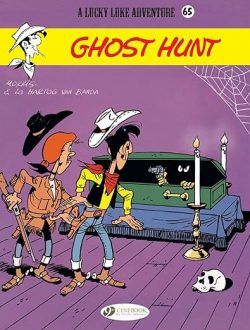
Lucky Luke volume 65: Ghost Hunt


By Morris & Lo Hartog van Banda, coloured by Studio Leonardo, translated by Jerome Saincantin (Cinebook)
ISBN: 978-1-84918-353-6 (Album PB/Digital edition)

This book includes Discriminatory Content produced in less enlightened times. This book also includes Discriminatory Content added for comedic effect.

Lucky Luke was created in 1946 by Belgian animator, illustrator and cartoonist Maurice de Bévère (AKA “Morris”), riding out in Le Journal de Spirou that summer sans title or banner, and only in the French-language edition. His official launch came in Christmas Annual L’Almanach Spirou 1947, before beginning his first official serial – ‘Arizona 1880’ – in December 7th 1946’s multinational weekly issue.

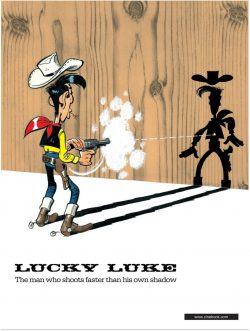
Doughty, dashing, dependable cowboy “good guy” Lucky is a rangy, implacably even-tempered do-gooder able to “draw faster than his own shadow”. He amiably ambles around the mythic Old West, having light-hearted adventures on his petulant and rather sarcastic wonder-horse Jolly Jumper. Over nine decades, his exploits have made him a top-ranking global comic character, filling nearly 90 individual albums and spin-off series like Kid Lucky and Ran-Tan-Plan, with sales upwards of 300 million copies in 30 languages. That renown translated into a mountain of merchandise, toys, games, animated cartoons, TV shows and live-action movies and even commemorative exhibitions. No theme park yet, but you never know…

Lucky global dominance resulted from a decades-long, 45 volume collaboration with superstar scripter René Goscinny (spanning Des rails sur la Prairie/Rails on the Prairie beginning August 25th 1955 to La Ballade des Dalton et autres histoires/The Ballad Of The Daltons And Other Stories in 1986). On Goscinny’s death, Morris worked alone again and with others, founding a posse of legacy creators including Achdé & Laurent Gerra, Benacquista & Pennac, Xavier Fauche, Jean Léturgie, Jacques Pessis and more, all taking their own shots at the venerable vigilante.

Morris soldiered on singly and with these successors before his own passing in 2001, having drawn fully 70 adventures, plus numerous sidebar and spin-off sagebrush sagas. The first of his new pardners was a fellow low-lander and comics legend: Lo Hartog van Banda (De Wonderlijke Lamp van Professor Halowits, Iris, Arman en Ilva, Student Tijloos – Het Spiegelpaleis). He was a prolific long-lived Dutch comics scripter and screenwriter who co-created today’s tombstone tome as well as Lucky Luke Fingers & Nitroglycerine.

Our taciturn trailblazer draws on western history as much as movie mythology, regularly meeting historical and legendary figures as well as even odder fictional folk in tales drawn from key themes of classic cowboy films – as well as some uniquely European notions and interpretations. As previously hinted, the sagebrush star is not averse to being a figure of political change and Weapon of Mass Satire…

Cinebook’s 65th Lucky Luke album was officially the frontier phenomenon’s 61st European exploit, originally seen au continent in 1992 as Chasse aux fantômes. Visualised with verve by veterans Morris & van Banda it offers a guest-packed jaunty haunty jamboree blessed by the return of an extremely popular guest star…

Once again urgently requested by the Wells, Fargo & Co. Transportation Company, Lucky is luckily on hand and (barely) able to stop a human whirlwind wrecking the head office. His appointment is interrupted by an old friend as Calamity Jane storms in demanding they hand over the brand-new Winchester rifle she mail-ordered. Her brand of customer complaint almost costs lives until Luke calms her down and she discovers her problem is also his problem…

What the boss wants no one to know is that their last stage coach vanished en route, as did everyone on it, and they need a capable troubleshooter to solve the mystery. The company and national commerce are at stake, but Lucky hasn’t been told everything…

Next day – with Jolly Jumper harnessed up and disguised as a coach horse – Lucky steers the stage coach out, pondering on those passengers who have ignored ghastly rumours of kidnappers and griping of the many drivers who have suddenly called in sick…

These bold voyagers comprise young lady Melanie and her maiden aunt, pompous widow Mrs Burdonck, an inept and officious State Senator and an extremely poorly disguised, ugly old bird with the mouth of a drunken sailor on shore leave who still wants her new Winchester and don’t trust nobody to find it for her.
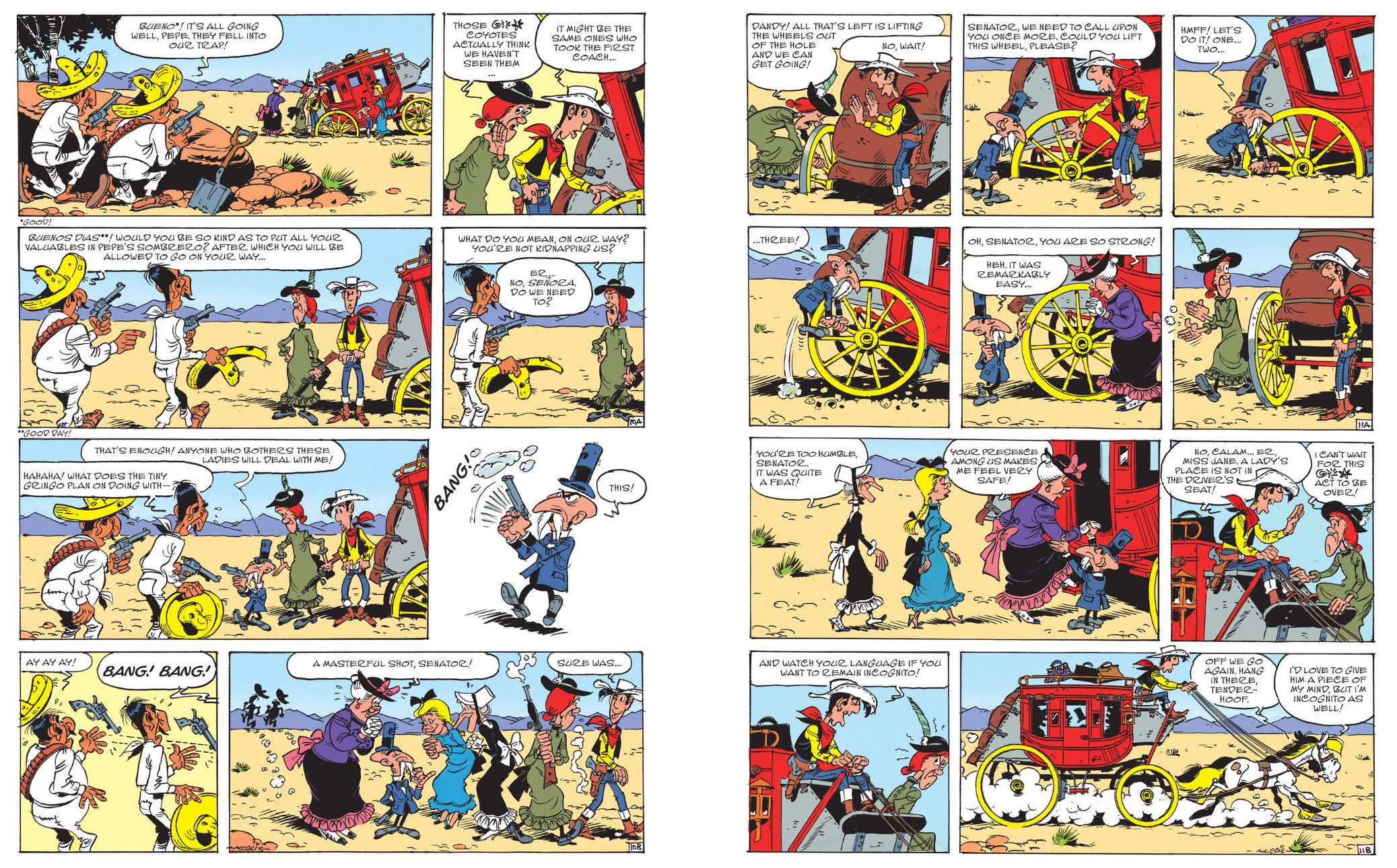
Following a number of failed robbery attempts – foiled by Lucky and the mean-mouthed old lady with the gun in her parasol – the coach arrives at the first staging post where Luke and Martha Jane Cannary compare notes. The Senator is clearly up to something as he’s ordered a change of route, but the largest part of the mystery is solved for them: explained by the station manager/bartender who reveals that the previous travellers were taken by a marauding spirit. The region of Phantom Valley is now an Indian reservation and Apache territory, but once upon a time the town of Doom was the home to hundreds of gold miners until the seam ran out. It was run by an awful creature: a bloodthirsty murdering harridan who killed or drove out everyone before dying in a gunfight and cursing the whole place with her last breath. Her name was Calamity Jane…
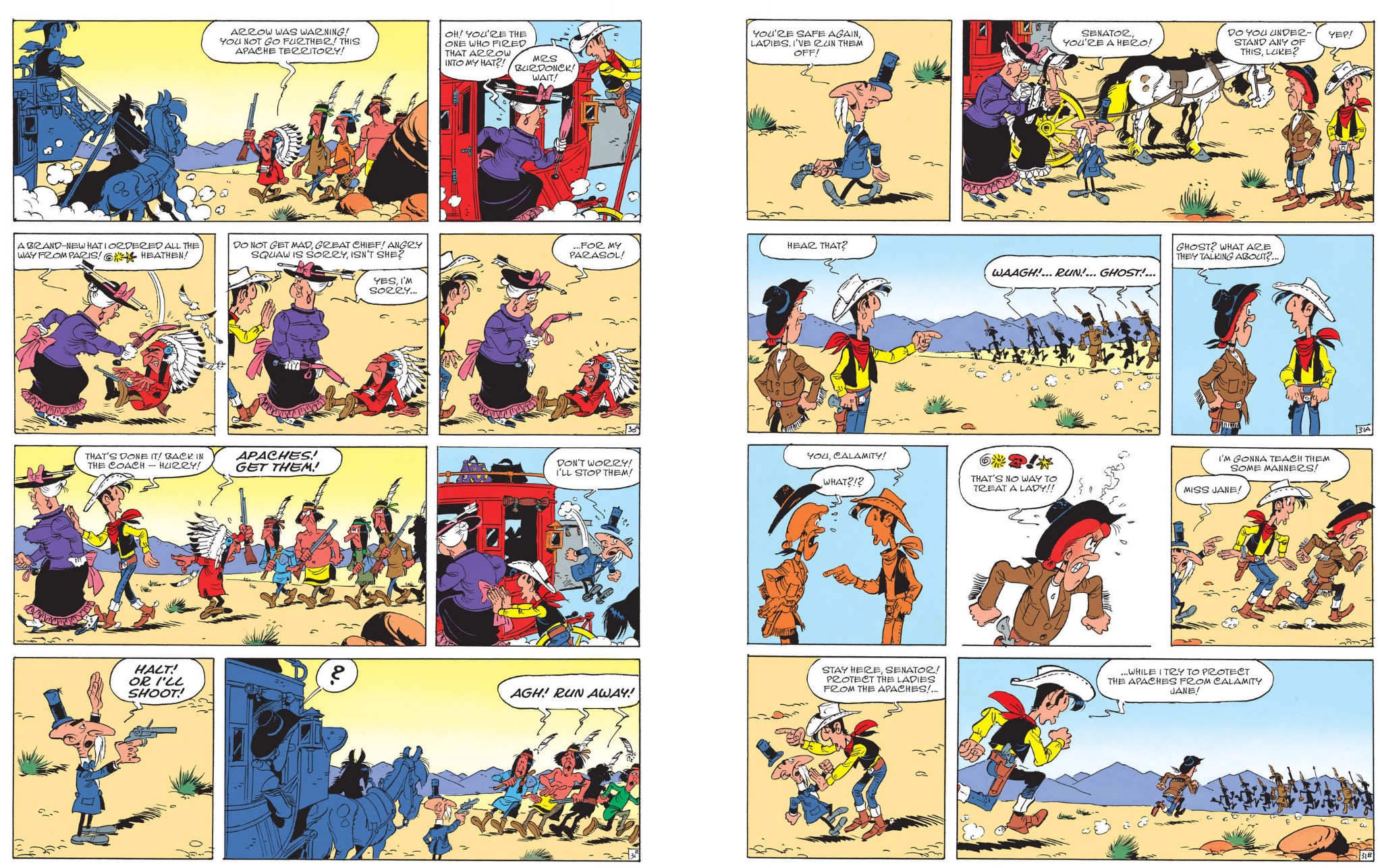
Before one passenger can (over)react the story is interrupted by a demonic coach roaring by and everyone can see it is being driven by that very spook; which is a big surprise to Luke and the baffled angry old coot beside him…

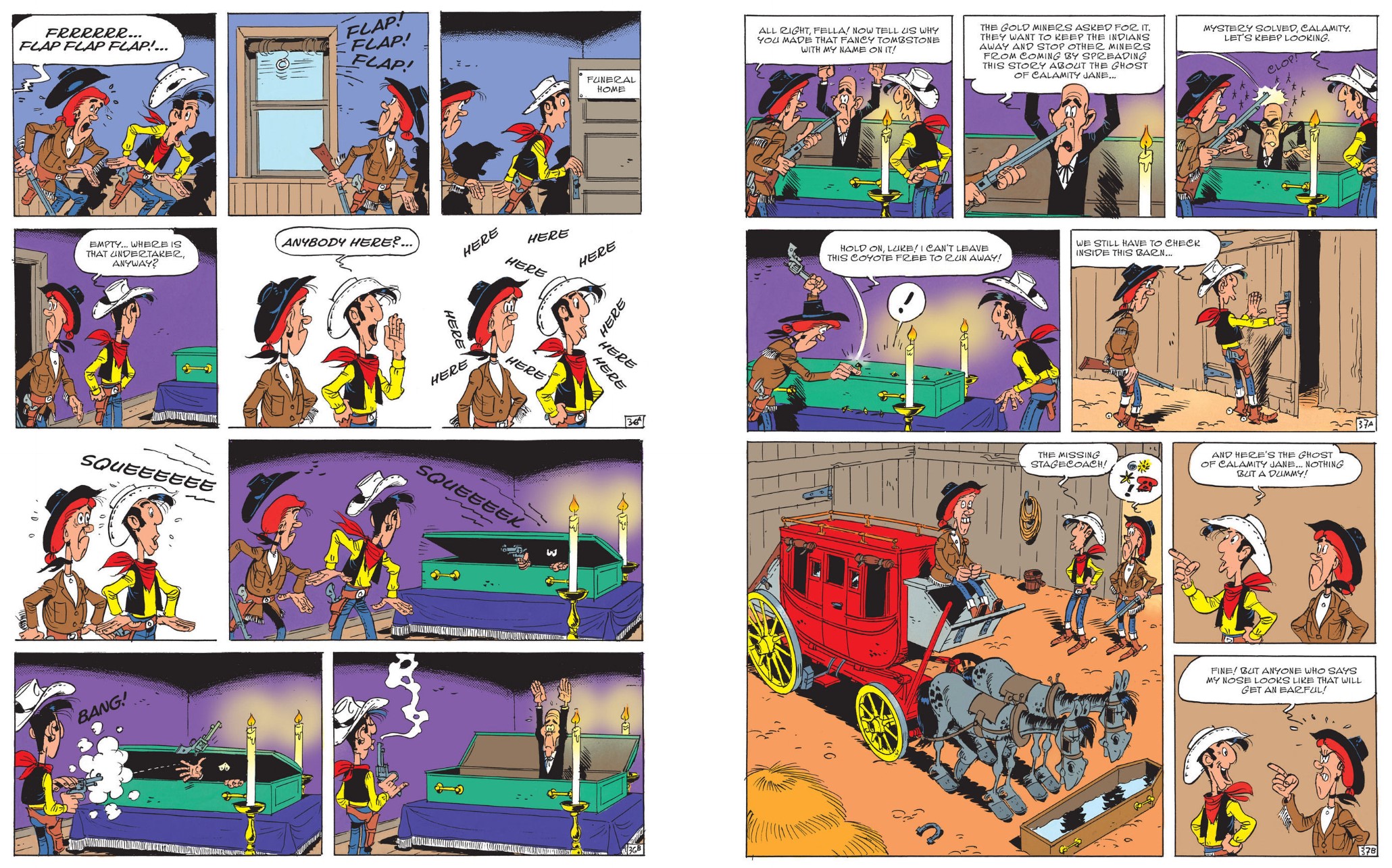
With the scene set, Luke, Jane, Jolly Jumper and the rest are reduced to a western Scooby Gang tracking the impossible carriage against impossible odds to expose the rational explanation for the sinister escapades and rescue the abducted hostages to (a golden) fortune…
Fast-paced, funny and thrillingly fulfilling, this is a gloriously riotous romp every fan and casual reader can enjoy and should. These youthful forays of an indomitable hero offer grand joys in the wry tradition of Destry Rides Again and Support Your Local Sheriff (but absolutely not the 1953 Calamity Jane flick with Doris Day!!), superbly executed by master storytellers and a wonderful introduction to this unique genre for today’s kids who might well have missed the romantic allure of the Wild West that never was…
© Dargaud Editeur Paris 1992 by Morris and Lo Hartog van Banda. © Lucky Comics. English translation © 2017 Cinebook Ltd.

Today in 1921 mythic American Good Guy Bill Mauldin was born. Check out Willie and Joe: The WWII Years to learn how that’s actually an understatement.

In 1959 French comics landmark Pilote first went on sale, coincidentally marking the official launch of Asterix & Obelix, whilst in 1999, Belgian comics legend Greg (Michel Regnier) died. His best stuff isn’t available in English but you could go enjoy Spirou & Fantasio volume 21: The Prisoner of the Buddha.
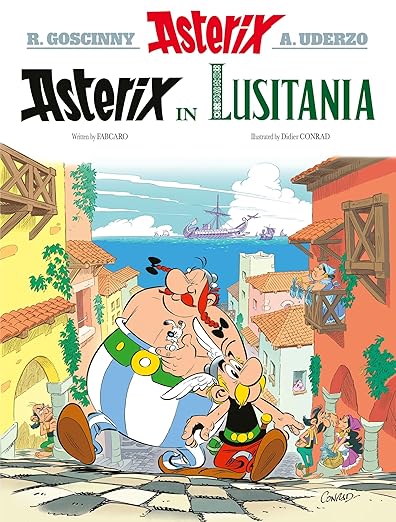
Asterix in Lusitania (Asterix volume 41)


By Fabcaro & Didier Conrad, coloured by Thierry Mébarki, translated by Adriana Hunter (Sphere)
ISBN: 978-1-4087-2499-6 (Album HB) 978-1-4087-2502-3 (Album TPB)  eISBN: 978-1-4087-2501-6

Win’s Christmas Gift Recommendation: Celebrate a Simmering Saturnalia in Classical Style… 9/10

Astérix le Gaulois debuted in 1959 and has since become part of the fabric of French life. His exploits have touched billions of people around the world ever since, and for almost all of that time his astounding adventures were the sole preserve of originators René Goscinny & Albert Uderzo.

After nearly 15 years dissemination as weekly serials (subsequently collected into book-length compilations), in 1974 21st saga Asterix and Caesar’s Gift was the first to be released as a complete, original album prior to serialisation. Thereafter each new tome was an eagerly anticipated, impatiently awaited treat for legions of devotees. The eager anxiety hasn’t diminished even now as Astérix en Lusitanie sees physicist/novelist/musician Fabrice Caro – AKA comics writer “Fabcaro” (Like a Steak Machine, Les Marseillais, Mars) rejoin in situ illustrator Didier Conrad (Les Innomables, Tatum), for a spot of traditional European travel fun in the grand manner.

Although divided by its Roman conquerors into provinces Celtica, Aquitania and Armorica, the very tip of the last-named land stubbornly refuses to be properly pacified. The otherwise supreme overlords, utterly unable to overrun this last little bastion of Gallic insouciance, are reduced to a pointless policy of absolute containment – even though the irksome Gauls come and go as they please. Thus, a tiny seaside hamlet is permanently hemmed in by heavily fortified garrisons Totorum, Aquarium, Laudanum and Compendium: packed with seasoned and terrified soldiers who would rather be anywhere else on earth than there…

Those supposedly contained couldn’t care less: daily defying and frustrating the world’s greatest military machine by going about their everyday affairs, bolstered by magic potion brewed by resident druid Getafix and the shrewd wits and strategic aplomb of diminutive dynamo Asterix and the stopping power of his simplistic, supercharged best pal Obelix

As always, action, suspense and comedy are very much in evidence. There’s much satirical lampooning of generation gaps, fads and trends as well as traditional regional/national leitmotifs. Whether as a comedic romp with sneaky, bullying baddies getting their just deserts or as a sly and wicked satire for older-if-no-wiser heads, these new yarns are just as engrossing as the established canon.

As you already know, half of the intoxicating epics take place in various exotic locales throughout the Ancient World, whilst the alternatives are set in and around Uderzo’s adored Brittany of long, long ago. This one’s another voyage away as we find it’s spring in 50 BC. It is always 50 BC…

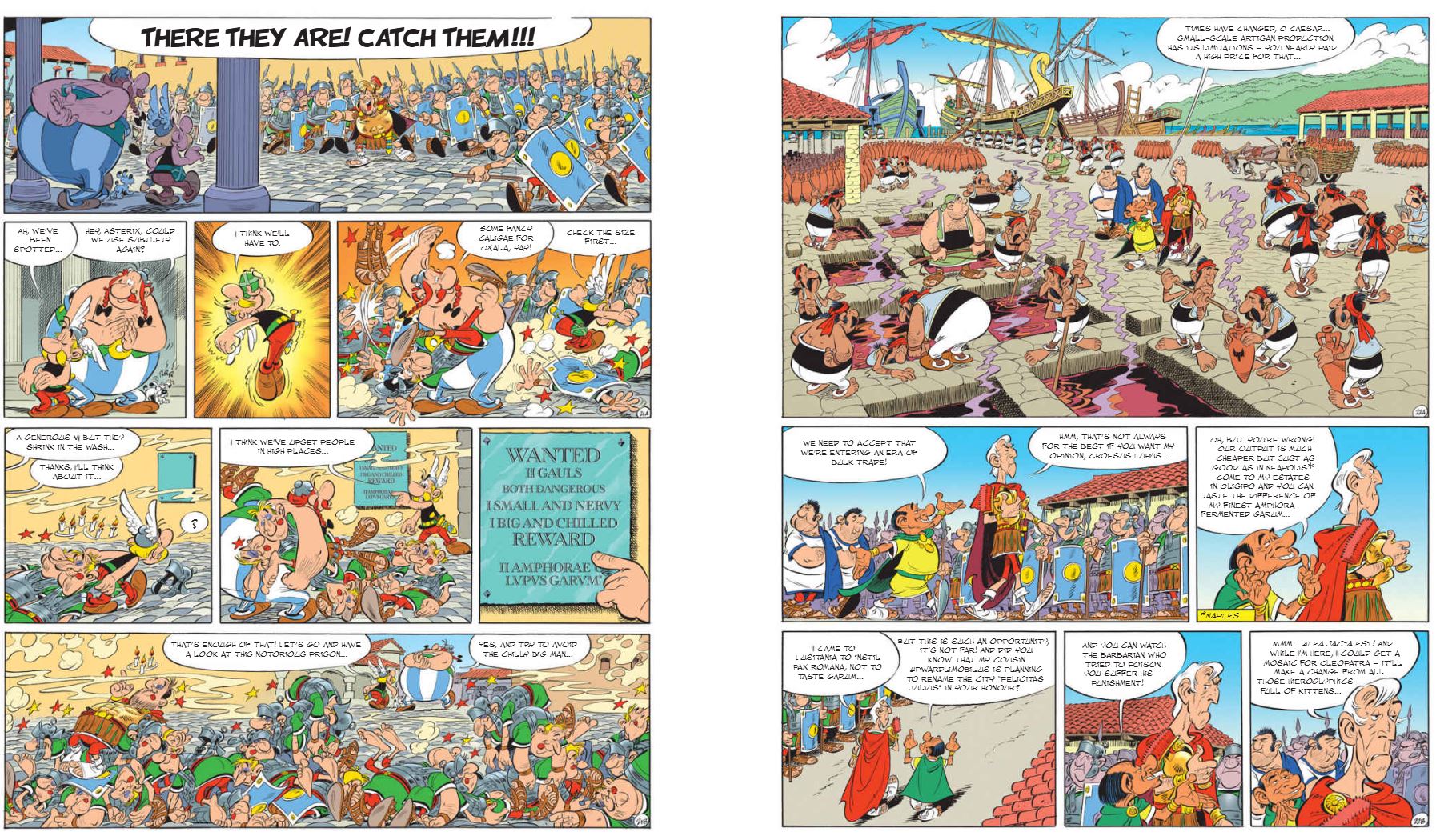
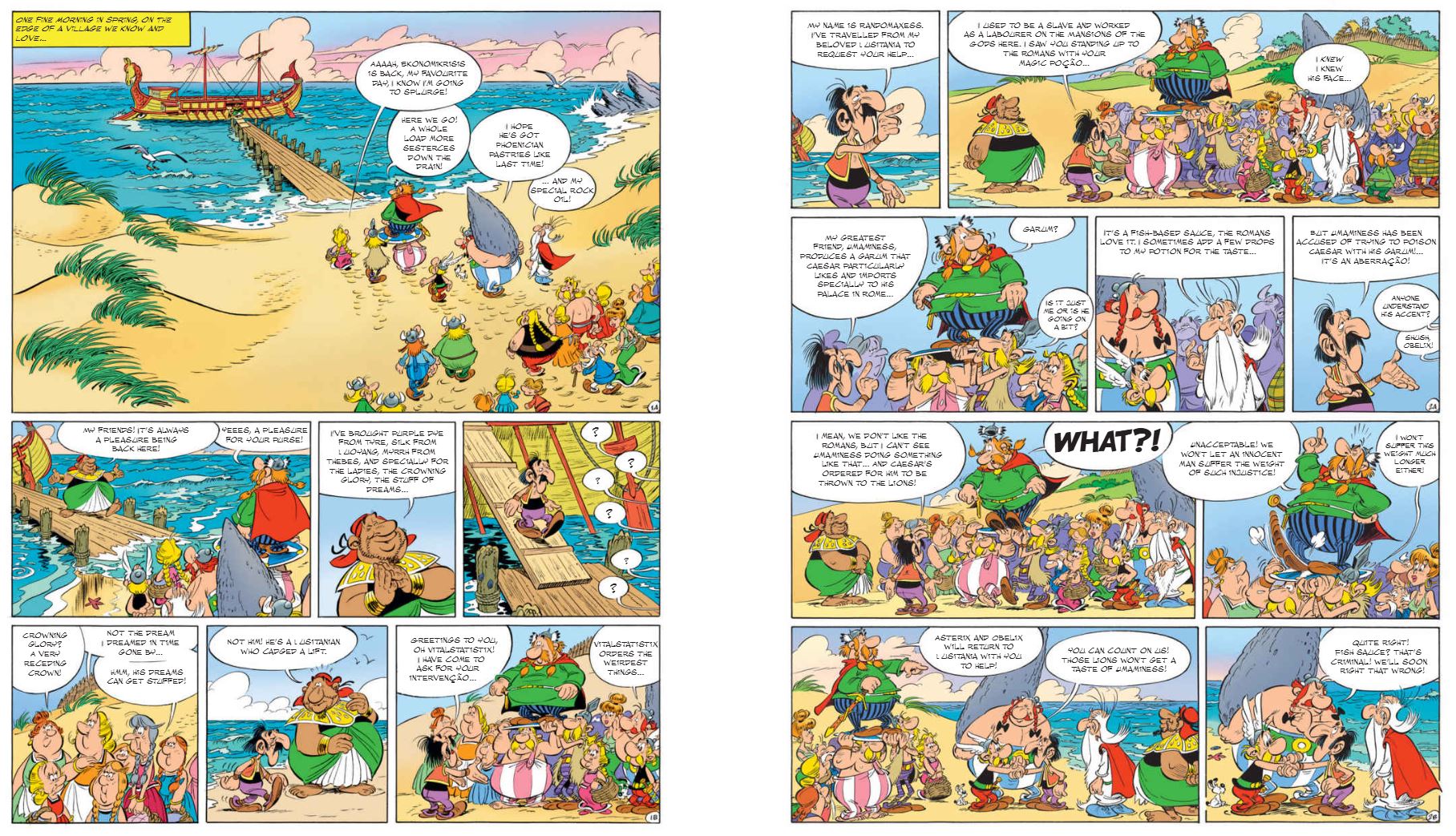
When Phoenician trader Ekonomikrisis arrives with his fabulous sea-borne wares, he also brings an old friend not seen since the affair of The Mansion of the Gods please link to Omnibus 6: Asterix in Switzerland, The Mansions of the Gods, Asterix & the Laurel Wreath April 25th 2019. However, weary Lusitanian Randomaxess is not here for a chinwag about old times. Rather, he’s on a mission of mercy due to his keen understanding of Gaulish adventure-seeking and taste for justice. His tale of skulduggery in the billion-sesterce fish sauce market is just what bored heroes want to hear…

The entire Roman empire runs on savoury additive Garum, and the big suppliers are playing dirty now that Caesar has expressed his personal love of a small, artisanal brand made with love in very small quantities by Randomacess’ dear pal Umaminess. Now, that humble sauce-meister is condemned to be main course for the lions after being accused of poisoning the emperor with his favourite condiment…

As with so many of these yarns, the real proof of the pudding is the villains. In in this case that’s nasty 1-per-center Croesus Lupus – who wants a total monopoly for his cheap ‘n’ nasty mass-produced, Lupus Garum® and his cousin the Lusitanian Governor. Upwardlimobilus wants to be Caesar…

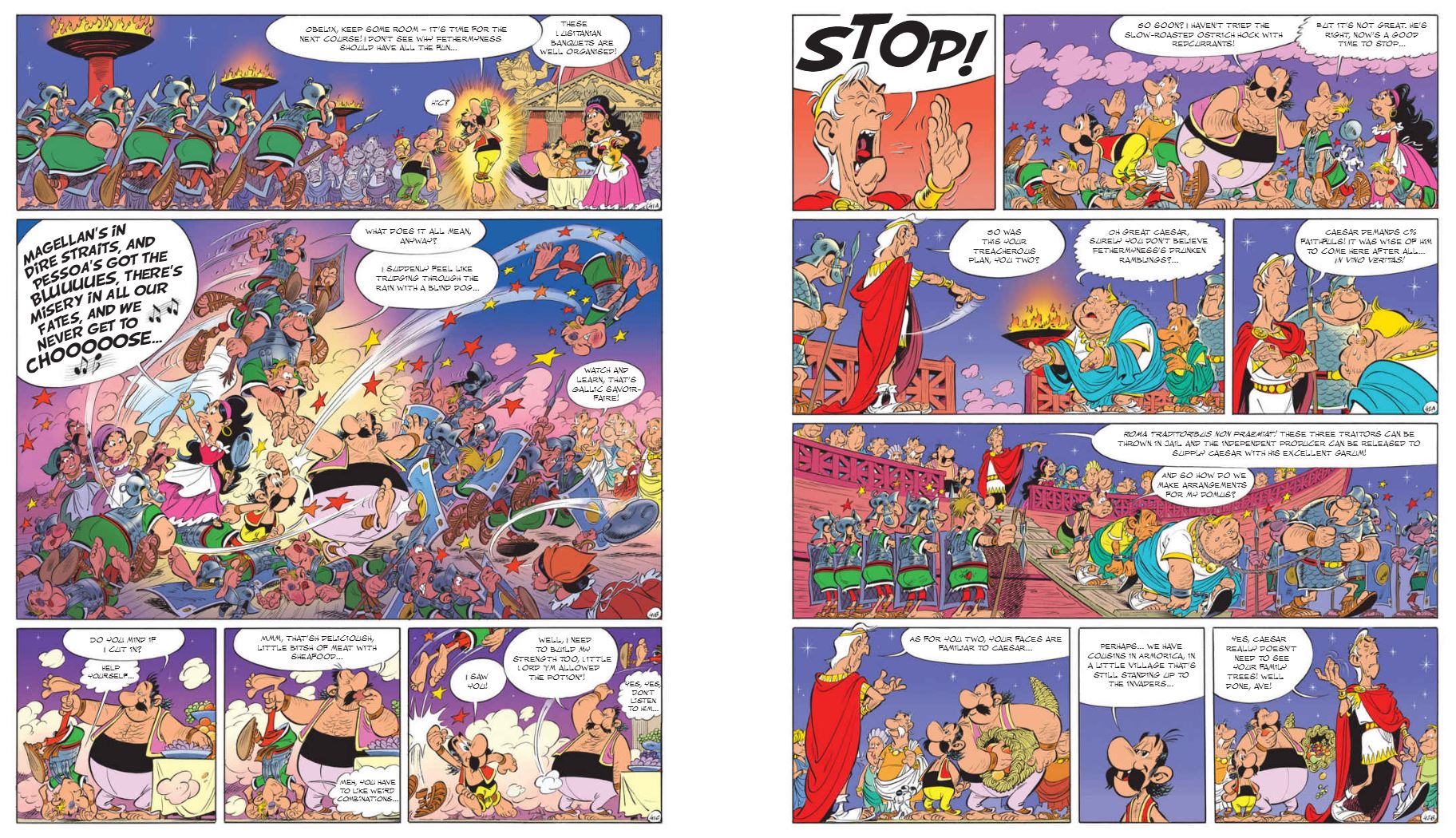
They cunningly employed professional traitor Fethermyness to arrange the culinary stitch-up and are already parcelling up the empire between their fellow disastrous capitalists, but never reckoned on the flavour-wizard having such dedicated friends. After all, there’s no profit in loyalty or friendship…

Mere days later, Asterix, Obelix & canny canine Dogmatix are wide-eyed, irretrievably provincial tourists again, having gone through all the rituals: pirates, food Obelix doesn’t like, shared folk-tales of old heroes and more. The big man never stops griping about the local food (nothing but cod!), but the wines are great and so are the towns and villas. Any lingering semblance of reluctance fades once he meets captive Umaminess’ delightful daughter Oxala...

With heaping helpings of sharp gags about the imaginatively dour, passionately fatalistic Lusitanians (aka Portuguese) and their poetic tongue winningly interspersed with a boatload of fresh Latin jests and grammatical tomfoolery, this is very much an old fashioned funny travelogue. As our heroes track down the taste-maker, they meet many odd folk and befriend a garrulous population always happy to take a pop at the uninvited Roman guests. Particularly useful is prison cook Bouillabess, who is delighted to spite his Roman employers…

Along the way the Gauls consider revolutions and organised labour, take a hard look at marketing and explore focus groups, but never miss an opportunity to sample the mettle of the local soldiery…

Impressionable Obelix may be distracted by trying to impress delicious Oxala, but does not falter or stir, even after having to embracing the dark side of the mission by going undercover and in disguise to expose the Governor’s plot. The job was always going to be tough, but everything goes well south when man-of-action Julius Caesar opts to personally investigate his attempted murder, culminating in a spectacular revelatory conclusion as Caesar’s state power smashes face-first into unchecked adventure capitalism during a do-or-die (possibly both) ceremonial banquet…

Thankfully, old adage in vino veritas** proves as potent as Getafix’s magic potion and all secrets are inescapably revealed, leading to a great deal of feasting, both at home and away with tasty happy endings all around…

With scathing pops at billionaire malfeasance, overstepping, rules for ruling, what you CAN’T buy, literary lunacy and ongoing challenges to AI, computer and culinary culture, Asterix in Lusitania is a fabulous look back and step forward dedicated devotees and fresh fans can share together, and another triumphant addition to the mythic canon for laugh-seekers of every age in every age.
© 2025 HACHETTE LIVRE/GOSCINNY-UDERZO. English translation: © 2025 HACHETTE LIVRE/GOSCINNY-UDERZO

** In wine there is truth. You should absolutely read more old books after you get this through this new one, OK?

Today’s a grand day for cats in comics. In 1913 George Herriman’s Krazy Kat first appeared as an independent strip. We think you might enjoy purr-rusing Krazy & Ignatz 1916-1918: The George Herriman Library volume 1, whilst in 1983 Felix the Cat cartoonist Otto Mesmer died. Oddly, other than Nine Lives to Live – A Classic Felix Celebration there’s remarkably little available on what was once a true global phenomenon…

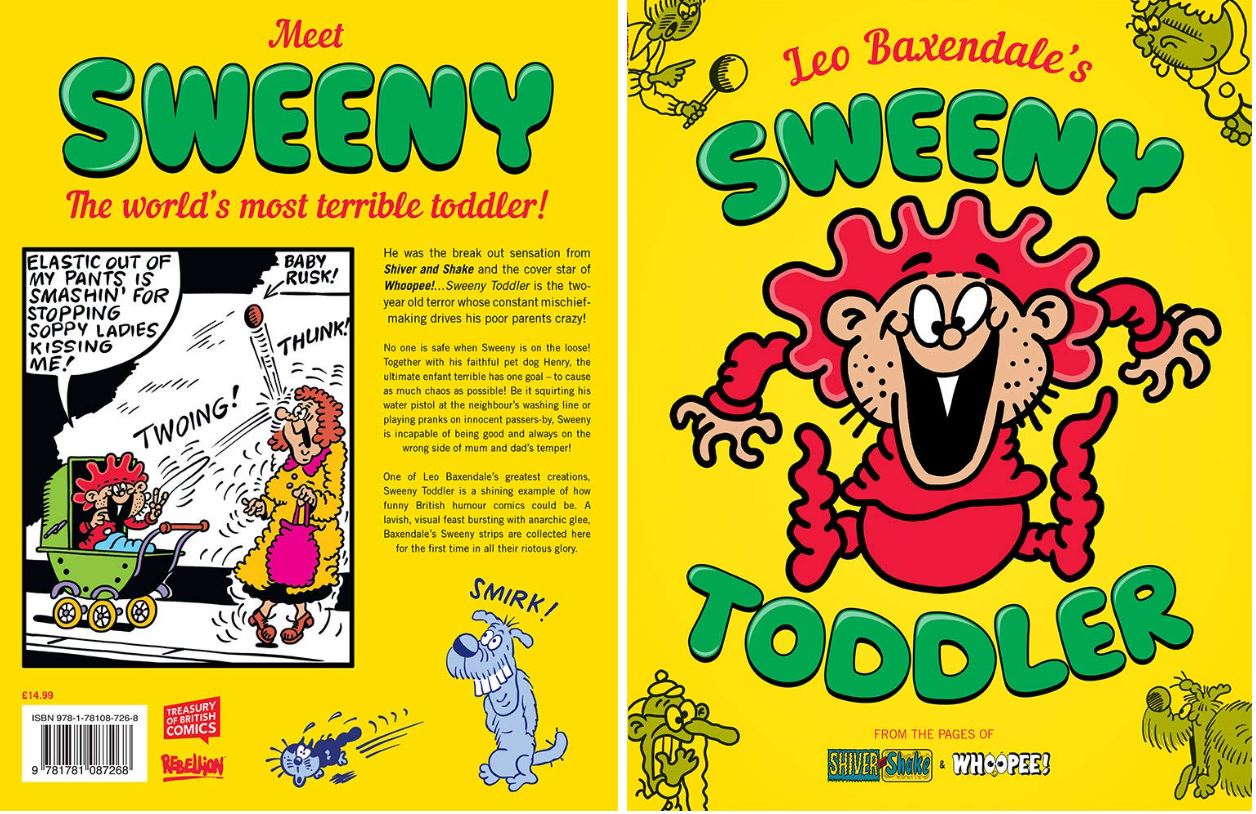
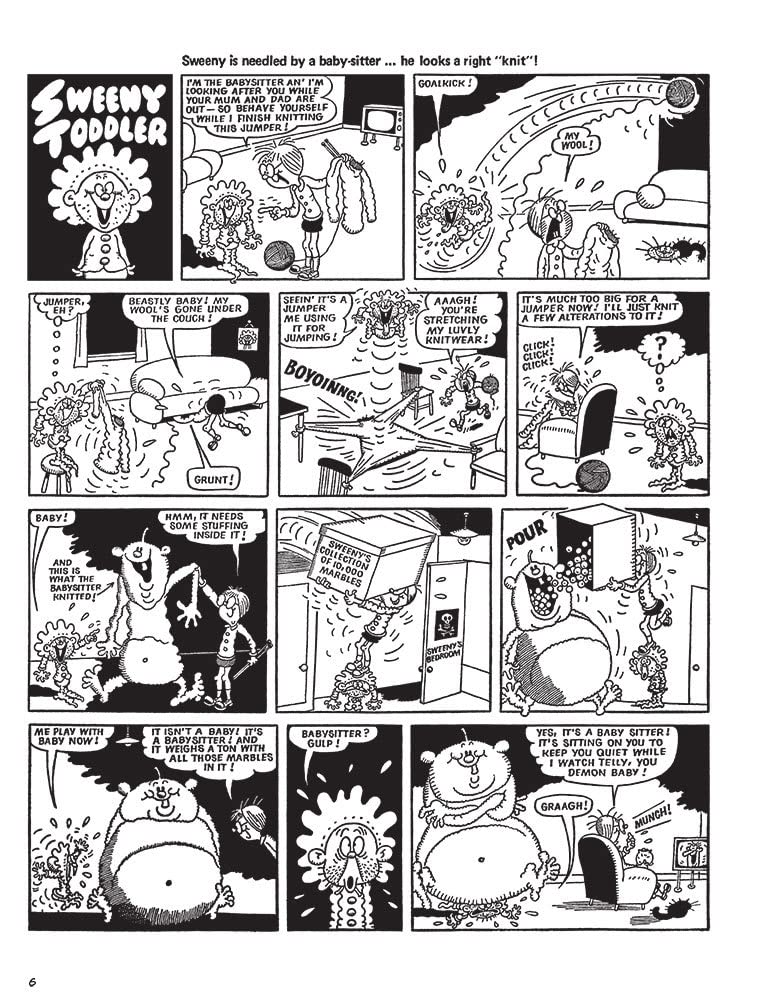
Leo Baxendale’s Sweeny Toddler


By Leo Baxendale & others (Rebellion Studios)
ISBN: 978-1-78108-726-8 (HB/Digital edition)

This book includes Discriminatory Content produced in less enlightened times.

Win’s Christmas Gift Recommendation: Utterly Bonkers, Inspired Lunacy… 10/10

If you know British Comics, you know Leo Baxendale.

Long ago and still right now, Baxendale (27th October 1930 – 23rd April 2017) was the epitome of rebellious, youth-oriented artistic prodigies who, largely unsung but definitely much noticed, went about seditiously transforming British Comics: entertaining millions and inspiring uncounted numbers of those readers to become cartoonists too.

Joseph Leo Baxendale was educated at Preston Catholic College, served in the RAF and was born on 27th, October 1930, in Whittle-le-Woods, Lancashire – but not necessarily in that order. Like Spike Milligan and so many brilliant others, his response to privation, injustice, war and the post war era was being funny in an absurd way. If you’re quick, you can track down some of his stuff – of which far too little has been archivally published – and celebrate his 95th anniversary in an appropriate manner.

Baxendale’s first paid artistic efforts were drawing ads and cartoons for The Lancashire Evening Post but his life – and the entire British comics scene – changed in 1952 when he began freelancing for DC Thomson’s top weekly The Beano. He assumed creative control of moribund Lord Snooty and his Pals and originated anarchically surreal strips Little Plum, Minnie the Minx, The Three Bears and When the Bell Rings. That last strip then rapidly metamorphosed into legendary, lurgy-packed anarchic icon The Bash Street Kids, thereby altering the daily realities and lifetime sensibilities of millions of readers and generations of kids.

Baxendale also contributed heavily to the creation of comics tabloid The Beezer in 1956 but, following editorial and financial disputes with his editors, migrated in 1962 to London-based, Harmsworth-owned conglomerate Odhams/Fleetway/IPC. South of the border, his initial humorous creations included Grimly Feendish, General Nitt and his Barmy Army, Bad Penny and a horrid horde of similarly revoltingly, uncannily engaging oiks, yobs and weirdoes who cumulatively made the company’s “Power Comics” experiment such a joy to behold.

During the 1970s he devised more remarkable cartoon star turns which, whilst not perhaps as seditiously groundbreaking as Plum, Minnie, or The Bash Street Kids, nor as subversively enticing as Wham, Smash and Pow creations such as Eagle Eye, Junior Spy, The Swots and the Blots and The Tiddlers (or indeed, as garishly outlandish as George’s Germs or Sam’s Spook), remained part of the nation’s junior landscape for decades after.

The main body of his later creations appeared in mighty anthology Buster: features such as The Cave Kids, Big Chief Pow Wow, Clever Dick and Snooper. Baxendale latterly foisted Willy the Kid upon the world before creating his own publishing imprint Reaper Books.

He also sued DCT for rights to his innovative inky inventions: a 7-year struggle that was eventually settled out of court. Other notable graphic landmarks include pantomimic vision THRRP!, his biography A Very Funny Business: 40 Years of Comics and the strip I Love You, Baby Basil which ran in The Guardian during the early 1990s.

Signature stinker Sweeny Toddler debuted in Shiver and Shake in 1973, unsurprisingly surviving repeated mergers – with Whoopee! and Whizzer and Chips – before settling in at the seemingly unsinkable Buster.

This stunning hardback (and eBook) celebration – hopefully the first of many gathering the entire run and Baxendale’s IPC/Fleetway oeuvre – is another crucial addition to Rebellion’s ever-expanding Treasury of British Comics. It gathers the episodes from Shiver and Shake spanning March 10th 1973 to 5th October 1974, plus the first nappy-load from Whoopee!, from 23rd November 1974 until 7th June 1975.

The potent package is suitably accompanied by an appreciative, informative and responsible Introduction by his son Martin (who drew the Bad Boy’s adventures after Baxendale senior moved into publishing) and offers a magnificent exercise in manic misrule starring the absolute worst baby in the world… outside of a democratically elected government.

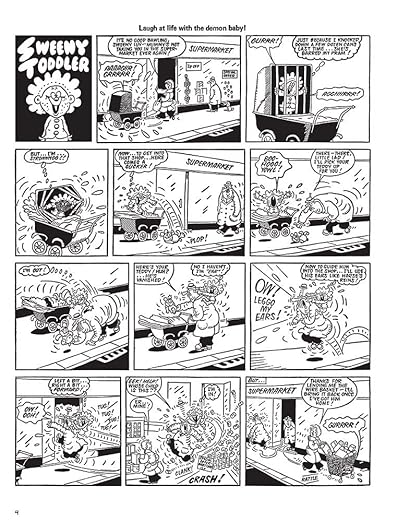
In a simple terrace house with the legend “Tremble wiv fear, Sweeny livs here” scrawled all over it, lives a spotty (occasionally be-stubbled) mono-fanged tyke who is disturbingly fast and strong with a physiognomy that can sour milk. He is precociously able to read – after a fashion – and that, coupled with a lethally low tolerance for boredom and obedience, means the nasty nipper always finds new and distressing ways to amuse himself at someone else’s expense…

With or without faithful dog and eager abettor Hairy Henry, Sweeny turns every pram ride into a pulse-pounding rollercoaster adventure for his poor benighted mum and grandad; every visit to park, shop or museum into a heart-stopping chase and every cuddlesome interlude with ill-advised adults into an exhausting episode in psychological and physical torture.

At least six strips re-presented here are not by Baxendale, but record-keeping is sadly incomplete. Chances are they’re drawn by Tom Paterson, who eventually took over the feature (or possibly Roy Nixon?) but they are all deliciously weird and wonderful: a blend of unbeatable whacky wordplay, explosive slapstick and bizarre situations, garnished by Baxendale’s unique and evocative sound effects: once read, never forgotten…

Briefly retitled Help! It’s Sweeny Toddler in experimental pages that feature second stories starring monstrous beasts living in the borders and margins of the panel dividers, later episodes never lost the eccentric impetus of the first, with the baby from hell, as ever, mugging old ladies, postmen, schoolboys and other unwary visitors; creating his own zoo, attempting to sneak into X films (maybe get granddad to explain those?) and totally tormenting anyone who treats him like a child…

As well as straight strips, this collection also offers ‘Sweeny Toddler’s Beat the Bully Guide’ and graphic game ‘Sweeny Toddler’s Fifty Frightful Faces!’, proving the vile versatility of the manky mite.

Leo Baxendale was one-of-a-kind: a hugely influential, much-imitated master of pictorial comedy and noxious gross-out escapades whose work deeply affected (some would say warped) generations of British and Commonwealth kids. We’ll not see his like again, but these astoundingly engrossing comedy classics are a perfect example of his resolutely British humorous sensibilities – absurdly anarchic, explosively whimsical, outrageously aggressive, crazily confrontational and gleefully grotesque – starring an unremittingly rebellious force of nature with no impulse control.

Sweeny Toddler says and does whatever he wants as soon as he thinks of it, albeit usually to his own detriment and great regret: a rare gift, usually only employed by madmen and foreign Presidents.

These cartoon capers are amongst the most memorable and re-readable exploits in all UK comics history: smart, eternal, existentially funny and immaculately rendered. This a treasure-trove of laughs that spans generations and must be in every family bookcase.
© 1973, 1974, 1975 & 2019 Rebellion Publishing Ltd. Sweeny Toddler is ™ & © Rebellion Publishing Ltd. All Rights Reserved.

Today in 1920 artistic icon Nicholas Vicardi AKA Nick Cardy was born. We last admired his mastery in DC Finest: Aquaman – The King of Atlantis.

In 1935 today, cartoon pioneer Sidney Smith died way too soon. You would already know that if you’d listened and looked up Sidney Smith’s The Gumps like we told you to last week.

In 1993 unsung legend Gaylord Dubois died. He wrote and edited dozens of key features, supplying thousands of stories to comics legends. We are particularly partial to Edgar Rice Burroughs’ Tarzan: The Jesse Marsh Years Omnibus volume two.

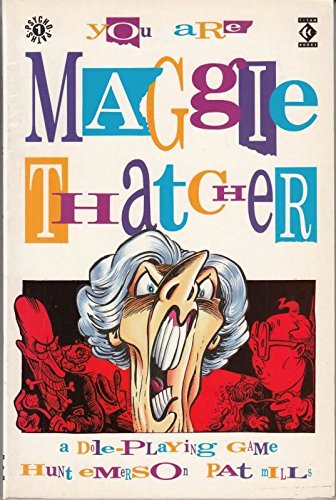
You Are Maggie Thatcher: A Dole-Playing Game


By Pat Mills & Hunt Emerson (Titan Books)
ISBN: 978-1-85286-011-0 (TPB)

This book includes Discriminatory Content produced in less enlightened times, and for comedic and satirical effect.

With the recent anniversary hagiographic whitewashing of “the Greatest Prime Minister we’ve ever had”, fond reminiscences of those truly grim times and policies by the still-privileged and renewed assaults on the poor and unwelcome in Britain, why don’t we proles also indulge in bit of comforting nostalgia for the good old days?

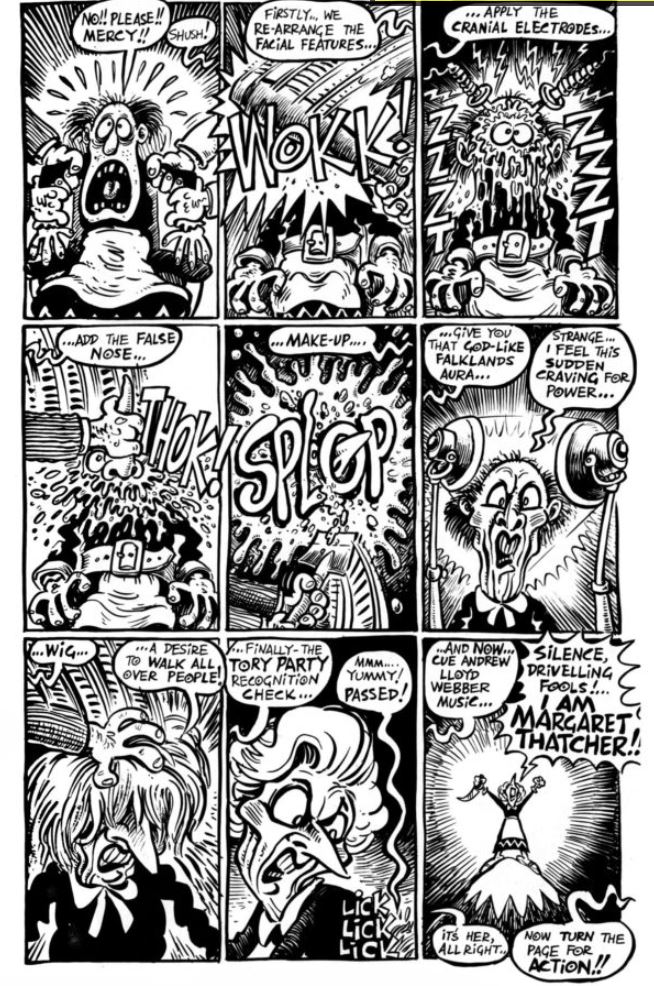
The most successful comic strips depend more on the right villain than any hero or combination of protagonists, so this quirky oddment was better placed than most for success. Created by British comics legends Pat Mills & Hunt Emerson at a time when our industry was at its most politically active, this strident, polemical satire put the proletarian boot in on the appalling tactics and philosophies of the third term Thatcher government with savagely hilarious art and stunningly biting writing.

Illo 1 here please


The concept is simple now but groundbreaking in 1987. The reader is to be Prime Minister Maggie who, by reading sections of the book and selecting a choice of action at the end of each chapter is directed to another page to experience the ramifications of that decision. The objective is to win another election (ah the wonderful irony!) and the method is to make only vote-winning decisions – hence the multiple-choice page-endings. The intention is not to win the game, obviously. What kind of monster are you?!

This powerful piece of graphic propaganda may have dated on some levels but the home truths are still as pertinent. Even as Maggie and her demented pack of lap-dogs wriggled and squirmed on Mills & Emerson’s pen-points, their legacy of personal gain was supplanting both personal and communal responsibility to become the new norm. More than ever, today’s Britain is their fault and this still readily available book reminds us of a struggle too few joined and a fight we should have won, but didn’t.

It’s still really, really funny too.
Text and concept © 1987 Pat Mills. Illustrations © 1987 Hunt Emerson. All Rights Reserved.

Today in 1969 anarchic weekly British treasure trove Whizzer and Chips began its three-decade rampage of fun. You could get a flavour of it all (mostly toffees, liniment, perished rubber and sweaty feet) by seeing Whizzer and Chips Annual 1979.

In 1973 cartoonist Walt Kelly finally had enough of our petulant crap and passed over. You can pay your respects at Pogo – The Complete Syndicated Comic Strips volume 3: Evidence to the Contrary

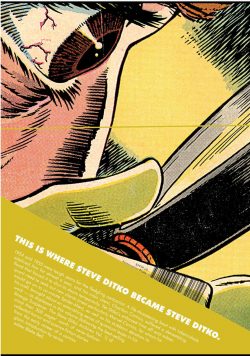
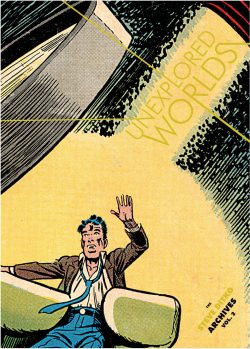
Steve Ditko Archives volume 2: Unexplored Worlds


By Steve Ditko, Joe Gill & various, edited by Blake Bell (Fantagraphics Books)
ISBN: 978-1-60699-289-0 (HB/Digital edition)

Win’s Christmas Gift Recommendation: Immaculate Yarn-Spinning… 9/10

This book includes Discriminatory Content produced in less enlightened times. It also has Discriminatory Content included for comedic and satirical effect.

Once upon a time the anthological title of short stand-alone stories was the sole staple of the comicbook profession, where the plan was to deliver as much variety as possible to the reader. Sadly, that particular vehicle of expression seems all but lost to us today…

Despite his death Steve Ditko remains one of our industry’s greatest talents and one of America’s least lauded. His fervent desire to just get on with his job and to tell stories the best way he can – whilst the noblest of aspirations – had always been a minor consideration or even stumbling block for the commercial interests which for so long controlled all comics production and still exert an overwhelming influence upon the mainstream bulk of comic book output. Before his time at Marvel, young Ditko perfected his craft creating short sharp yarns for a variety of companies and it’s an undeniable joy today to be able to look at this work from such an innocent time when he was just breaking into the industry: tirelessly honing his craft with genre tales for whichever publisher would have him, utterly free from the interference of intrusive editors.

A superb full-colour series of hardback collections reprinted those early efforts (all of them here are from 1956-1957) with material produced after the draconian, self-inflicted Comics Code Authority sanitised the industry following Senate Hearings and a public witch-hunt.

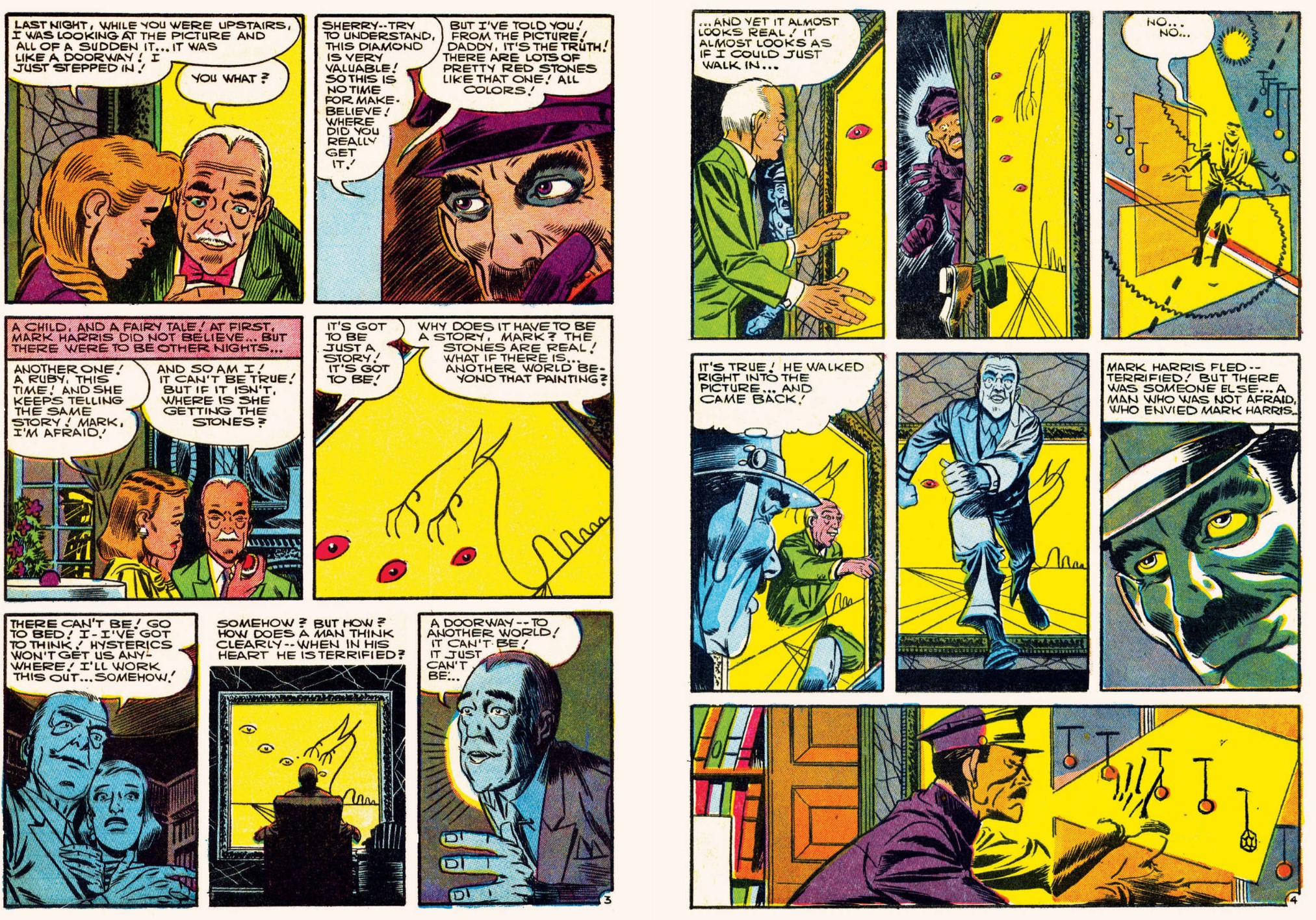
Most are wonderfully baroque bizarre supernatural or science fantasy stories, but there are also examples of Westerns, Crime and Humour: cunningly presented in the order he completed and sold them rather than the more logical but far-less-revealing chronological release dates. Moreover, they’re all helpfully annotated with a purchase number to indicate approximately when they were actually drawn – even the brace of tales done for Stan Lee’s pre-Marvel Atlas company.

Sadly, there’s no indication of how many (if any) were actually written by the moody master…

This second sublime selection reprints more heaping helpings of his increasingly impressive works: most courtesy of the surprisingly liberal (at least in its trust of its employees’ creative instincts) sweat-shop publisher Charlton Comics.

And whilst we’re being technically accurate, it’s also important to reiterate that those cited publication dates have very little to do with when Ditko crafted them: as Charlton paid so little, the cheap, anthologically astute outfit had no problem in buying material it could leave on a shelf for months – occasionally years! – until the right moment arrived to print. The work is assembled and runs here in the order Ditko submitted it, rather than when it reached our grubby sweaty paws…

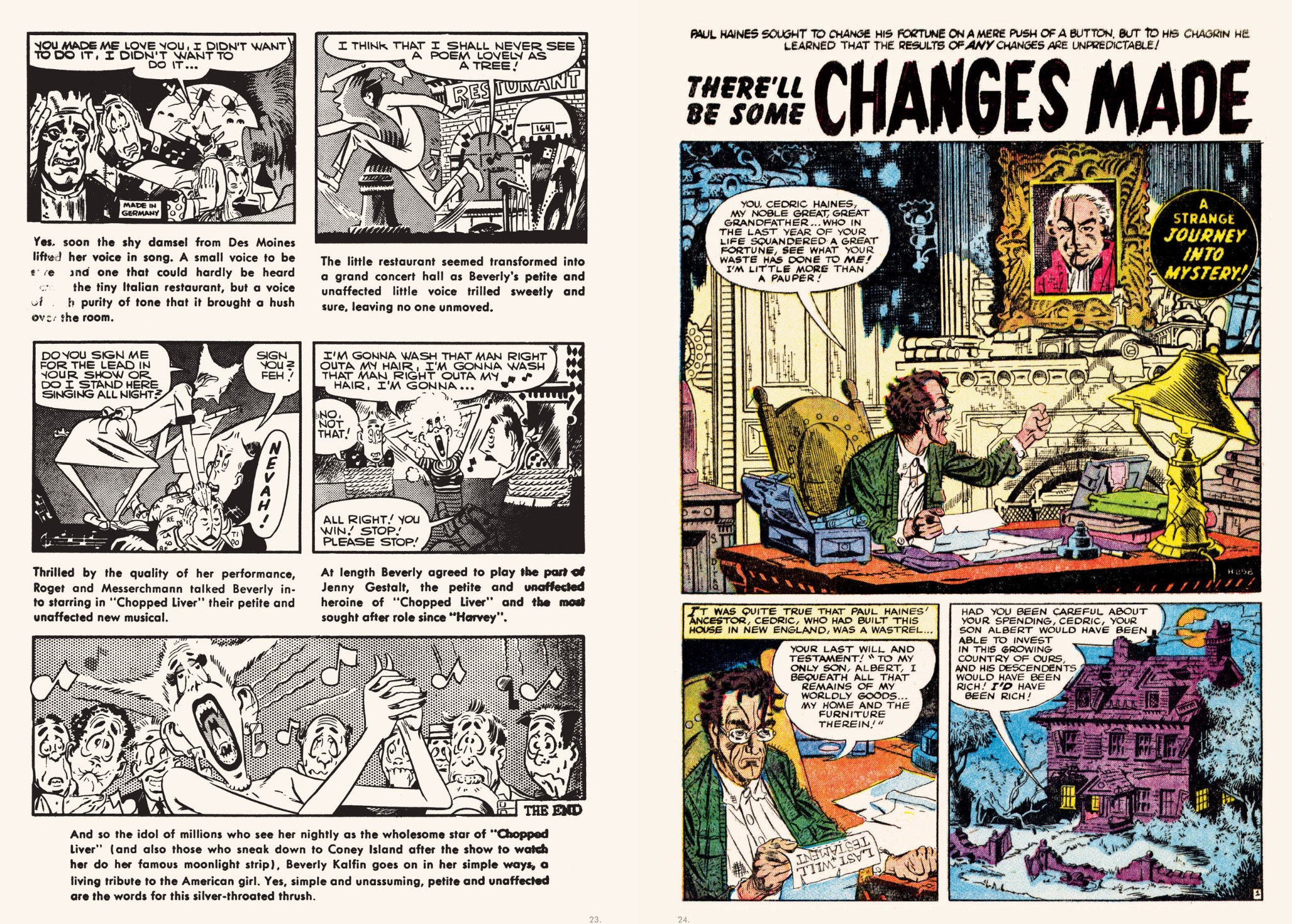
Following an historically informative Introduction and passionate advocacy by Blake Bell, concentrating on Ditko’s near-death experience in 1954 (when the artist contracted tuberculosis) and subsequent recovery, the evocatively eccentric excursions open with a monochrome meander into the realms of satire with the faux fable – now we’d call it a mockumentary – ‘Starlight Starbright’ as first seen in From Here to Insanity (volume 3 #1 April 1956) before “normal” service resumes with financial fable ‘They’ll Be Some Changes Made’ (scripted by Carl Wessler from Atlas’ Journey Into Mystery #33, April 1956).

Here a petty-minded pauper builds a time machine to steal the fortune his ancestors squandered, after which a crook seeking to exploit a mystic pool finds himself the victim of fate’s justice in ‘Those Who Vanish’ (Journey Into Mystery #38, September 1956) again scripted by Wessler.

Almost – if not all – the Charlton material was scripted by astoundingly prolific Joe Gill at this time, and records are spotty at best, so let’s assume his collaboration on all the material here begins with ‘The Man Who Could Never Be Killed’ (Strange Suspense Stories #31, published in February 1957). This yarn of a circus performer with an incredible ethereal secret segues into ‘Adrift in Space’ (Mysteries of Unexplored Worlds #8 June 1958) as a veteran starship captain pushes his weary crew over the edge, whereas ‘The King of Planetoid X’ from the previous MoUW (February) details a crisis of conscience for a benevolent and ultimately wise potentate…

The cover of Strange Suspense Stories #31 (February 1957) leads into ‘The Gloomy One’ as a misery-loving alien intruder is destroyed by simple human joy, before the cover to Out of This World #5 (September 1957) heralds that issue’s ‘The Man Who Stepped Out of a Cloud’ and an alien whose abduction plans only seem sinister in intent. MoUW #5 (October 1957) tells the story of a young ‘Stowaway’ who finds fulfilment aboard a harshly-run space ship after which Out of This World #3’s cover (March 1957) ushers us to an apparent alien paradise for weary star-men in ‘What Happened?’

Next up is a tale from one of Charlton’s earliest star characters. The title came from a radio show that Charlton licensed the rights to, with the lead/host/narrator acting more as voyeur than active participant. The Mysterious Traveler spoke directly to camera, asking readers for opinion and judgement as he shared a selection of funny, sad, scary and miraculous human-interest yarns, all tinged with a hint of the weird or supernatural. Whenever rendered by Ditko, whose storytelling mastery, page design and full, lavish brushwork were just beginning to come into its mature full range, the contents of Tales of the Mysterious Traveler were always exotic and esoteric and utterly beguiling.

From issue #2 (February 1957), ‘What Wilbur Saw’ reveals the reward bestowed on a poverty-stricken country bumpkin who witnessed a modern-day miracle, after which Out of This World #3 covers a cautionary tale of atomic mutation in ‘The Supermen’ before the eerie cover to OoTW #4 (June 1957) signals a chilling encounter for two stranded sailors who briefly board the ‘Flying Dutchman’ whilst SSS #32’s cover (May 1957) dabbles in magic art when a collector is victimised by a thief who foolishly stumbles into ‘A World of His Own’.

From the same issue comes a salutary parable concerning a rich practical joker who goes too far before succumbing to ‘The Last Laugh’, after which ‘Mystery Planet’ (SSS #36, March 1958) offers a dash of interplanetary derring-do as valiant agent Bryan Bodine and comely associate Nedra confound intergalactic pirates piloting a planet-eating weapon against Earth!

A similarly bold defender liberates ‘The Conquered Earth’ from alien subjugation (OoTW #4, June 1957) whilst in ‘Assignment Treason’ (Outer Space #18. August 1958) the clean-cut hero goes undercover to save Earth from the predatory Master of Space as OoTW #8 (May 1958) and ‘The Secret of Capt. X’ reveals the inimical alien tyrant threatening humanity is not what he seems…

The cover to Mysteries of Unexplored Worlds #3 (April 1957) makes way for three fantastic thrillers, beginning with ‘The Strange Guests of Tsaurus’ as an alien paradise proves to be anything but, then ‘A World Where I Was King’ sees a clumsy janitor catapulted into a wondrous realm to win a kingdom he doesn’t want. Diverting slightly, Fightin’ Army #20 (May 1957) provides a comedic interlude as a civil war soldier finds himself constantly indebted to ‘Gavin’s Stupid Mule’ before ‘A Forgotten World’ wraps up MoUW #3’s contributions with a scary tale of invasion from the Earth’s core. ‘The Cheapest Steak in Nome’ turns out to be defrosted from something that died millions of years ago in a light-hearted yarn from MoUW #7 (February 1958)…

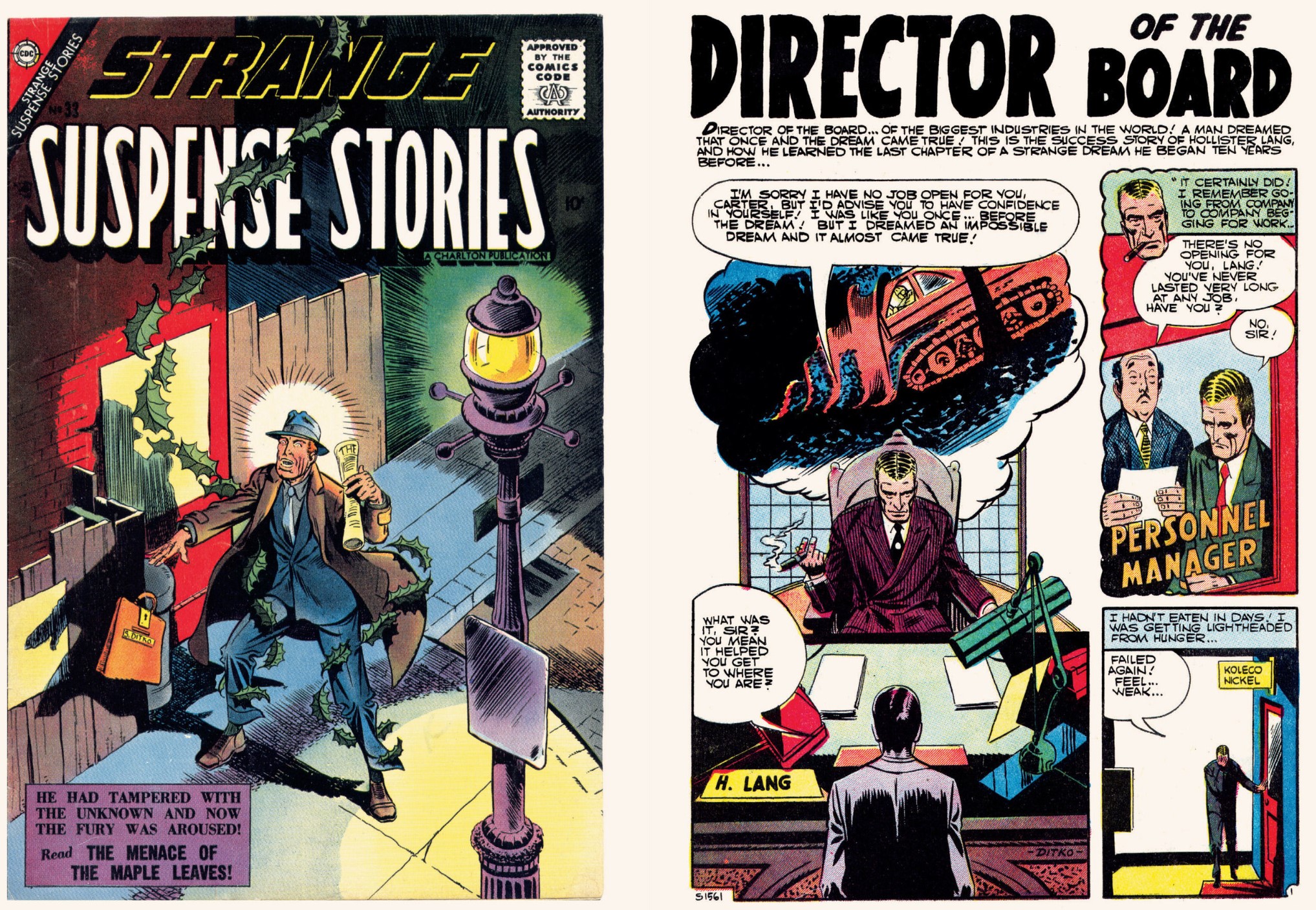
The cover to MoUW #4 (July 1957) precedes more icy antediluvian preservations found in the ‘Valley in the Mist’ whilst the one for Strange Suspense Stories #33 (August 1957) leads into a bizarre corporate outreach project as the ‘Director of the Board’ attempts to go where no other exploitative capitalist has gone before. Next, it’s back to MoUW #3 for a brush with the mythological in ‘They Didn’t Believe Him’ after which ‘Forever and Ever’ (SSS #33) reveals an unforeseen downside to immortality and Out of This World #3 sees a stranger share ‘My Secret’ with ordinary folk despite – or because of – a scurrilous blackmailer…

‘A Dreamer’s World’ from Mysteries of Unexplored Worlds #5 (October 1957) follows the chilling cover thereof as a test pilot hits his aerial limit and discovers a whole new existence, whilst Unusual Tales #7 (May 1957) traces the tragic path of ‘The Man Who Could See Tomorrow’ before the cover of Tales of the Mysterious Traveler #4 (August 1957) opens a mini-feast of voyeur’s voyages beginning with that issue’s ‘The Desert’: a saga of polar privation and survival.

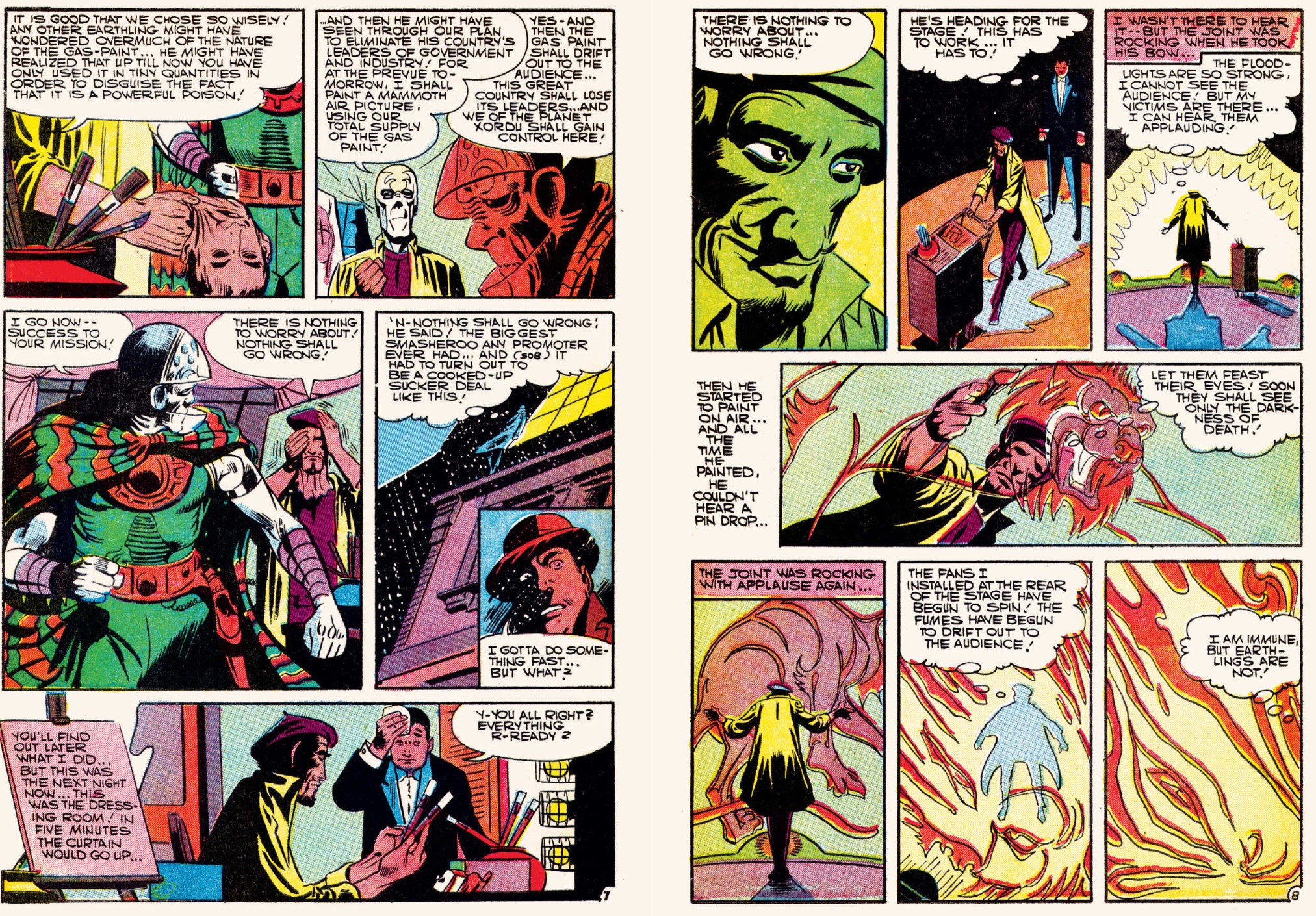
TotMT #3 (May 1957) shows the appropriate cover and a ‘Secret Mission’ for a spy parachuted into Prague, whilst #4 offers ‘Escape’ for an unemployed pilot dragged into a gun-running scam in a south American lost world; ‘Test of a Man’ sees a cruel animal trainer receive his just deserts and ‘Operation Blacksnake’ grittily exposes American venality in the ever-expanding Arabian oil trade. Returning to Mysteries of Unexplored Worlds #5, ‘The Mirage’ torments an escaped convict who thinks he’s escaped his fate, whilst Texas Rangers in Action #8 (July 1957) sees a ruthless rancher crushed by the weight of his own wicked actions as ‘The Only One’, after which stunning covers to Unusual Tales #6 and 7 (February and May 1957) lead into our final vignette – ‘The Man Who Painted on Air’: exposing and thwarting a unique talent to preserve humanity and make a few bucks on the side…

This sturdily capacious volume has episodes that terrify, amaze, amuse and enthral: utter delights of fantasy fiction with lean, plots and stripped-down dialogue that let the art set the tone, push the emotions and tell the tale, from times when a story could end sadly as well as happily and only wonderment was on the agenda, hidden or otherwise.

These stories display the sharp wit and contained comedic energy which made so many Spider-Man/J. Jonah Jameson confrontations an unforgettable treat half a decade later, and this is another cracking collection not only superb in its own right but as a telling tribute to the genius of one of the art-form’s greatest stylists. This is something every serious comics fan would happily kill or die or be lost in time for…
Unexplored Worlds: The Steve Ditko Archive Vol. 2. This edition © 2010 Fantagraphics Books. Introduction © 2010 Blake Bell. All rights reserved.

Today in 1914, Jerry Siegel was born. Don’t make me have to finish this heads-up…

In 1937 Huey, Dewey & Louie Duck debuted. Ditto.

In 1959 The last issue of UK icon Comet was published and a decade later across the Pond Sidney Smith’s The Gumps ended. It had begun in 1917 as you’d know if read Sidney Smith’s The Gumps.

Bunny vs Monkey Book 11: Intergalactic Monkey Business!


By Jamie Smart, with Sammy Borras, Paul Duffield & Armin Roshdi (David Fickling Books)
ISBN: 978-1-78845-327-1 (Digest HB) 978-1-78845-387-5 (Waterstones Exclusive Team Bunny Edition) 978-1-78845-388-2 (Waterstones Exclusive Team Monkey Edition)

Win’s Christmas Gift Recommendation: Because… Just Because… 10/10

Bunny vs Monkey has been the inspirationally bonkers breakout star of The Phoenix since the first issue in 2012: recounting a madcap vendetta gripping animal archenemies set amidst an idyllic arcadia, masquerading as more-or-less mundane but critically endangered English woodlands. Concocted with gleefully gusto – but increasingly with cerebral cosmic crescendo in mind – by cartoonist/comics artist/novelist Jamie Smart (Fish Head Steve!; Looshkin; Max and Chaffy, Flember, Find Chaffy), these trendsetting, mind-bending yarns have been wisely retooled as best-selling graphic albums available in remastered, double-length digest softcover and hardback editions such as this one. All the tail-biting tension and animal argy-bargy began yonks ago after an obnoxious little beast plopped down in after a disastrous British space shot. OR DID IT?

Crashlanding in Crinkle Woods – scant miles from his launch site – lab animal Monkey believed himself the rightful owner of a strange new world, despite every effort of genteel, contemplative, reasonably sensible forest resident Bunny to dissuade him. For all his patience, propriety and good breeding, the laid-back lepine could not contain or control the incorrigible idiot ape, who to this moment remains a rude, troublemaking, chaos-creating, noise-loving lout intent on building his perfect “Monkeyopia” and/or being a robot, with or without the aid of evil supergenius Skunky or tagalong useless “henches” Metal Steve and Action Beaver

Daily wonders and catastrophes were exacerbated by a broad band of unconventional Crinkle creatures, none more so than monochrome mad scientist Skunky, whose intellect and cavalier attitude to life presents as a propensity for building dangerous robots, bio-beasts and sundry other super-weapons. He is, at his core, a dangerously inquisitive thinker and tinkerer…

Here – with artistic fiddling about from design deputy Sammy Borras – the war of nerves and mega-ordnances resumes as if nothing cosmic or multiverse-changing had ever happened or any hint of a restart after a cosmic culmination. See, that’s what happens if you let books pile up and don’t read them immediately! Go check out Bunny vs Monkey: The Great Big Glitch! and then come back and we’ll talk some more…

Okay then, new day, new start, same old mega mecha meta nonsense as ‘Clouding Over’ sees a suspiciously low-lying cirrus formation starts dumping rain and then increasing more noisome and noxious substances on the woodsfolk in what appear to be targeted strikes. Could there possibly be some kind of intelligence behind the atmospheric attacks?

With propriety and good taste in full retreat, the sensorial assaults resume in ‘Guts n’ Butts!’ as Monkey and Skunky debate the appalling assets and proposed “improvements” to the weaponised flatulence engine dubbed Bungamungus with no consideration of those in its path prior to the simian unleashing his own worst nightmare. The giant ‘MonkeyBot 5000’ is supposed to make life hell for his fluffy white foe, but it appears Bunny can find plenty of uses for a mechanised personal organiser that can bench press trucks, topple buildings, file and colour co-ordinate…

Reality trembles all over again when Monkey’s ‘Mum and Dad’ pop by for a visit and nice bit of tea, but nature’s innocents Weenie and Pig Piggerton are too busy having adventures with ‘Frogs!’ and their mystical king to really notice, whereas ‘Lucky… The Unluckiest Red Panda in the World!!’ stumbles into unbridled chaos (as always) when Skunky & Monkey decide to go through the forgotten inventions bin…

Worried about declining productivity, the sinister science sinner uses his 3D printer to unleash a horde of ‘Fun-Size Skunkies’ who are anything but, before Bunny learns where all the wreckage, rubbish and remains go when the latest catastrophe has finished unfolding. Sadly, there are good reasons nobody wants to see ‘Binbag Sam’ carry out his nasty but necessary job…

Always seeking peace and serene contemplation, mysterious Le Fox has found a wilderness to dig in, but when Monkey comes by and discovers gold in ‘Them Thar Hills’ that’s another dead dream, and only a prelude to planet-shaking events when Skunky’s new signal array test coincides with Monkey’s latest eating challenge. ‘Message in a Butthole’ reveals how – after, inevitably – a monumental foofie erupts across the universe, the consequences will be appalling but not at all unexpected…

In a fabulous tribute to Chuck Jones cartoons ‘Monkey vs Ai’ sees the annoying ape test a bunch of inventions that should work “in theory”, before going back to stinky basics with a cheese cannon. Sadly, the anticipated Cheesepocalyse is derailed by ‘The Turning of the Pig’ as pacifistic Piggerton reaches a limit and shows the monkey miscreant just what it all feels like…

‘Buzzing Off’ finds Skunky testing ways to end the really annoying fly suit he built for his partner in chaos and then hiding along with everyone else in ‘Who’s Afraid of the Monkey’ when the simian simpleton gets really, really hungry. Eventually sated, the little sod resumes pranks and pestiferations with a giant robot in ‘Close Encounters of the Bird Kind’. Remember that olfactory beacon blasted across infinity? This is the moment something answers that unique call…

Suddenly, in ‘You Looking at Me?’ Crinkle Woods are alive with alien weirdoes, but it’s just Skunky messing about with quantum physics and nothing to do with Monkey, because he’s currently hurtling to the other side of the Universe, testing to destruction the super-high-tech toilets of the extraterrestrials who abducted him…

He can’t be blamed for the astonishing void discovered by Pig and Weenie prompting the chilling question ‘What Lies Inside… the Hole?!’ or sensible but naïve robot Metal E.V.E.’s attempts to balance out Lucky’s cosmic misfortunes in ‘What Luck Befalls’ or even Metal Steve’s crisis of confidence and inexplicable desire to ‘Destroy’ because Monkey is currently spreading his brand of chaos while ‘Hitching a Ride’ on the ship of judgemental civilisation eradicating superior being Grand Master Nexus

Meanwhile on Earth, Skunky discovers the missing co-miscreant has left his life unfulfilled and dissatisfied and switches to a copy to serve his unsuspected emotional needs. ‘Little Monkey’ is wild, bitey, uncommunicative, un-potty-trainable and disgusting… such an improvement on the original! Enjoying his fresh start the evil inventor unleashes ‘A Clever Endeavour’ in the compulsive form of a malign puzzle box that baffles and bamboozles everyone – except the mini monkey who might just be the smartest thing in the woods now…

Pig’s penchant for peculiar pets sees the adoption of Blue-bummed Bimblebug ‘Parpy’  but the critter’s 24-hour lifespan brings near-instant woe, This leads to the advent of colossal hermit savant Capybara 5000 whose answers to all the ‘Big Questions’ are surprisingly violent. That search for truths culminates in sage advice ‘Run!’ before calm returns with Pig exploring wild water rafting and Le Fox confronting increasingly sinister Little Monkey in ‘The Happiness of the Kitsune’

In another beleaguered solar system Monkey is slowly wearing down Nexus and his minions, before accidentally warping them all back to Earth to enjoy a spontaneous battle of ‘Rather Big Lasers’ with Skunky. When that eradicates the mastermind’s secret underground lair all Skunky can think of is ‘Revenge’. With Little Monkey in tow the genius goes ‘On the Hunt’ in a unique battleship, pursuing ‘Space Wars’ even as his hirsute former best-buddy seizes control of the Nexus craft and drives it into ‘A Hella Interstellar Yeller’

Marooned on a muddy morass world, Monkey establishes his dream of a dictatorship. Sadly, ‘Chutneyopia’ is right next to the equally barren planet Skunky crashed on and war is declared as the newcomer demands an apology that just won’t be forthcoming…

Moreover, when Skunky took off after Monkey, most of Crinkle Wood went with him and as Bunny ruminates on ‘The Intergalactic Adventures of Weenie and Cinnamon Bun Pig!’ plans are underway to terraform the barren planetoid into ‘A New Home’ unfortunately undertaken by ‘Even More Skunkies’

With the enemy busy converting Chutneyopia into his other, better dream of Monkeyopia, ‘A New Plan’ is needed, but the still active Grand Master finally concedes that its superior mentality and firepower are no match for the annoying Earth ape. With its minions in revolt and resolved to blow up Earth, there nothing left for Monkey to worry about ‘Apart from the Bomb’ that’s going to end his grotty mucky dream world…

What better time for a reconciliation with Skunky?

Back on Earth, other Crinkle Wood critters have briefly enjoyed their time of growth and limelight in ‘Not Bunny vs Monkey’ but the likes of Stan Stoat and Randolph Raccoon are helpless when the minions start blasting. As Monkeyopia becomes a vast spaceship, Skunky begins his ‘Race to Save the World’ with his secret weapon Little Monkey but the outcome is never certain and our heroes all decide they’re ‘Best Off Out of It’, leaving a monumental deus ex machina to sort everything out…

Wrapping up these sidereal shenanigans and cosmic bum gags are related activities offered under the aegis of the Phoenix Comics Club. Bring paper, pencils and you to a compact online course in all aspects of comic strip creation supervised by Jamie Smart & Armin Roshdi detailing ‘How to draw King Frog!’, ‘A Bungamungous!’, ‘Capybara 5000!’ and ‘An Alien!’ before closing with an extensive plug for the aforementioned Phoenix Comics Club website complete with instant access via a QR code, plus previews of other treats and wonders available in The Phoenix to wind down from all that cosmic furore…

Another book for your kids to explain to you, the zany zenith of absurdist adventure, Bunny vs Monkey is weird wit, brilliant invention, potent sentiment and superb cartooning all crammed into one eccentrically excellent package. These tails never fail to deliver jubilant joy for grown-ups of every vintage, even those who claim they only get it for their kids. Is that you?
Text and illustrations © Fumboo Ltd. 2025. All rights reserved.

Today in 1926 Joe Sinnott was born. His inking made Fantastic Four impeccable and unmissable, but if you fancy seeing his pencilling mastery you should see Mighty Thor Omnibus volume 1.

Back in 1954 UK preschool comic milestone Playhour began its 1700+ issue run.

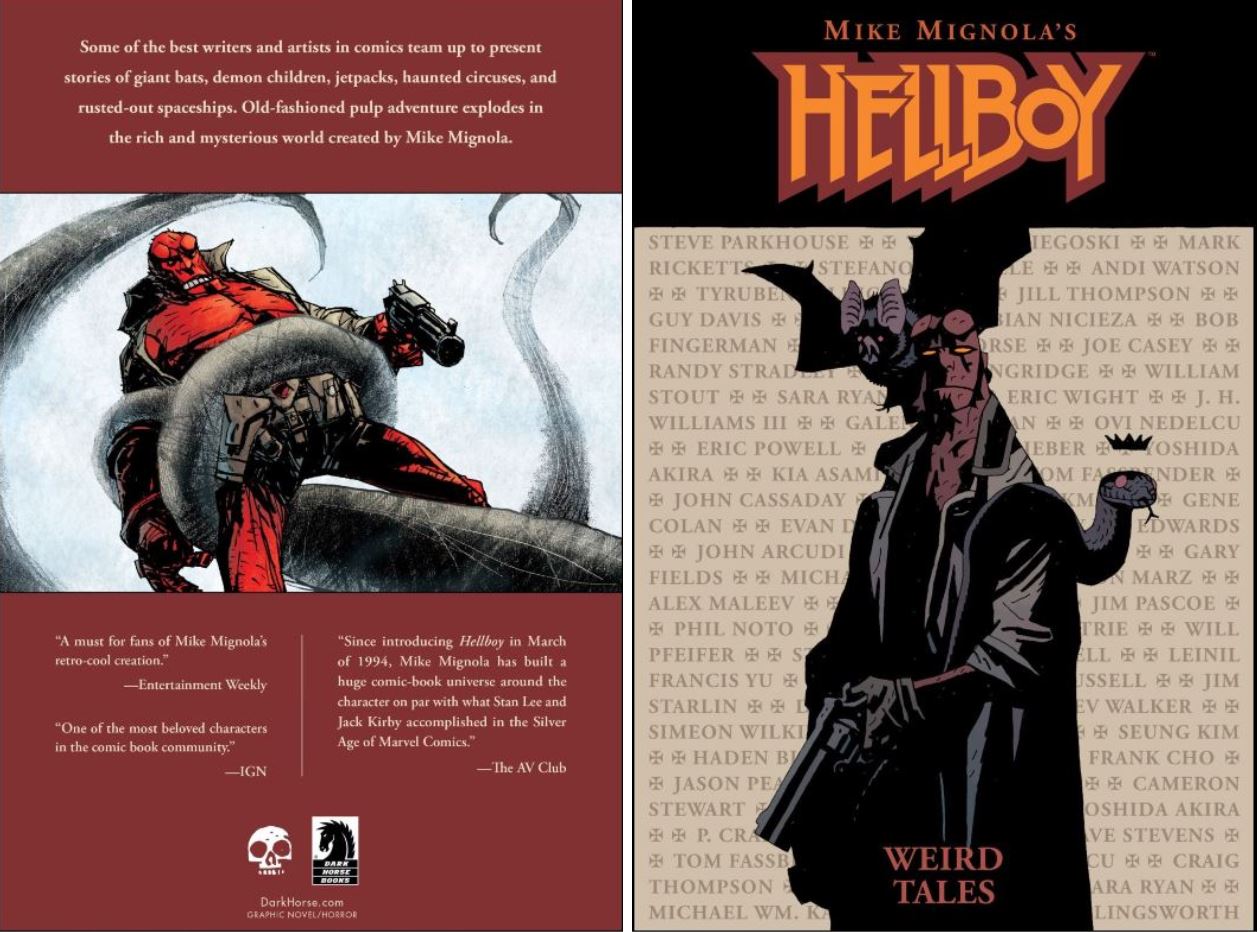
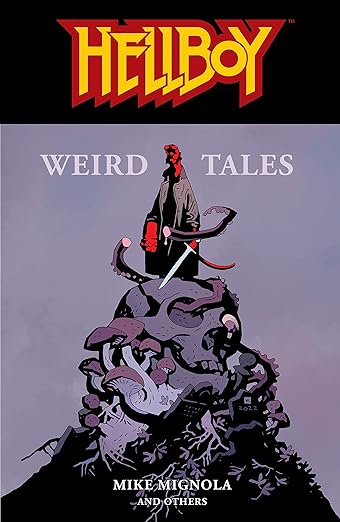
Hellboy: Weird Tales


By Mike Mignola, Fabian Nicieza, John Cassaday, Eric Powell, Tom Sniegoski, Tommy Lee Edwards, Randy Stradley, Joe Casey, Sara Ryan, Ron Marz, J. H. Williams III, Jim Pascoe & Tom Fassbender, Will Pfeifer, John Arcudi, Matt Hollingsworth, Jill Thompson, Alex Maleev, Jason Pearson, Scott Morse, Akira Yoshida & Kia Asamiya, Doug Petrie, Bob Fingerman, Evan Dorkin, Andi Watson, Mark Ricketts, Kev Walker, Craig Thompson, Guy Davis, Stefano Raffaele, Ovi Nedelcu, Seung Kim, Steve Parkhouse, Steve Lieber, Jim Starlin, P. Craig Russell, Simeon Wilkins, Gene Colan, Roger Langridge, Eric Wright, Dave Stewart, Clem Robins & various (Dark Horse Books)
ISBN: 978-1-61655-510-8 (HB) eISBN: 978-1-63008-121-8 (digital) 978-1506733845 (2022 Omnibus TPB)

This book includes Discriminatory Content produced in less enlightened times. It also has Discriminatory Content included for comedic and satirical effect.

After the establishment of the comic book direct market system, there was a huge outburst of independent publishers in America and, as with all booms, a lot of them went bust. Some few, however, were more than flash-in-the-pans and grew to become major players in the new world order.

Arguably, the most successful was Dark Horse Comics who fully embraced the shocking new concept of creator ownership (amongst other radical ideas). This concept – and professional outlook and attitude – drew many big-name creators to the new company and in 1994 Frank Miller & John Byrne formally instituted sub-imprint Legend for those projects major creators wanted to produce their own way and at their own pace. Over the next four years the brand counted Mike Mignola, Art Adams, Mike Allred, Paul Chadwick, Dave Gibbons and Geof Darrow amongst its ranks; generating superbly entertaining and groundbreaking series and concepts. Unquestionably the most impressive, popular and long-lived was Mignola’s supernatural thriller Hellboy.

The hulking monster-hunter debuted in San Diego Comic-Con Comics #2 (August 1993) before formally launching in 4-issue miniseries Seed of Destruction (with Byrne scripting Mignola’s plot & art). Colourist Mark Chiarello added layers of mood with his understated hues. Once the fans saw what was on offer there was no going back…

What You Need to Know: on December 23rd 1944 American Patriotic Superhero Torch of Liberty and a squad of US Rangers intercepted and – almost – foiled a satanic ceremony predicted by Allied parapsychologist Professors Trevor Bruttenholm and Malcolm Frost. They were working in conjunction with influential medium Lady Cynthia Eden-Jones. Those stalwarts were waiting at a ruined church in East Bromwich, England when a demon baby with a huge stone right hand appeared in a fireball. The startled soldiers took the infernal yet seemingly innocent waif into custody.

Far, far further north, off the Scottish Coast on Tarmagant Island, a cabal of Nazi Sorcerers roundly berated ancient wizard Grigori Rasputin whose Project Ragna Rok ritual seemed to have failed. The Russian was unfazed. Events were unfolding as he wished…

Five decades later, the baby had grown into a mighty warrior engaging in a never-ending secret war: the world’s most successful paranormal investigator. Bruttenholm spent years lovingly raising the weird foundling whilst forming an organisation to destroy unnatural threats and supernatural monsters – The Bureau for Paranormal Research and Defense. “Hellboy” quickly became its lead agent.

As the decades of his career unfolded, Hellboy gleaned tantalising snatches of his origins, hints that he was an infernal creature of dark portent: born a demonic messiah, somehow destined to destroy the world and bring back ancient powers of evil. It is a fate he despises and utterly rejects, even though the universe keeps inexorably and relentlessly moving him towards it.

Hellboy earned the status of ‘actual legend’ in the comics world, starting as the particular vision of a single creator and, by judicious selection of assistants and deputies, cementing a solid take on the character in the hearts of the public. That’s just how it worked for Superman, Batman and Spider-Man (except for the whole “owning the fruits of your own labours” thing) and a big part of the same phenomenon was the eagerness of fellow creators to play in the same universe. Just how that and this collection came about is detailed in Editor Scott Allie’s Introduction preceding a blazing welter of strange and bizarre entertainment…

Originally an 8-part comics series wherein a star-studded cast of creators tell their own stories in their own varied styles under the watchful supervision of the big cheese himself in his unique infernal playground, Hellboy’s Weird Tales was gathered into a 2-volume set in 2004. This luxurious hardback and digital reissue originated in 2014, supplementing the original miniseries with back-up stories from Hellboy: The Wild Hunt #2-4.

Dramas that add to the canon nestle alongside bizarre and humorous vignettes that simply live for the moment and begin with ‘How Koschei Became Deathless’ crafted by Mignola, Guy Davis, Dave Stewart & Clem Robins. The filler from Hellboy: The Wild Hunt #2 & 3 details the valiant trials of a noble warrior and the bad bargain he made, after which a crafty man turns the tables on the world’s wickedest witch in ‘Baba Yaga’s Feast’ (H:TWH #4).

The mother of monsters returns in Fabian Nicieza & Stefano Raffaele’s ‘The Children of the Black Mound’ wherein a future soviet dictator has his own youthful, life-altering encounter with the queen of magic.

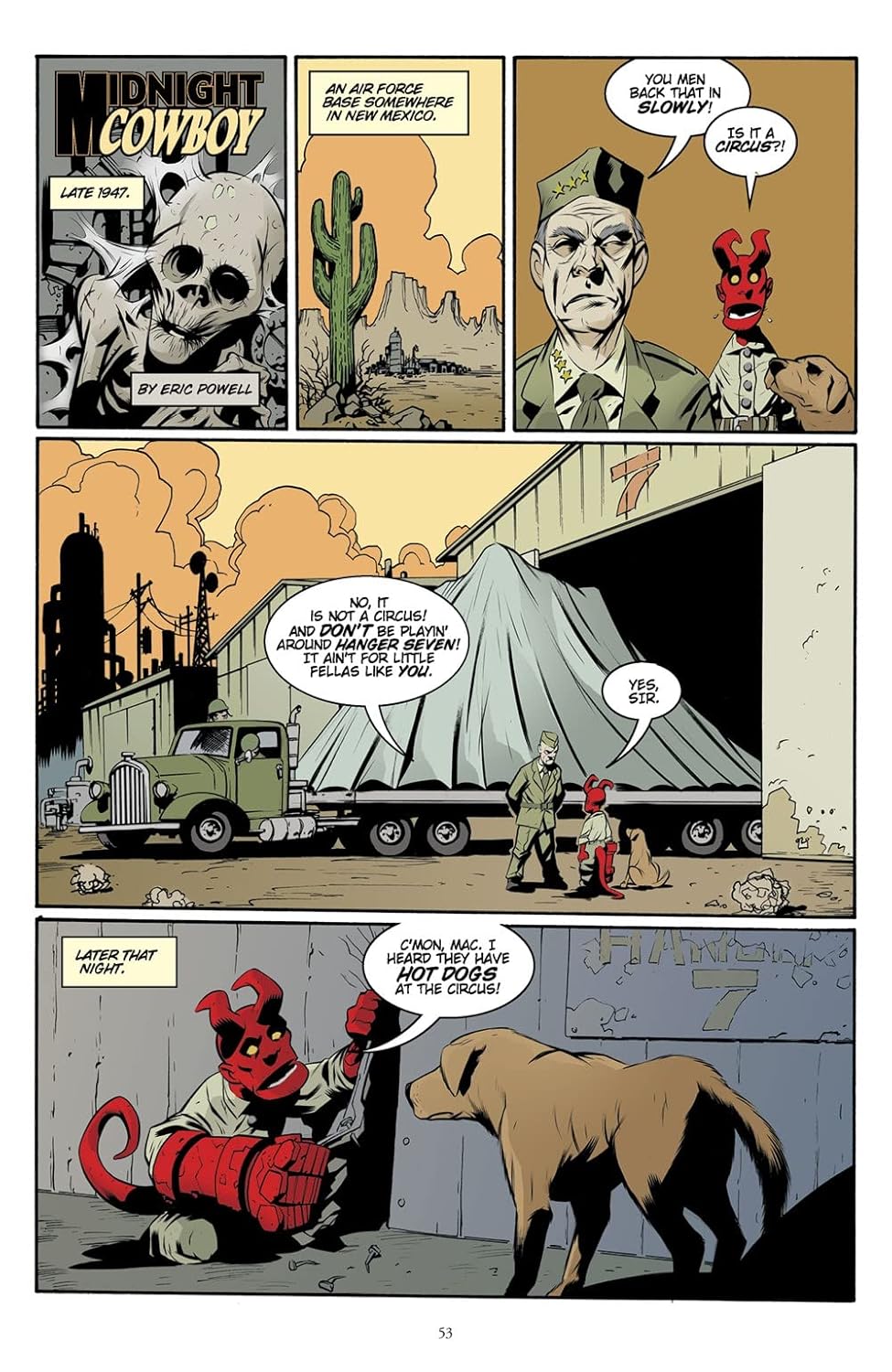
John Cassaday spoofs classic newspaper strips with rollicking pulp science hero in ‘Lobster Johnson: Action Detective Adventure’ after which Nazi-bashing nonsense, Eric Powell explores Hellboy’s childhood and early monster-mashing in ‘Midnight Cowboy’ whilst Tom Sniegoski & Ovi Nedelcu raise our spirits with an older ghostbuster failing to tackle a playful posse of spooks in ‘Haunted’

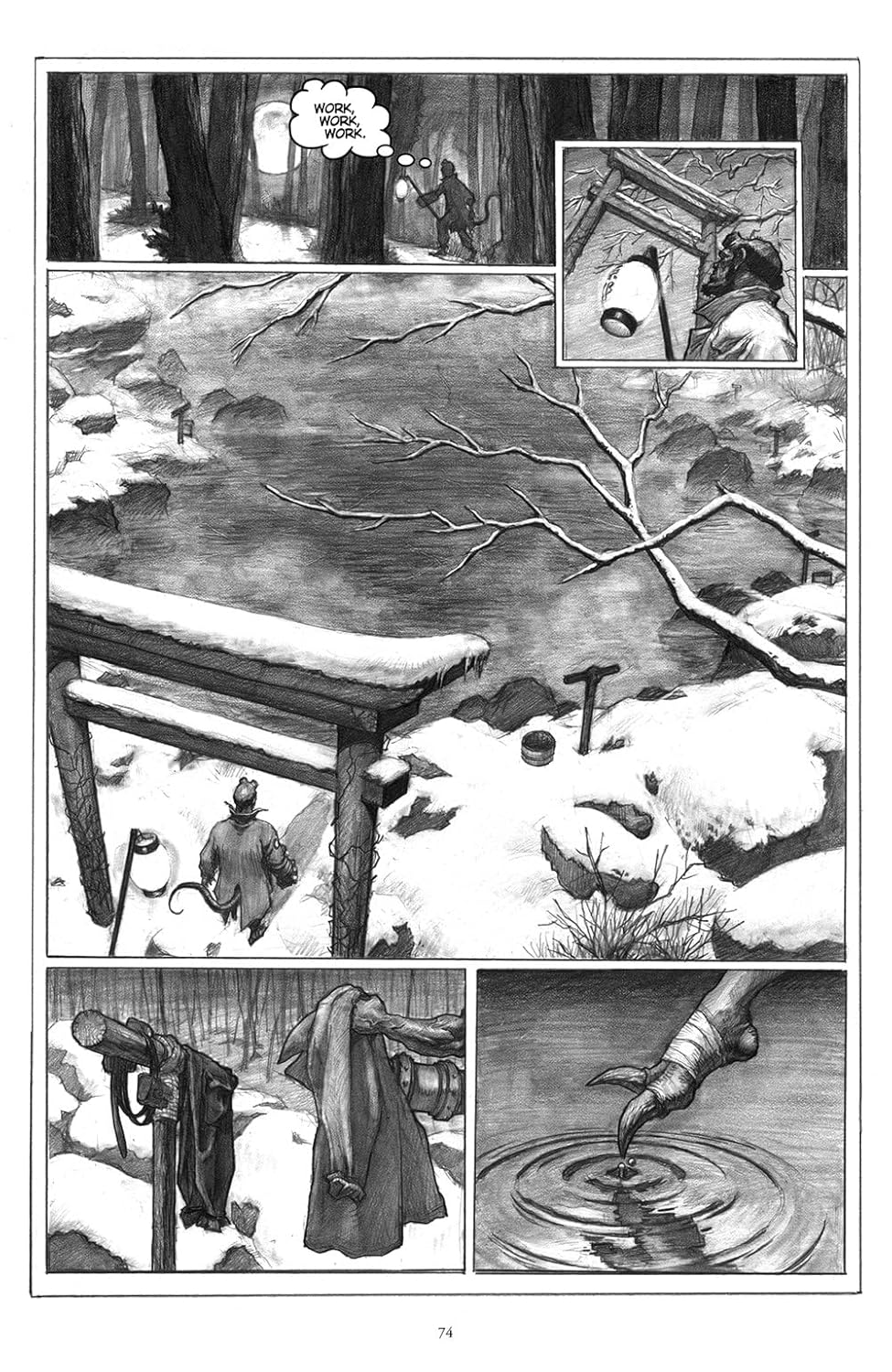
A classical doomed East/West war romance ghost tragedy is settled by Tommy Lee Edwards & Don Cameron in ‘A Love Story’, setting a scene for more Japanese myth busting in Randy Stradley & Seung Kim’s ‘Hot’ wherein the B.P.R.D. star clashes with an unhappy Tengu (water spirit) inhabiting a mountain hot spring…

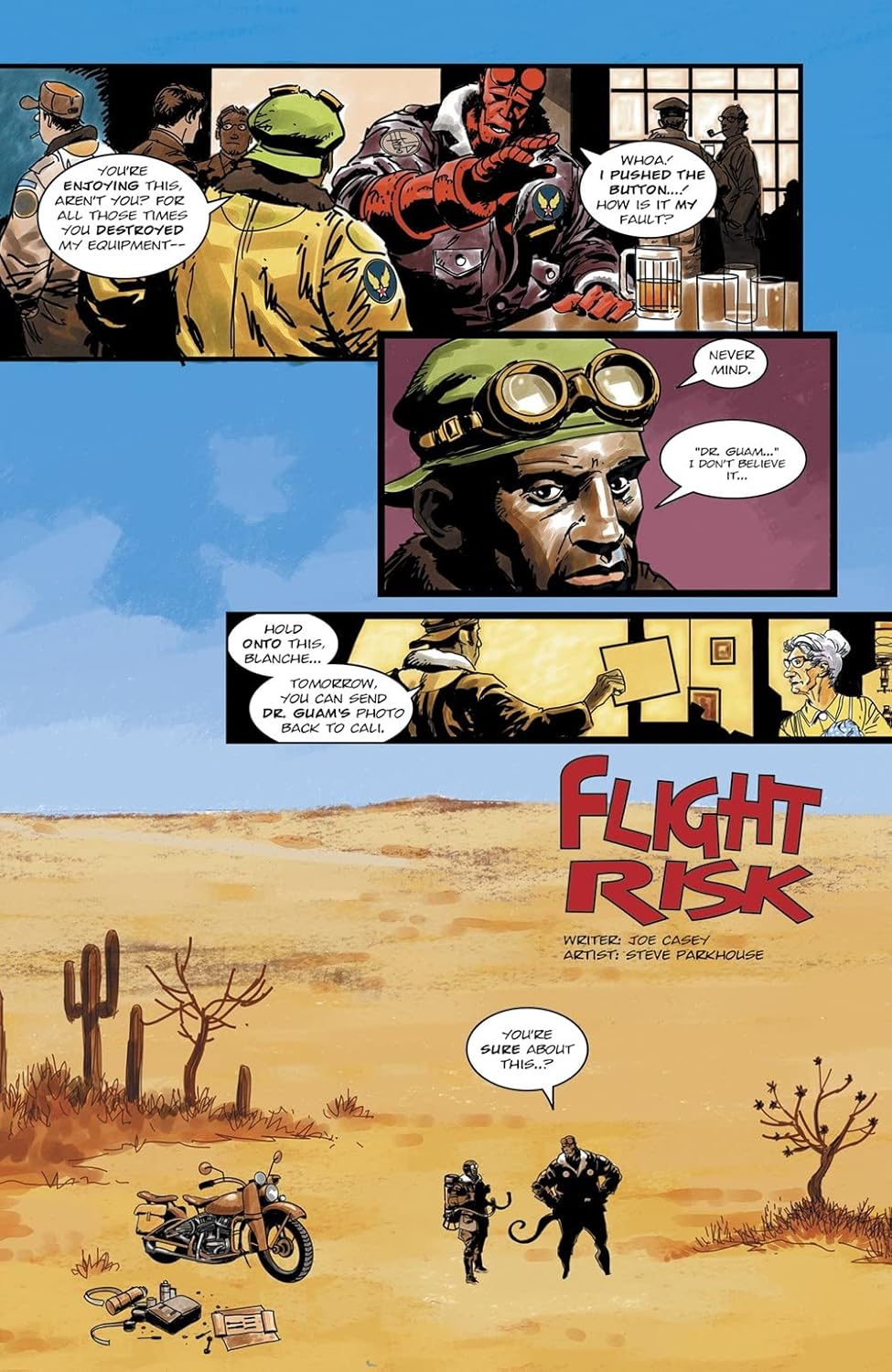
Joe Casey & Steve Parkhouse celebrate the glory days of test pilots and the right stuff in ‘Flight Risk’ when Hellboy is involved in a competition to see who’s got the best jetpack, after which ‘Family Story’ (Sara Ryan & Steve Lieber) sees him acting as counsellor to the mum and dad of a rather diabolical kid, before we slip into all-out arcane action to retrieve a time bending artefact from a Guatemalan temple in ‘Shattered’ by Ron Marz & Jim Starlin.

A stakeout with an over-amorous fellow agent leads to unanticipated consequences in J. H. Williams III’s ‘Love is Scarier than Death’, whilst Will Pfeifer & P. Craig Russell’s dalliance with an undying theatre troupe traps our hellish hero in a ‘Command Performance’ and the entertainment motif continues in John Cassaday’s ‘Big-Top-Hell-Boy’ as the B.P.R.D. try to exorcise a mass-murderous circus in Germany before Hellboy and aquatic investigator Abe Sapien battle zombies in the ‘Theatre of the Dead’ courtesy of scripters Jim Pascoe & Tom Fassbender, as illustrated by Simeon Wilkins.

Thanks to John Arcudi & Roger Langridge, the undersea avenger sort of stars in comedic daydream ‘Abe Sapien: Star of the B.P.R.D.’, after which Jill Thompson takes ‘Fifteen Minutes’ to offer us the other side’s view of the eternal struggle, whilst Matt Hollingsworth & Alex Maleev show us the struggle against evil starts before we’re even legally alive in ‘Still Born’. Indomitable psychic Firestarter Liz Sherman acknowledges personal loss and the dreadful cost of the job in Jason Pearson’s ‘The Dread Within’ before Scott Morse conjures up a calmer moment for Hellboy in ‘Cool Your Head’ and Akira Yoshida & Kia Asamiya return us to ghost-riddled Japan for an unconventional duel with childish spirits in ‘Toy Soldier’

Bob Fingerman’s ‘Downtime’ pits the cream of the B.P.R.D. against the vexatious thing inhabiting the office vending machine, after which Doug Petrie & Gene Colan follow Liz and Abe on a typical ‘Friday’, even as artificial hero Roger the Homunculus foolishly seeks ‘Professional Help’ during a devious demonic assault (as recorded by Evan Dorkin). Andi Watson tackles Hellboy’s infernal heritage and possible future during a social function where he is – as always – the ‘Party Pooper’, after which team leader/psychologist Kate Corrigan endures an acrimonious reunion with her dead-but-still-dreadful mother in ‘Curse of the Haunted Dolly’ (Mark Ricketts & Eric Wright), whilst Kev Walker pits bodiless spirit Johann Krauss against a thing from outer space in ‘Long Distance Caller’.

The narrative portion of this stellar fear & fun fest rightly focuses on Hellboy himself as Craig Thompson takes the weird warrior on an extended tour of the underworld in ‘My Vacation in Hell’ and there’s still a wealth of wonder to enjoy with Mike Mignola’s Hellboy Weird Tales Gallery offering a selection of potent images by Cameron Stewart, Maleev, Dave Stevens with Dave Stewart, Steve Purcell, William Stout, Leinil Francis Yu, Phil Noto, Gary Fields with Michelle Madsen, J. H. Williams III, Rick Cortes with Anjin, Galen Showman with Michelle Madsen, Ben Templesmith, Frank Cho with Dave Stewart, Michael Wm. Kaluta, Lee Bermejo with Dave Stewart and Scott Morse.

Baroque, grandiose, scary, hilarious and even deeply moving, these vignettes alternate suspenseful slow-boil tension with explosive catharsis, and trenchant absurdity, proving Hellboy to be a fully rounded character who can mix apocalyptic revelation with astounding adventure to enthral horror addicts and action junkies alike or enthral jaded fun-lovers in search of a momentary chuckle. This is a classic compendium of dark delights you simply must have.

™ & © 2003, 2009, 2014 Mike Mignola. Weird Tales is ® Weird Tales, Ltd.

Today in 1932 Francis Burr Opper’s landmark strip And Her Name Was Maud ended. If only someone would release a definitive archive I certainly review it!

Also today, the amazing and astounding Otto Binder died in 1974. He wrote everything from Superman to Captain Marvel to Mighty Samson so go seek him out too for a grand old time…

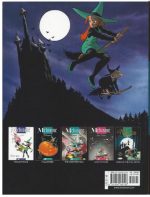
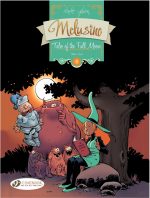
Melusine volume 5: Tales of the Full Moon


By Clarke & Gilson, coloured by Cerise; translated by Jerome Saincantin (Cinebook)

ISBN: 978-1-84918-212-6 (album TPB/Digital edition)

This book includes Discriminatory Content produced in less enlightened times.

Historically, whenever we used to feel out of sorts we’d consult the wise women to pull our fat out of the fire. Thus as we’re still sick and I’m out of pre-completed reviews here’s a sample of that and me being too clever for my own good.

Let’s see what tomorrow brings…

Witches – especially cute, sassy and/or teenaged ones – have a surprisingly long pedigree in all branches of fiction, and one of the most seductively engaging first appeared in venerable Belgian comic Le Journal de Spirou way back in 1992.

Mélusine is actually a sprightly (119 years old) neophyte sorceress diligently studying to perfect her craft at Witches’ School. To make ends meet she spends her off-duty moments working as au pair/general dogsbody to a shockingly disreputable family of haunts & horrors inhabiting and/or infesting a vast, monster-packed, ghost-afflicted chateau during some chronologically adrift, anachronistically awry time in the Middle-ish Ages…

Episodes of the much-loved feature are presented in every format from one-page gag strips to full-length comedy tales; each and all riffing wickedly on supernatural themes and detailing Melusine’s rather fraught existence. Our magical maid’s life is filled with daily indignities: skivvying, studying, catering to the appalling and outrageous domestic demands of the master and mistress of the castle and – far too occasionally – schmoozing with a large and ever-increasing circle of exceedingly peculiar family and friends.

The strip was devised by writer Françoise Gilson (Rebecca, Cactus Club, Garage Isidore) and cartoon humourist Frédéric Seron – AKA Clarke – whose numerous features for all-ages LJdS and acerbic adult humour Fluide Glacial include Rebecca, Les Cambrioleurs, Durant les Travaux, l’Exposition Continué… and Le Miracle de la Vie. Under the pseudonym Valda, Seron also created Les Babysitters and as “Bluttwurst” Les Enqu?tes de l’Inspecteur Archibaldo Massicotti, Mister President and P.38 et Bas Nylo.

A former fashion illustrator and nephew of comics veteran Pierre Seron, Clarke is one of those insufferable guys who just draws non-stop and is unremittingly funny. He also doubles up as a creator of historical & genre pieces like Cosa Nostra, Les Histoires de France, Luna Almaden and Nocturnes. He was obviously cursed by some sorceress and can no longer enjoy the surcease of sleep…

Collected Mélusine editions began appearing annually or better from 1995 onwards, with the 27th published in 2019. Thus far thanks to Cinebook, five of those have shape-shifted into English translations, but there have been ads for a sixth…

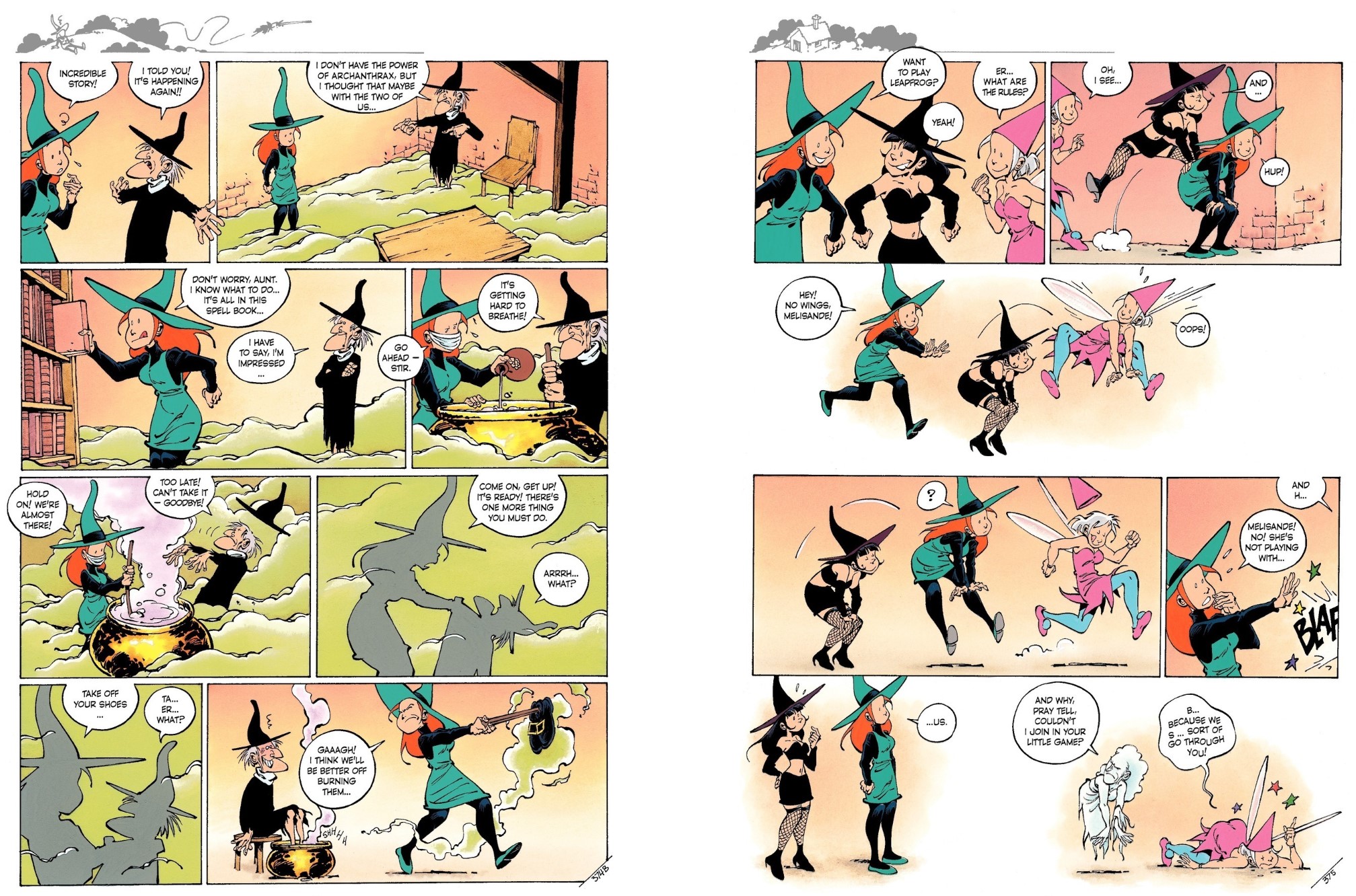
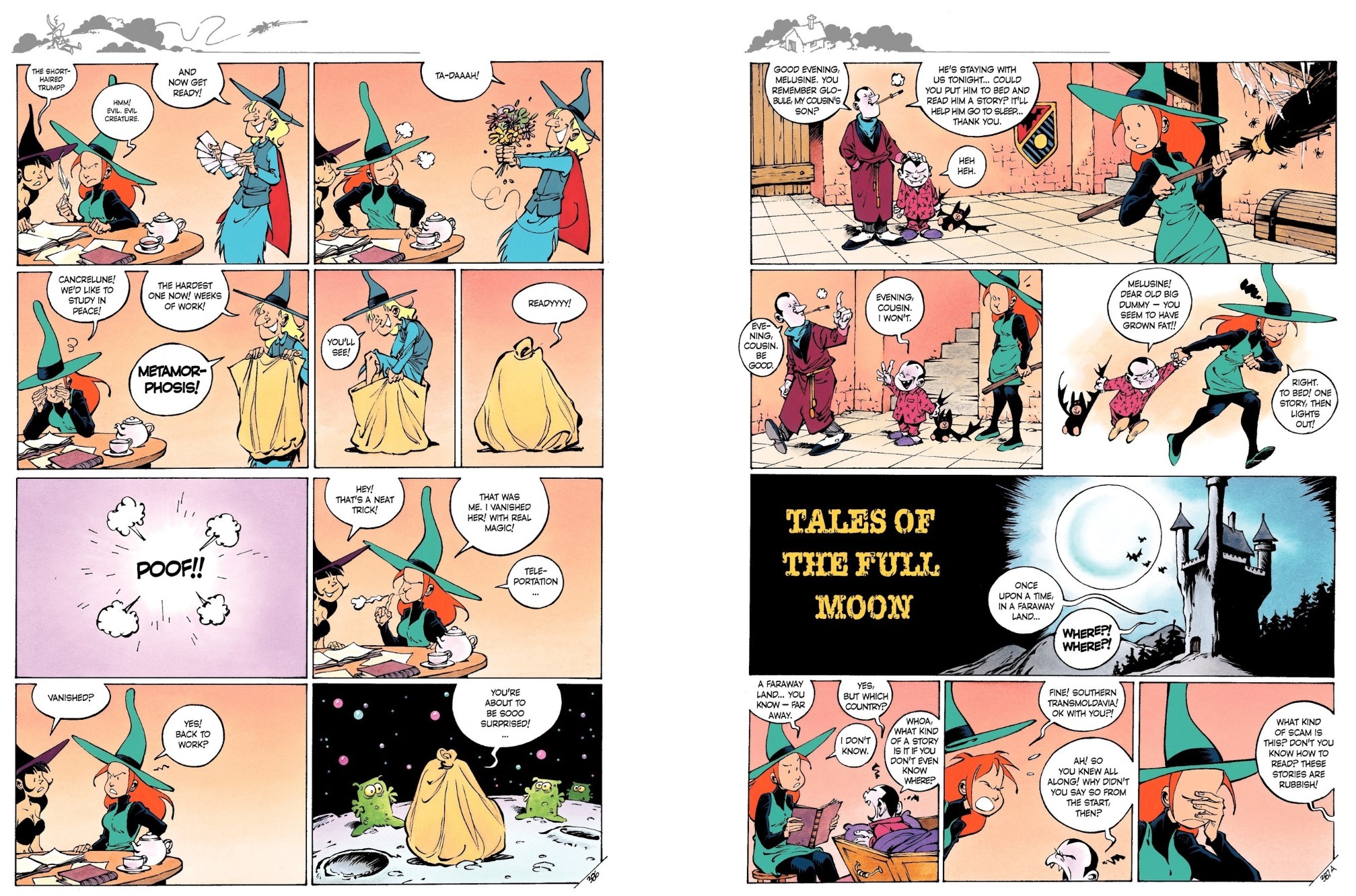
Continentally released in October 2002, Contes de la pleine lune was the 10th groovy grimoire of mystic mirth and is again most welcoming: primarily comprised of single or 2-page gags starring the enticing enchantress and delightfully eschewing continuity for the sake of new readers’ instant approbation. When brittle, moody, over-stressed Melusine isn’t being bullied for her inept cleaning skills by the matriarchal ghost-duchess who runs the castle; ducking cat-eating monster Winston; dodging frisky vampire The Count or avoiding unwelcome and often hostile attentions of horny peasants and over-zealous witch-hunting priests, the wily witchlette can usually be found practising spells or consoling/coaching inept, un-improvable and lethally unskilled classmate Cancrelune.

Unlike Mel, this sorry sorceress-in-training is a real basket case: her transformation spells go appallingly awry; she can’t remember incantations and her broomstick-riding makes her a menace to herself, any unfortunate observers… and even the terrain and buildings around her.

As the translated title suggests, Tales of the Full Moon dwells on demolishing fairy fables and bedevilling bedtime stories but also gives proper introduction to Mel’s best friend Krapella: a rowdy, roistering, mischievous and disruptive classmate who is the very image of what boys want in a “bad” witch…

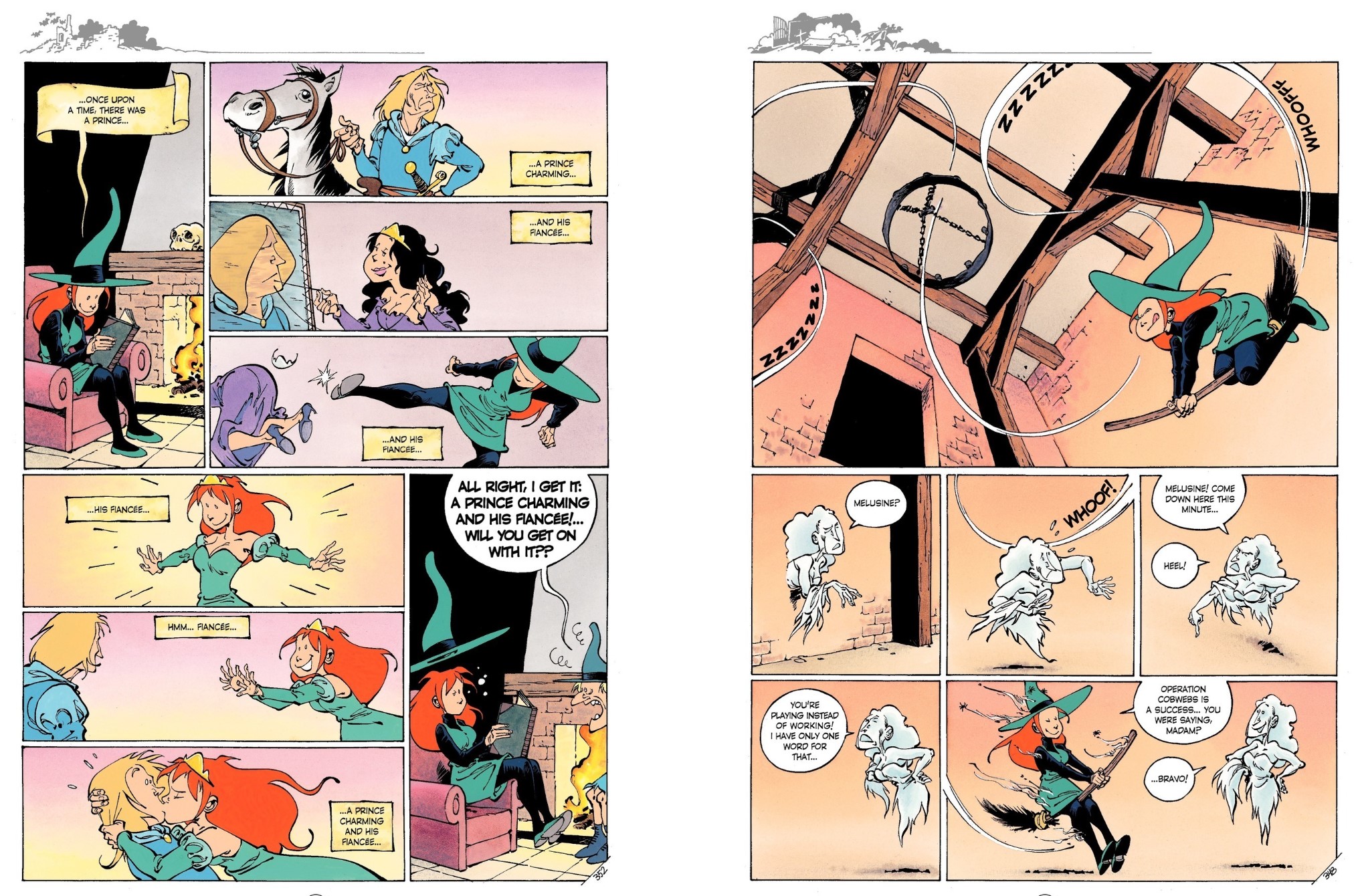
This tantalising tome is filled with narrative nostrums featuring the traditional melange of slick sight gags and pun-ishing pranks highlighting how our legerdemainic lass finds a little heart’s ease by picturing how one day she’ll have her very own Prince Charming. Sadly, every dream ends – usually because there’s something sticky that needs cleaning up – but Melusine absolutely draws the line when Cancrelune (and even her own sweetness-&-light Fairy cousin Melisande!) start hijacking her daydreams…

This fusillade of fanciful forays concludes with eponymously titled, extended episode Tales of the Full Moon wherein Melusine is ordered to read a bedtime story to the Count’s cousin’s son: obnoxiously rambunctious junior vampire Globule, who insists on twisting her lovely lines about princesses and princes into something warped and Gothic… and even that’s before Cancrelune starts chipping in with her own weird, wild suggestions and interjections…

Wacky, wry, sly, infinitely inventive and uproariously funny, this arty arcana of arcane antics is a terrific taste of Continental comics wonderment: a beguiling delight for all lovers of the cartoonist’s art. Read well before bedtime – or you’ll be up laughing all night…
Original edition © Dupuis, 2002 by Clarke & Gilson. All rights reserved. English translation 2014 © Cinebook Ltd.

Speaking of Dark Nights, today in 1915 Bob Kane was born. Whatever happened to him?
Today in 1906 Golden Age comics scripter Joe Samachson was born. He’s all over this blog so just initiate a little search dialogue action to know more.

And in 1938 the inimitable E.C. “Elzie” Segar died. We last worshipped at his salty feet with Popeye: The E.C. Segar Popeye Sundays volume 4: Swea’Pea and Eugene the Jeep (February 1936 – October 1938); so should you as soon as possible.

The Complete Peanuts volume 1: 1950-1952


By Charles Schulz (Canongate Books/Fantagraphics Books)
ISBN: 978-1-56097-589-2 (Fantagraphics HB) 978-1-60699-763-5 (Fantagraphics TPB) 978-1-84767-031-1 (Canongate)

This book includes Discriminatory Content produced in less enlightened times.

Win’s Christmas Gift Recommendation: All that’s great about cartoon strips… 10/10

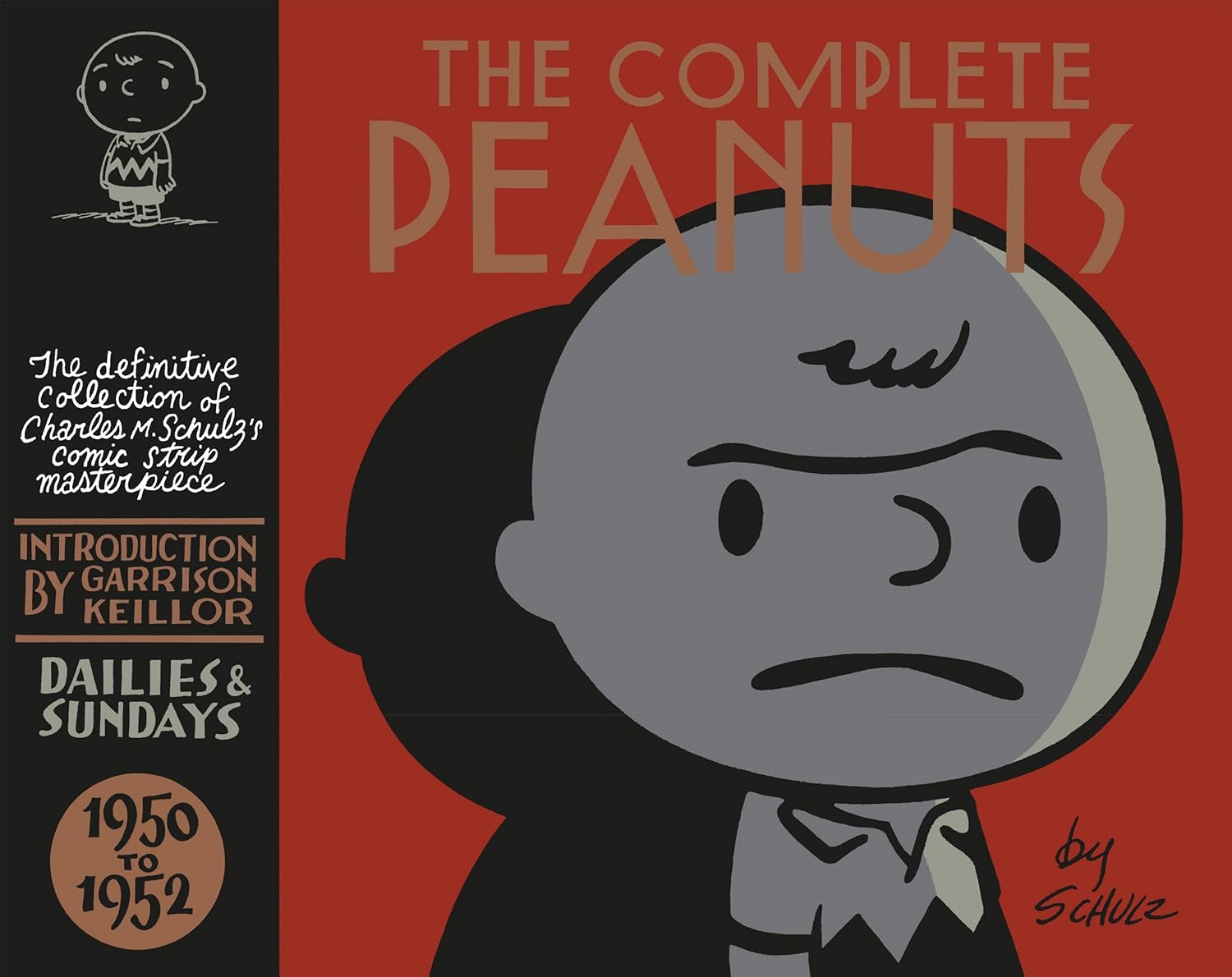
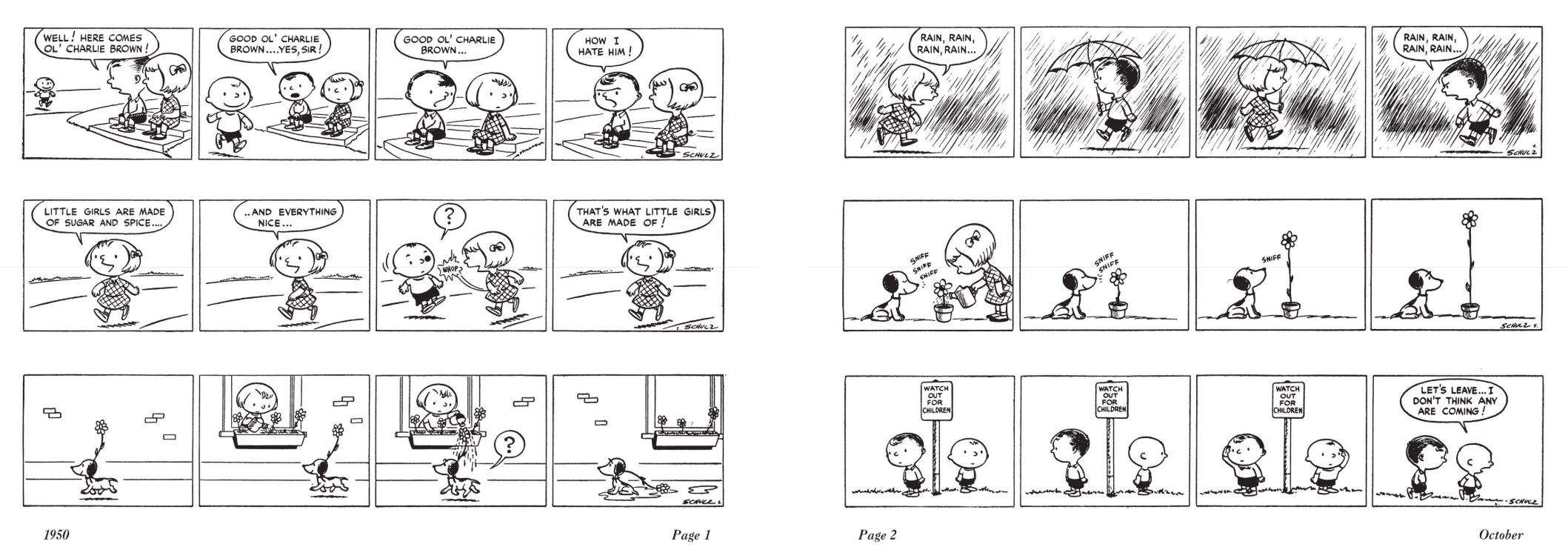
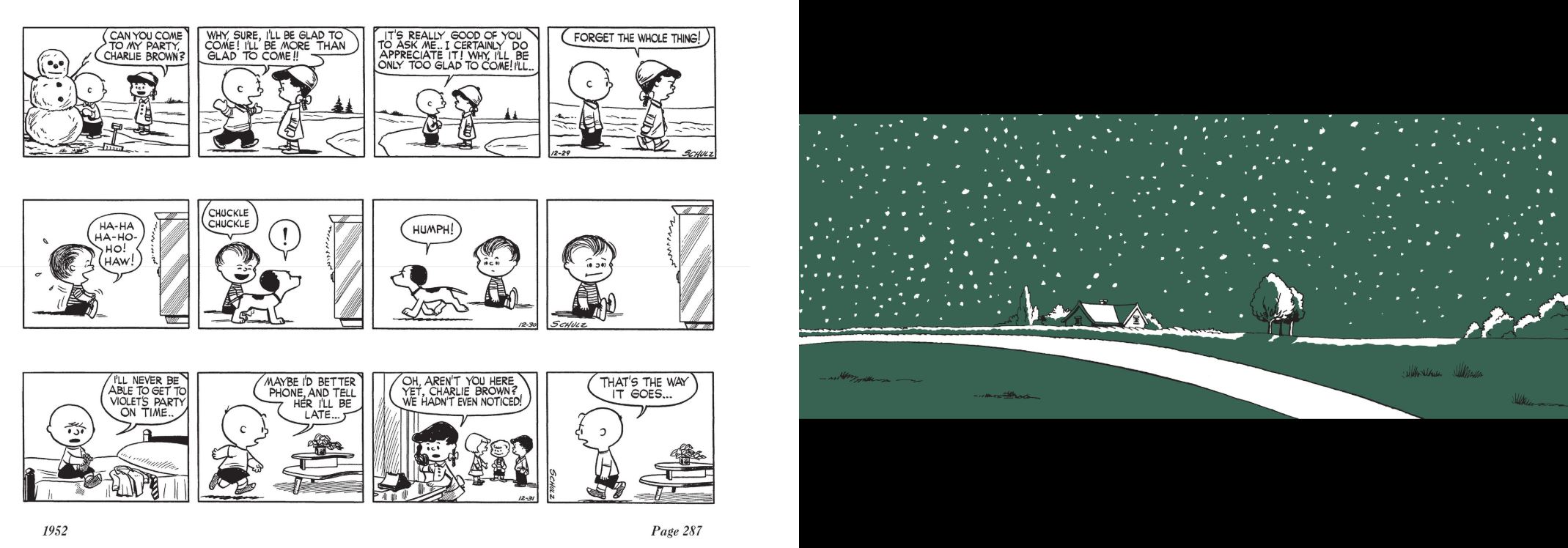
Peanuts is unequivocally the most important comics strip in the history of graphic narrative. It is also the most deeply personal. Today in 1950 it all began, and cartoonist Charles M Schulz went on crafting his moodily hilarious, hysterically introspective, shockingly surreal philosophical epic for half a century: 17,897 strips spanning October 2nd 1950 to February 13th 2000.

He died from complications of cancer the day before his last strip was printed.

At its height, Peanuts ran in 2,600 newspapers, in 21 languages and in 75 countries. Many of those venues still run it as perpetual reprints, and have ever since his death. During Schulz’s lifetime, book collections, a merchandising mountain and television spin-offs had made the publicity-shy doodler an actual billionaire at a time when that really meant something…

None of that matters. Peanuts – a title Schulz loathed, but one the syndicate forced upon him – changed the way comics strips were received and perceived: proving cartoon comedy could have edges and nuance and meaning as well as soon-forgotten pratfalls and punchlines.

Following a typically garrulous, charming and informative Introduction from fellow Minnesotan Garrison Keillor, this mammoth (218 x 33x 172 mm) landscape compendium offers the first two and a bit years. Here a prototypical, rather outgoing and jolly Charlie Brown and high-maintenance mutt Snoopy joined with bombastic Shermy and mercurial Patty in hanging out doing kid things.

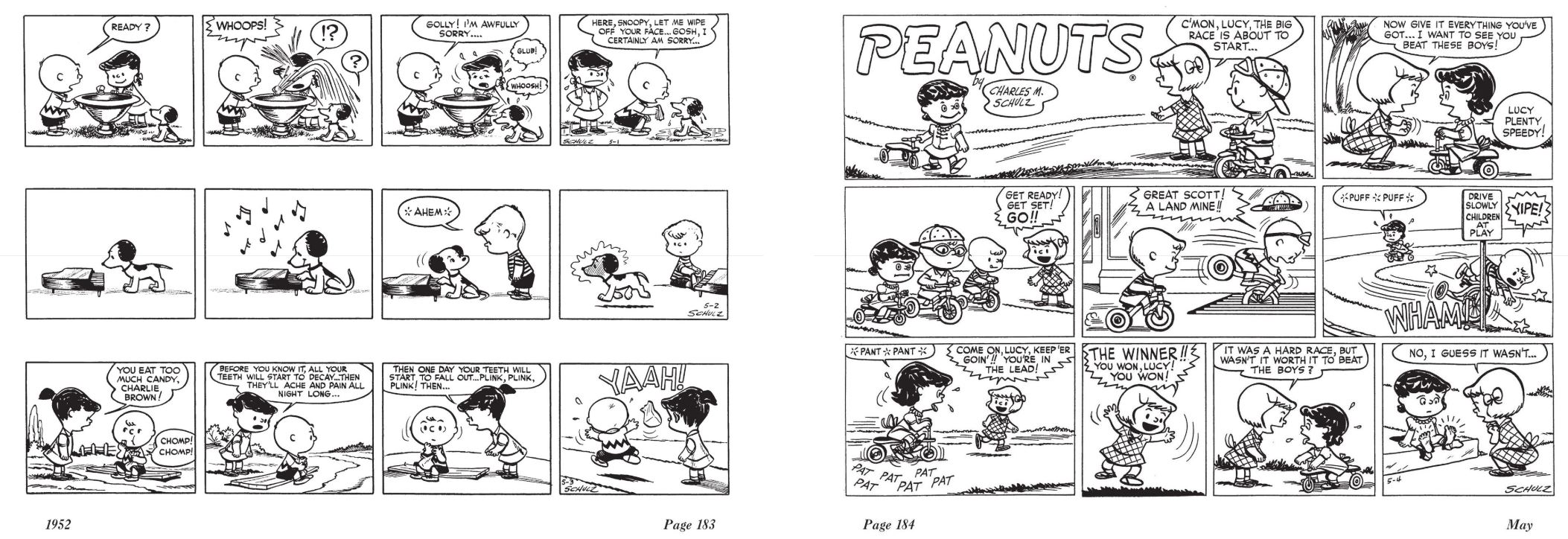
These include playing, playing pranks, playing sports such as tennis, golf and baseball, playing musical instruments, teasing each other, making baffled observations and occasionally acting a bit too much like grown-ups. Fans of Bill Watterson’s Calvin and Hobbes will feel eerie familiarity with much of the hijinks and larks of these episodes.

As new characters Violet, infant prodigy Schroeder, and Lucy and her strange baby brother Linus were added to the mix, the boisterous rush of the series began to imperceptibly settle into a more contemplative pace. Charlie Brown began to adopt and embrace his eternal loser, singled-out-by-fate persona and the sheer diabolical wilfulness of Lucy began to sharpen itself on everyone around her…

The first Sunday page debuted on January 6th 1952; a standard half-page slot offering more measured fare than the daily. Both thwarted ambition and explosive frustration became part of the strip’s signature denouements…

By the end of 1952, all those the rapid-fire gags had evolved from raucous slapstick to surreal, edgy, psychologically barbed introspection, garnished by crushing judgements and deep rumination in a world where kids – and certain animals – were the only actors. The relationships, however, were increasingly deep, complex and absorbing even though “Sparky” Schulz never deviated from his core message: entertain…

David Michaelis then celebrates and deconstructs ‘The Life and Times of Charles M. Schulz’ after which Gary Groth & Rick Marschall conduct ‘An Interview with Charles M. Schulz’, rounding out our glimpse of the dolorous graphic genius with intimate revelations and reminiscences whilst a copious ‘Index’ offers instant access to favourite scenes you’d like to see again.

Readily available in hardcover, paperback and digital editions, this initial volume offers a rare example of a masterpiece in motion: comedy gold and social glue gradually metamorphosing in an epic of spellbinding graphic mastery which became part of the fabric of billions of lives, and which continues to do so long after its maker’s passing.

Happy ever afters, kids.
The Complete Peanuts: 1950-1952 (volume 1) © 2004 Peanuts Worldwide, LLC. Introduction © 2004 Garrison Keillor. “The Life and Times of Charles M. Schulz” © 2000 David Michaelis. “Interview with Charles M. Schulz” © 2004 Gary Groth and Richard Marschall. All other material copyright its respective owners. All rights reserved.

Today in 1909 Alex Raymond was born. You’ll know him best for stuff like Flash Gordon on the Planet Mongo volume 1: Sundays 1934-1937 (The Complete Flash Gordon Library. In 1916 Bob Powell, was born. He went on to do things like Bob Powell’s Complete Jet Powers.

Ramona Fradon was born in 1926, and Spirou stalwart Janry arrived in Belgium in 1957, whilst Maltese docu-comics journalist Joe Sacco was born in 1960. You can find dozens of books by the first two just by using a search box here, and I’ve almost summoned enough nerve to review Sacco’s Palestine despite – or because of – these febrile times…

My Dad Fights Demons


By Bobby Joseph & Abbigayle Bircham (SelfMadeHero)
ISBN: 978-1-914224-34-8 (TPB)

This book includes Discriminatory Content included for dramatic and comedic effect.

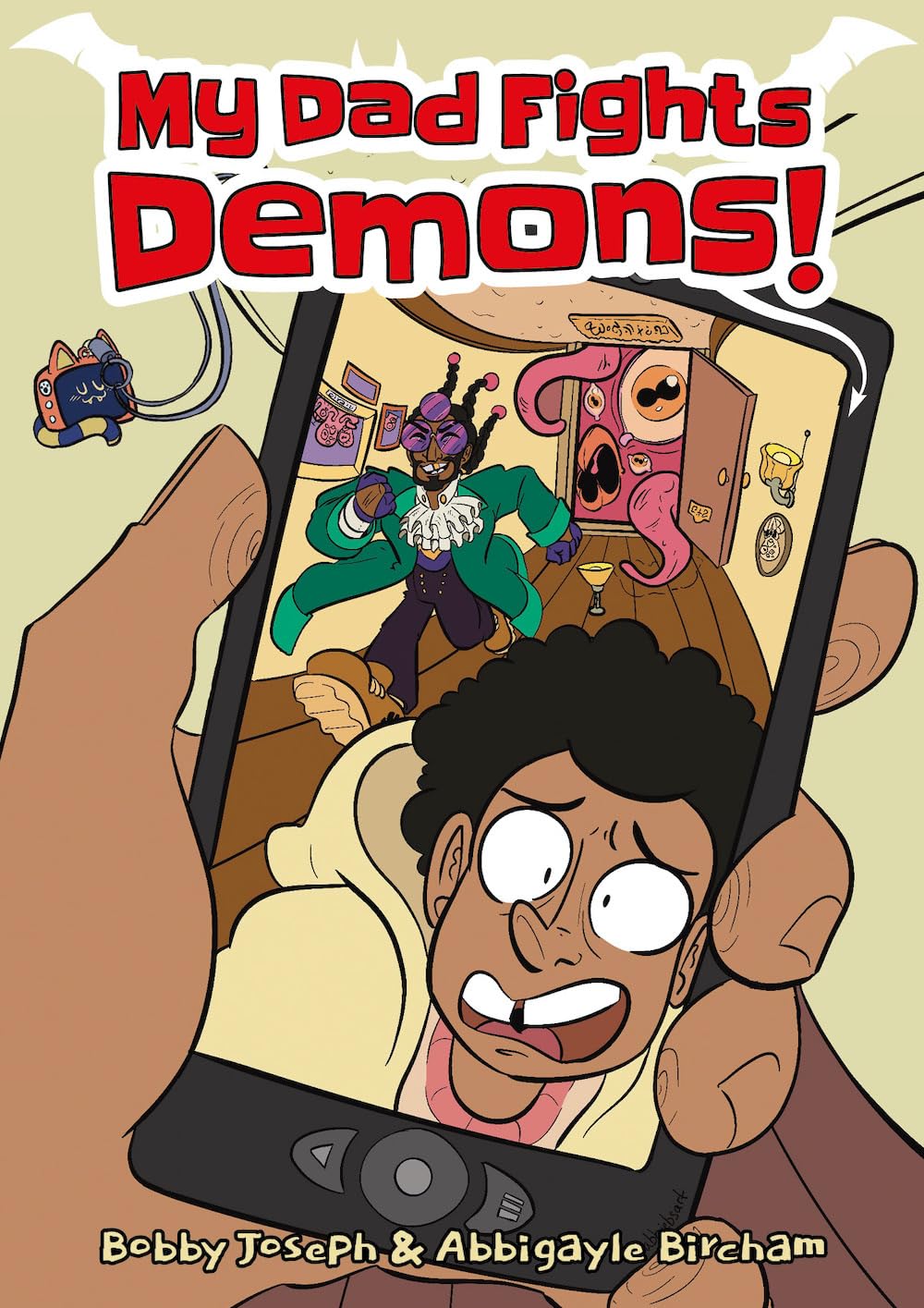
Here’s a short, sweet and sarcastically sharp poke at modern culture’s transient nature, mayfly attention-spans and perennially parlous state, delivered in a delicious ribald and deceptively irreverent tone and stylee (not a typo). The deed is done by street-wizened South Londoner and incumbent Comics Laureate Bobby Joseph (Dazed and Confused, Vice, The Guardian, Skank Magazine, Scotland Yardie) and rising star Abbigayle Bircham (Soaring Penguin Press, The Rat Pack Collective).

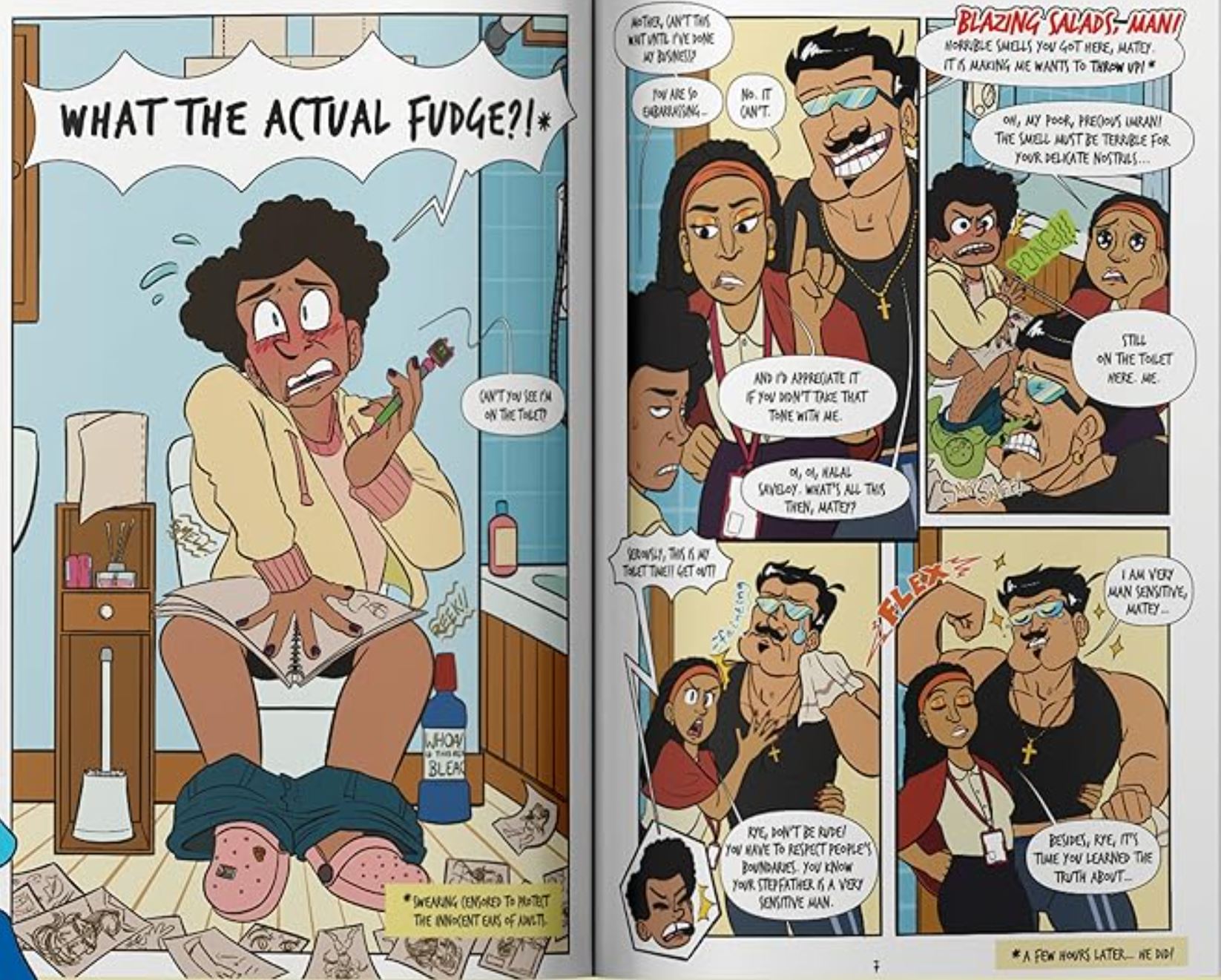
Anarchic, subversive and definitely NOT for little kids – unless they live inside the heads of adult-seeming types – here is a potent close-up peep at little Londoner Rye who is navigating the already-too-much-to-bear life of a kid trying to find themselves in a world of constant confliction and change-made-for-profit. The often overwhelmed and undervalued young ’un is just about coping with being vegan, addicted to sprout flavoured vapes, embarrassed by mum and her man, unappreciated by peers and schoolmates and generally not digging life when another body blow lands…

Mum and her manly beau – overly eager for a little intimate alone time – suddenly spring the news that Rye’s biological dad is in town and will be exercising visitation rights for the weekend. That’s when Rye first learns that Mr. Mantriks is not actually deceased (as was previously believed) but is in fact a wizard – “greatest sorcerer in the world” – who has been defending reality from inside a hell dimension for most of Rye’s short life.
Such reunions are always a bit uncomfortable, but this one is more fraught than most as daddy (and his appalling goblin familiar “Gobby”) are criminally unaware of how life has moved on, and are fact only really here to retrieve a lost spell of catastrophically evil potential.

However, like all such odd couple yarns, there’s the promise of reconciliation and a happy ending in store, but only if the long-parted in loco parentis pair – and Rye! – can mend long-ignored fences, avoid waves of disembodied body-parts, the allure of parallel universes (and fried chicken shops), totally solve the mystery of the lost cantrip and foil the cunning convoluted schemes of demonic social influencers who shouldn’t be here and SHOULD know better…

Manic-paced and wildly imaginative, this yarn might be impenetrable to certain ossified sections of the readership were it not for the absolutely indispensable aide memoire ‘Gobby’s Guide to UK Slang!’ Moreover, once an ending is reached, you can learn a little of the how and why thanks to ‘Sketches and development work’ provided by the creators…
Text and images © 2025 Bobby Joseph and Abbigayle Bircham. All rights reserved.

Today in 1911, artist Charles Paris was born. Although he probably inked every great pre-Silver Superman & Batman story you’ve ever read, I’d recommend checking out DC Finest: Metamorpho – The Element Man for a wilder ride.

In 1922, unsung comics icon & secret weapon Roz Kirby entered the world, whilst six years later comic strip pioneer Richard Outcault left it. I’m sure you already know all about him, but just in case why not look at Buster Brown: Early Strips in Full Color?