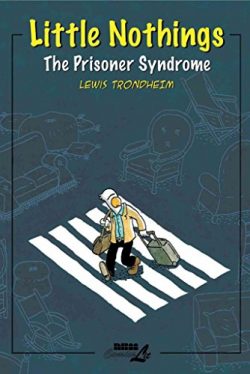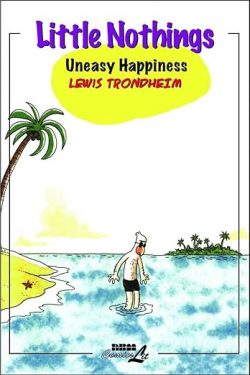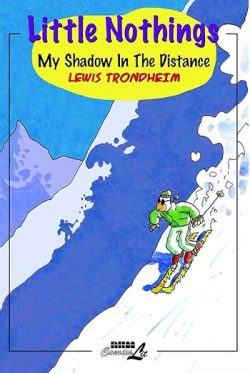
Little Nothings volumes 1-4: The Curse of the Umbrella, The Prisoner Syndrome, Uneasy Happiness, My Shadow in the Distance


By Lewis Trondheim, translated by Joe Johnson (NBM/ComicsLit)
ISBN: vol. 1: 978-1-56163-523-8 (Album PB), vol. 2: 978-1-56163-548-1 (Album PB),

vol. 3: 978-1-56163-576-4(Album PB), 978-1-56163-523-8 (Album PB),

I first became aware of Lewis Trondheim’s subtly enchanting vignettes in Fantagraphics’ Mome comics anthologies rather than through its internet presence and it’s a constant and utter delight for this old duffer (me, not him) to see this blend of cartoon philosophy, personal introspection, whimsical inquiry and foible-filled observations gathered into such handy tomes for constant re-reading. With over 100 books sporting his name (which isn’t actually Lewis Trondheim but Laurent Chabosy), the writer/artist/editor/educator is one of Europe’s most prolific comics creators: illustrating his own work, overseeing animated cartoons of such print successes as La Mouche (The Fly) and Kaput and Zösky or editing younger readers books (Dargaud’s series Shampooing).

His most famous works are global hits Les Formidables Aventures de Lapinot (translated as The Spiffy Adventures of McConey), Infinity 8, Ralph Azam and, with Joann Sfar, epic nested fantasy series Donjon as seen anglicised as Dungeon, Dungeon: Parade, Dungeon: Monstres, Dungeon: the Early Years et al. In his spare time he has written for satirical magazine Psikopat and provided scripts for the continent’s most popular artists, such as Fabrice Parme, Manu Larcenet, José Parrondo and Thierry Robin. Trondheim is, of course, a cartoonist of uncanny wit: piercing, gentle perspicacity, comforting affability and self-deprecating empathy, and prefers to control scrupulously what is known and said about him…

Some while ago the well-travelled graphic introvert began drawing a deliciously intimate cartoon blog wherein all the people Trondheim knows are rendered as anthropomorphised animals (with him a dowdy, parrot-beaked actor/director) which has been edited into a series of enchanting full-colour albums. Page after page of introspective, whimsical, querulous and enticingly intriguing reportage has emerged since.

Volume 1 – The Curse of the Umbrella – features ruminations on gardening and possessing a vegetable death-touch; introduces his family; examines a love-hate relationship with technology and computer games, also covering the dramas of becoming first time cat-owners at an advanced (human) age. Similarly scrutinised are hypochondria and the internet’s impact as an enabler of such recurs, as also work-processes for the self-employed, snacks, keeping fit, memory, death, bird-poop, the weather and travel to comics events in exotic locations such as the Reunion Islands and Edinburgh.

The daily bulletins explore little events and really big themes and there are also purely visual moments that you just have to see to appreciate and get…

In second volume The Prisoner Syndrome, the cascade of cartoon delights continues with more of the same whilst adding summer beach madness, floating with the fishes, exploring volcanoes, ecology and hotel wastefulness, comic convention memory (so different from the regular kind). There’s animal antics, travel, energy-saving, visiting Africa, Guadeloupe, Romania and London, the differences between men and women, global political crises and the heartbreaking helplessness and inevitable consequences of seeing your pet die.

Third stanza Uneasy Happiness sees our absurdly bird-faced gentleman amicably nit-picking and further musing his way through the life of an old and successful comic creator: travelling to conventions, making stories and dealing with the distressingly peculiar modern world, especially focusing on his increasing hoarding proclivities, concerns over his creative and financial legacy, mice in the bookshelves and packing…

The ruminations and anti-dramas regularly range from his inability to de-clutter (every comic maven’s weakness!), toilet etiquette (public and private), gadgets, marriage, parenthood, the actual science in TV shows, how mad are cats, brilliant ideas that come when you’re asleep, computers (again and still!), and getting old, all interspersed with reactions to the many wonderful places he has visited on the comics convention circuit (Venice, Portugal, Fiji, Australia and others in this volume alone).

My Shadow in the Distance was the fourth Little Nothings accumulation of deliciously rendered watercolour epigrams…

This collection focuses heavily on Trondheim’s global peregrinations – with and without his family – to such far-flung places as Iceland, America (for an extended and hilariously unsettling family vacation spanning New York to Las Vegas), Quebec & Canada, Germany, Prague, Madrid, Italy, Corsica, Argentina, Ushuaia, Antarctica and Africa, with all attendant joys and night-terrors such voyages engender for him.

As ever, the auteur highlights the ways in which humans vary whilst remaining intrinsically similar – although only my own German forebears could possibly have devised such a brilliant method of enhancing and yet sanitising men’s urinal experiences…

Trondheim also finds time and space to ponder the inevitable decline in quality of movie sequels; roaming credit-card charges; his health, travel etiquette and preparation; the pitfalls of snacking; airports everywhere; the urge to eavesdrop; varying quality of hotels; weather & climate; forgetfulness; comics conventions; fans & professionals; personal space & getting old; skiing holidays; making your own music and what cats are good for before concluding with an extended if rather grotesque episode covering nasal polyp surgery and his inevitable overreaction to it…

All genteelly re-coloured for book publication, Little Nothings is easily one of the most comforting, compelling biographical comics series ever created: gently contemplative, subtly pleasing and ineffably something no fan of any advanced or significant vintage would care to miss. I once more strongly suggest that if you need a little non-theological, un-theosophical yet hilariously existential spiritual refreshment you take advantage of these visual bon mots toot da sweet and with the utmost alacrity…
© 2009-2010 Trondheim. English translation © 2010, 2011 NBM. All Rights Reserved.

Today in 1934, Batman, Phantom and Aquaman artist Don Newton was born. In 1977 landmark UK comic Action was controversially cancelled. In 2003 US artist John Tartaglione died. He was a solid journeyman best know now for his inking during the 1960s and 1970s but he was good at his job and should be lauded for it. Go Google or scroll about on this blog for more.

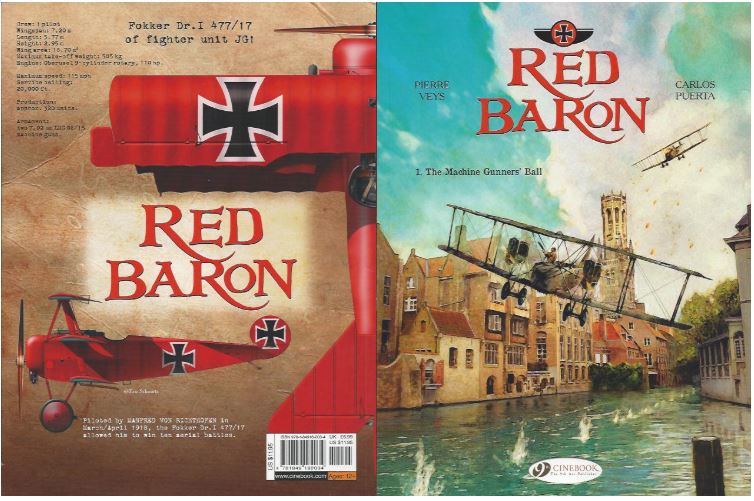
Red Baron volumes 1- 3: The Machine Gunner’s Ball, Rain of Blood & Dungeons and Dragons


By Pierre Veys & Carlos Puerta, translated by Mark Bence (Cinebook)
ISBN:  978-1-84918-203-4 (Machine Gunner’s Ball Album PB),
978-1-84918-211-9 (Rain of Blood Album PB),
978-1-84918-252-2 (Dungeons & Dragons Album PB)

With the passage of more than a century and as those involved have all passed on, the Great War has notionally become an historical conflict. That means for many forms of media – especially film and television – it’s become demi-semi-fictional and can be employed as a useful tool to tackle other themes and tropes. It’s something comics have done for years…

There have been some astounding comics stories about the Great War. Pat Mills & Joe Colquhoun’s Charley’s War still tops the list for me – with Tardi’s It Was the War of the Trenches! & Goddamn This War! – holding hard on its heels, but the centennial conflict has generated plenty more thought-provoking sagas for us all to savour.

One particularly beautiful, strangely intriguing fictionalised fantasy – which began in 2012 as Baron rouge: Le Bal des Mitrailleuses – takes a fascinating step into the bizarre with an inspired tale in faux-autobiographic mode, as described by air ace and military man-into-myth Manfred von Richthofen. Scripted with great style and Spartan simplicity by prolific bande dessinée writer Pierre Veys (Achille Talon, Adamson, Baker Street, Boule et Bill/UK, les Chevaliers du Fiel), the drama is stunningly illustrated by advertising artist and veteran comics painter Carlos Puerta (Los Archivos de Hazel Loch, Aeróstatas, Tierra de Nadie, Eustaquio, Les Contes de la Perdition) in a staggeringly potent photo-realistic style.

The action begins with ‘Chivalry’ as the infamous Red Baron pursues his latest target through lush countryside and historical landmarks of the Front. Forcing the British Spad XIII to the fields below, the handsome Hun is just in time to see the light fade from his foe’s eyes forever.

The sight gives him indescribable, ineffable pleasure…

As he returns to the skies, Von Richthofen’s mind drifts back a decade to his time in Berlin’s Military Academy and how his expertise in the gymnasium made him a target of the rich Junker scions who clustered around spoiled, vicious Prince Friedrich. Already despised and disdained, the proud, cocky young man happily embarrassed the Prince and walked into the changing rooms fully expecting a beating…

Then, for the first time, his “power” manifested. Believing himself able to somehow read the minds of his attackers, Manfred viciously trounced them all and provoked a dread in his would-be tormentors that carried him safely to graduation. Talking the strange event over with his pal Willy, Von Richthofen deduced it is the taste of true danger that triggers his gift. He later tests the theory: heading for the worst part of town to provoke the peasants and rabble. However, he never questioned how or why such savage exercise of brutal violence made him feel so indescribably happy…

When the war began, former cavalry officer Manfred had further proof of his talent when he casually acted on a vague impulse and avoided lethal shelling from a threat he could neither see nor anticipate. Soon after, he joined the Fliegertruppen (Imperial German Flying Corps) as gunner in a two-man reconnaissance craft and learned that to the men in the trenches below, one nation’s planes were as dangerous as the other’s… and they all needed to be shot at…

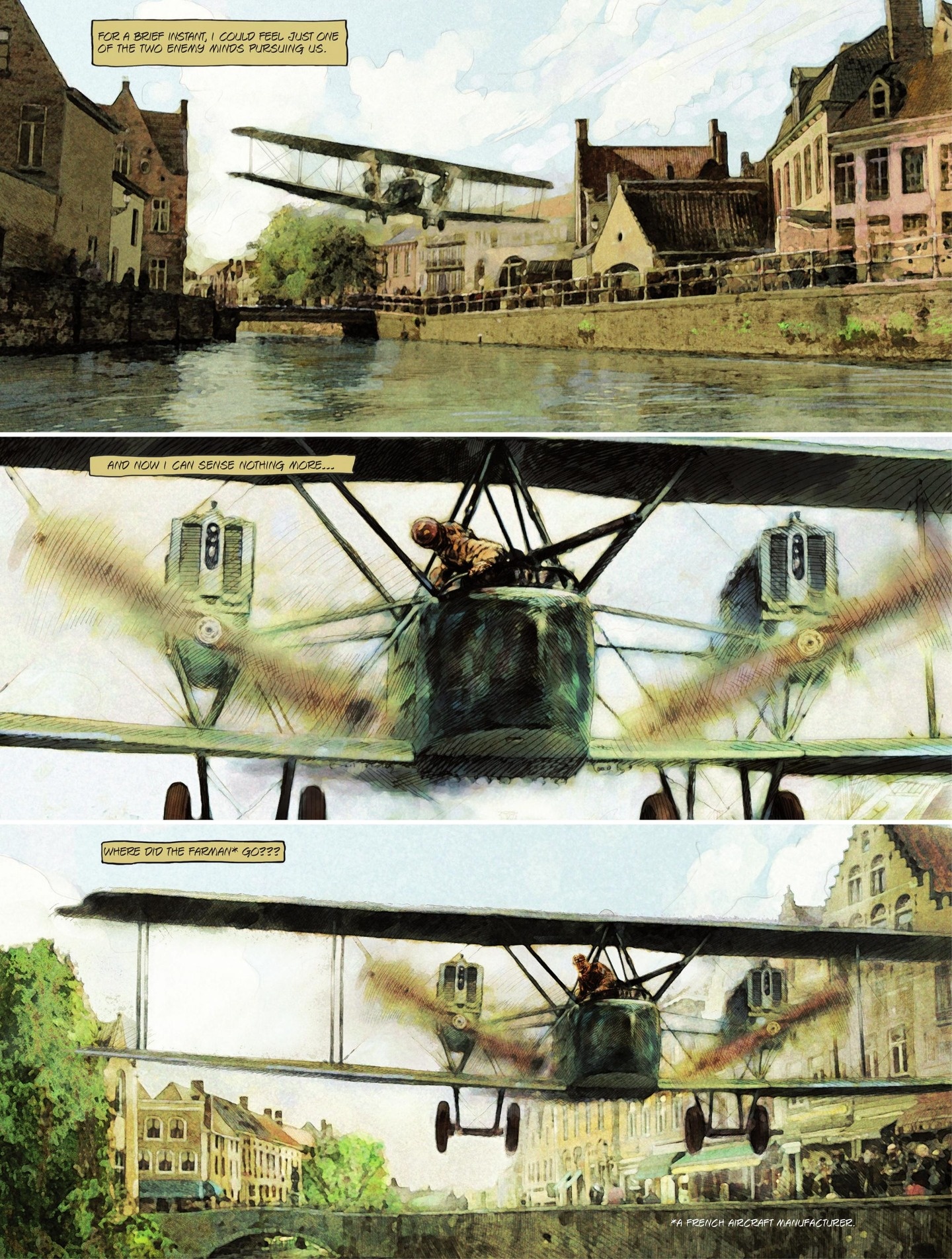
Thanks to a whirling propeller, he also painfully realised he was not beyond harm: a fact that was reiterated when he and pilot Georg were suddenly attacked by a French aircraft and he found himself in his first dogfight over the scenic Belgian landscape…

To be Continued…

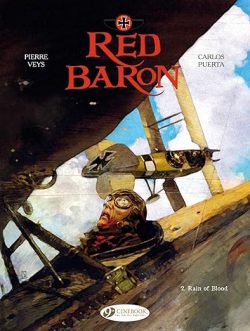
Red Baron volume 2: Rain of Blood
The gripping thriller daringly continues in second no-nonsense instalment Baron rouge: Pluie de sang which debuted Continentally in 2013. Here, the illuminating inner ruminations resume their fascinating, faux-autobiographic course as notionally described by the titular flier, in the established, staggeringly potent photo-realistic style.

In the first volume young military student Manfred discovered an uncanny psychic gift: when endangered he could read opponents’ intentions and counteract every attack. Immediate peril seemingly triggered his gift which he subsequently tested by heading for the worst part of town to provoke and pummel the peasants and rabble. Manfred never questioned how or why the savage exercise of brutal violence – especially killing – made him feel so good…

A cavalry officer when the conflict kicked off, he sought and always found further proof of his talent but could never convince his sole confidante, even after transferring to the Imperial German Flying Corps. The saga picks up here as Von Richthofen barely survives his first taste of sky-borne dogfighting and immediately resolves to learn how to properly fly. Never again will he trust his life to someone else’s piloting skills…

Sadly, he is very far from being a natural pilot. Only hard work and persistence allow him to qualify as a flier. Even after his first kill, he cannot stop his privileged, elitist comrades laughing at his pitiful landings…

Things start to change after he modifies his two-man Albatross C.111 so that he can fire in the direction of his flight, rather than just behind or to the sides. Now a self-propelled machine-gun, Von Richthofen returns to the skies and scores a delicious hit on a hapless British pilot. Days later his joy increases when Willy is assigned to his squadron.

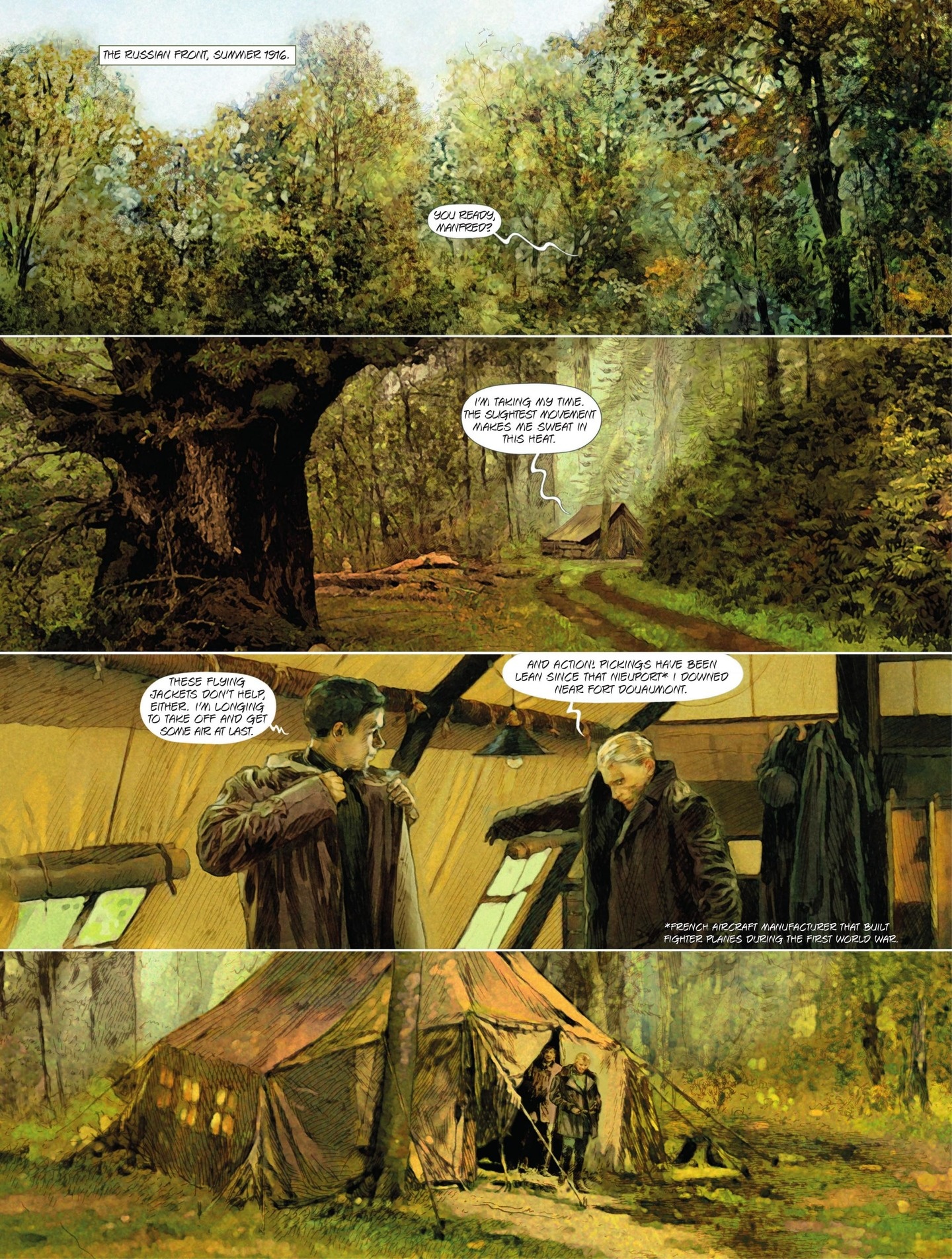
Sharing the spoils of occupation life, von Richthofen relates his earliest war exploits as a cavalryman pushing east into Russia. A grisly escapade with a single Uhlan against a company of Cossacks is again greeted with tolerant disbelief, and Willy is only mildly surprised by the callous indifference Manfred displays when recalling how he hanged some monks whilst moving through Belgium to the Western Front. Now, the affronted boaster is determined to prove his powers are real, and opportunity comes when they come across enlisted men indulging in a boxing match.

Lieutenant von Richthofen orders them to let him join in: facing down hulking brute Stoph, German national champion before hostilities started. As Willy watches his slightly-built school chum easily avoid every lethal blow before slowly and methodically taking his opponent apart, he finally believes.

He also begins to feel fear…

To be Concluded…

Red Baron volume 3: Dungeons and Dragons
Launching in 2015, Baron rouge: Donjons et Dragons marches steadfastly to the finish of this fantastic fascinating, faux-tobiography related from the horseman’s mouth, in a beguiling album.

Having followed the peril-packed path to success of a psychotic psychic psycho-killer who found his niche in the Great War by perseverance and practice, and by perfecting his trade tools, found his final fate. Now a self-propelled gun, Von Richthofen mastered the skies…

The story recommences here with Manfred utterly revelling in murderously destructive excesses of his new killing proficiency. His successes bring him and wingman Willy to the attention of national hero and top air ace Oswald Boelcke, who invites him to join his new fighter squadron…

Manfred’s gory glee is only barely dimmed by the discovery that among his new comrades is old school archenemy Prince Friedrich who – complete with new coterie of sycophantic hangers-on – vows vengeance for past indiscretions…

Manfred’s gift for slaughter continues to grow, especially after being assigned a string of increasingly more efficient flying machines. However, after a close call against a calmly methodical British pilot, von Richthofen realises a way to enhance his psychic advantage in the air and paints his ships blazing scarlet to unsettle and terrify airborne opponents…

Less easily handled is Friedrich and his gang. Thanks to his gift, Manfred knows they intend to murder him and takes swift, merciless and pre-emptive action to end their threat. However, even after ruthlessly eliminating his notional comrades, the Red Baron’s problems do not end despite his daring and bravado: prompting a bravura daily performance of sang-froid seeing him triumph over every burgeoning horror and mechanical innovation of the War To End All Wars: tanks, submarines and even naval destroyers…

A net of evidence is closing around Manfred and despite his insouciance, the hunter-killer feels something is coming on the sunny morning he joins the flight to escort a Zeppelin safely home. Of course, his arrogant overconfident cockiness proves to be his ultimate downfall that day…

A sharp and shocking blend of staggering beauty and distressingly visceral violence, The Red Baron is a strange brew of traditional war story and horror yarn mixing epic combat action with enthralling suspense. The concept of the notorious knight of the clouds as psychic psycho-killer is not one many purists will be happy with, but the conceit is executed with superb conviction and the illustration is both potently authentic and gloriously lovely.

A decidedly different combat concoction: one jaded war lovers should definitely dabble with.
Original edition © Zephyr Editions 2012, 2014 by Veys & Puerta. All rights reserved. English translation 2014, 2015 © Cinebook Ltd.

Today in 1942 we lost pioneering cartoonist Billy de Beck, creator of Barney Google and Snuffy Smith. However, one year later Dave Cockrum was born, and look what he went on to do. On a less famous but equally entertaining note, in 1969 James A Owen was born and you can and should assess his classic Starchild: Awakenings.

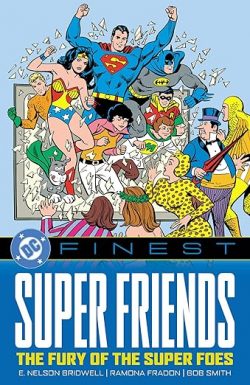
DC Finest: Super Friends – The Fury of the Super Foes


By E. Nelson Bridwell, Denny O’Neil, Ramona Fradon, Kurt Schaffenberger, Ric Estrada, Alex Toth, Joe Orlando, Bob Smith, Vince Colletta with Dick Giordano, Curt Swan & Geoge Klein & various (DC Comics)
ISBN: 978-1-79950-316-3 (TPB)

This book contains Discriminatory Content produced during less enlightened times.

Win’s Christmas Gift Recommendation: Evergreen Superhero Sagas For All… 9/10

Once upon a time comics were primarily created with kids in mind. Whilst I’d never advocate exclusively going back to those days, the modern industry has for the longest time sinned by not fully addressing the needs and tastes of younger fans these days. By that I mean less tie-ns and more accessible standard stoires like Marvel Adventures material or this stuff here.

Happily, DC has latterly been rectifying the situation with new and – most importantly for old geeks like me – remastered, repackaged age-appropriate gems from their vast back catalogue.

A superb case in point of all-ages comics done right is this tome celebrating the joys of childhood when comics and TV shows were interchangeable in kids’ head. It was all one great big dangerous fun world to save or conquer…

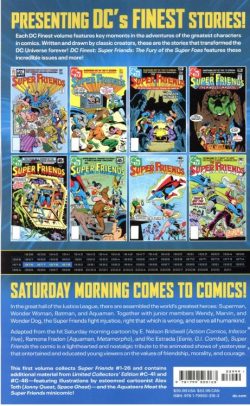
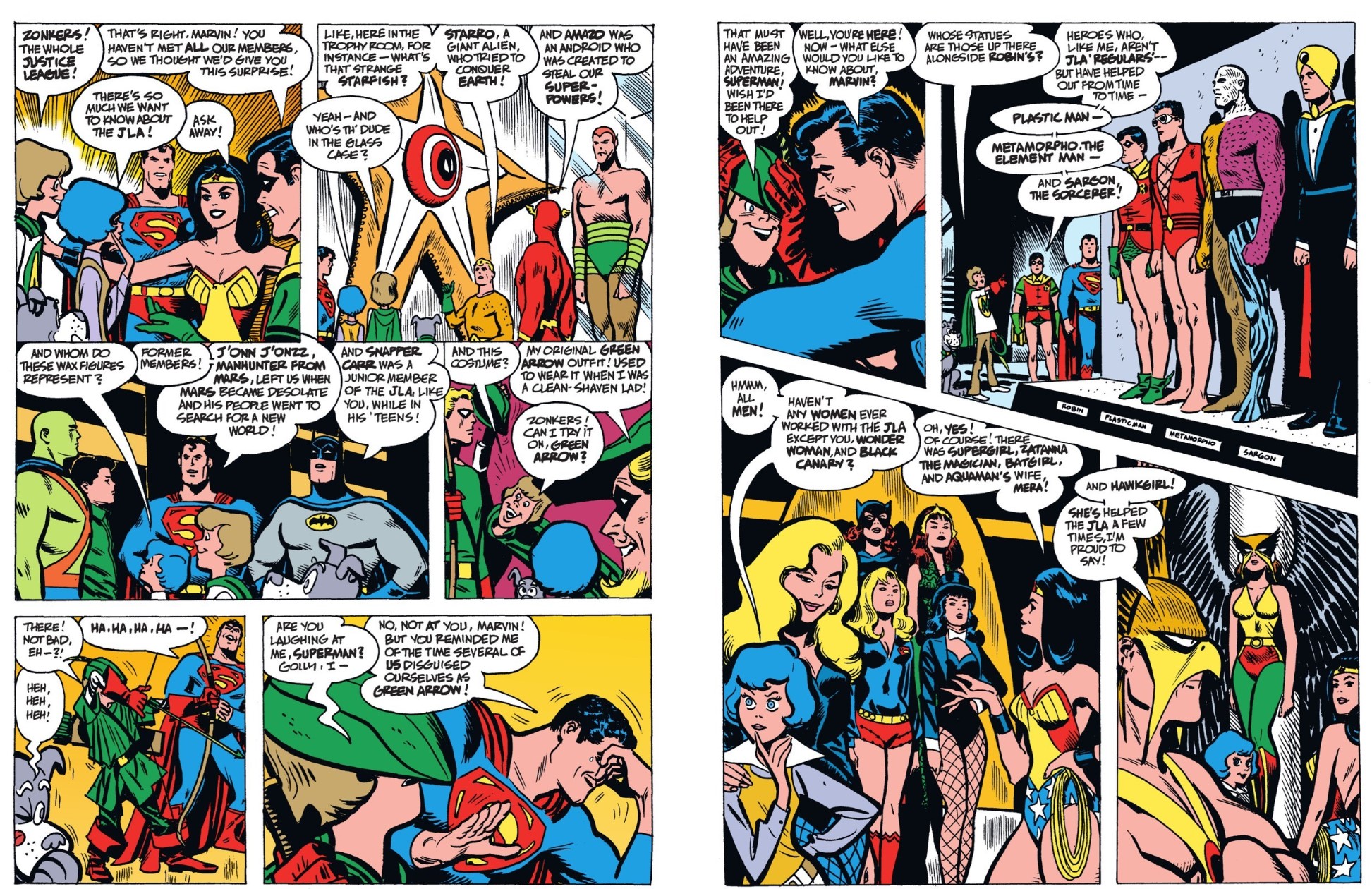
DC Finest: Super Friends:- The Fury of the Super Foes gathers comic book tales spun off from a hugely popular Saturday Morning TV Cartoon show: one that, thanks to the canny craftsmanship and loving invention of lead scripter E. Nelson Bridwell, became an integral and unmissable component of the greater pre Crisis on Infinite Earths DC Universe.

It was also one of the most universally thrilling and satisfying superhero titles of the period: featuring the smart, witty, straightforward adventures people my age grew up with, produced during a period when the entire industry was increasingly losing itself in colossal continued storylines and bombastic, convoluted, soap opera melodrama.It’s something all creators should have tattooed on their foreheads: sometimes all you really want is a smart plot well illustrated, sinister villains well-smacked, a solid resolution and early bed…

TV show Super Friends ran (under various iterations) from 1973 to 1986; starring primarily Superman, Batman and Robin, Wonder Woman, Aquaman and a brace of studio-originated kids as student crimebusters. The cast was supplemented by guest stars from the DCU on a case by case basis. The animated series made the transition to print as part of the publisher’s 1976 foray into “boutiqued” comics which saw titles with a television connection cross-marketed as DC TV Comics.

Child-friendly Golden Age comic book revival Shazam!- the Original Captain Marvel had been adapted into a successful live action series and its Saturday Morning silver screen stablemate The Secrets of Isis consequently reversed the process to become a comic book. With the additions of hit comedy show Welcome Back Kotter and animated blockbuster Super Friends four-colour format, DC had a neat outreach imprimatur tailor-made to draw viewers into the magic word of funnybooks.

At least that was the plan: with the exception of Super Friends none of the titles lasted more than ten issues beyond their launch…

This massive mega-extravaganza collects Super Friends #1-26 (spanning November 1976 to November 1979), includes promo comic Aquateers Meet the Super Friends and reprints material from Limited Collectors’ Edition #C-41 and C-46.

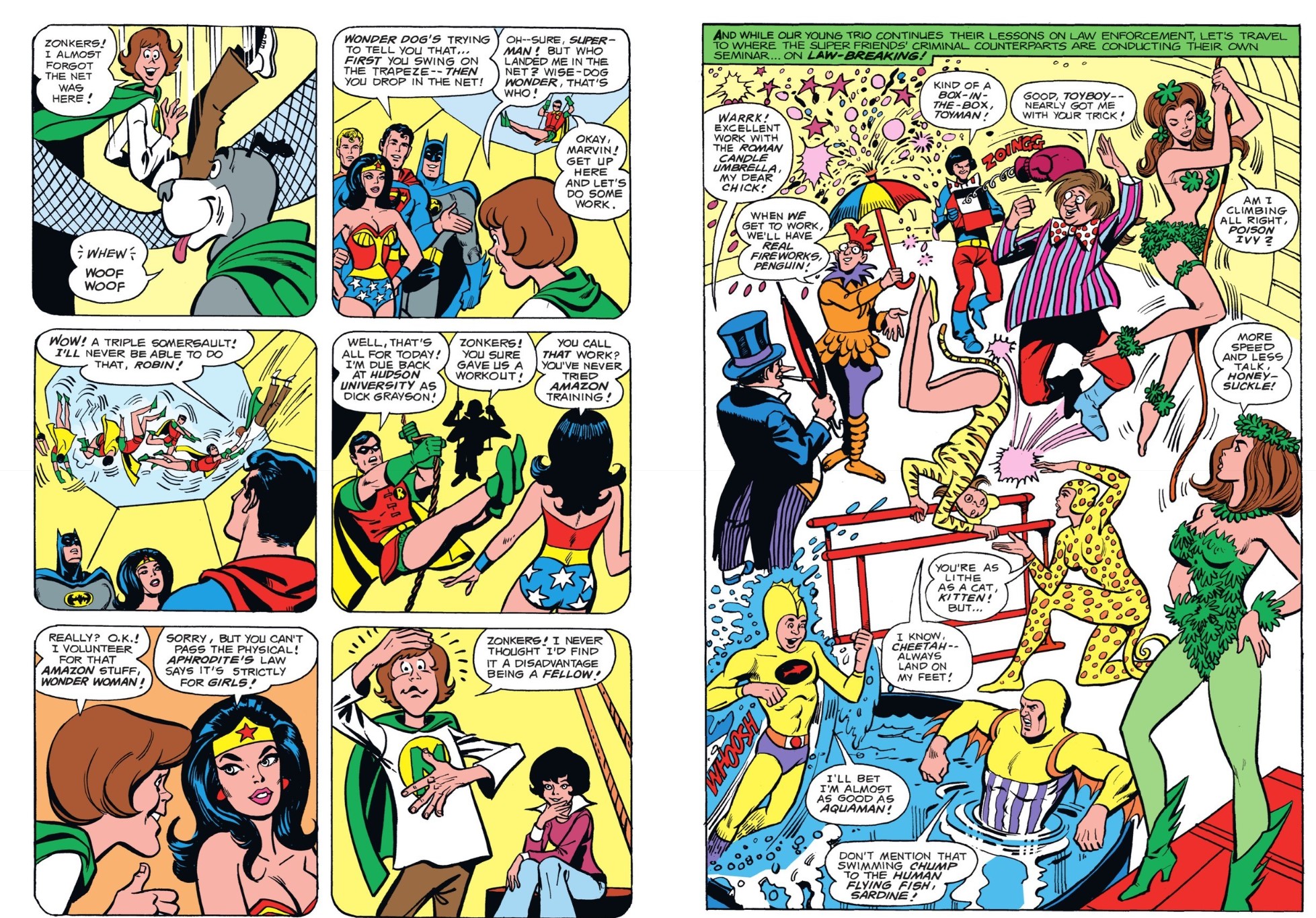
The fun begins a crafty 2-part caper by the wondrous E. Nelson Bridwell and illustrators Ric Estrada, Vince Colletta & Joe Orlando. ‘The Fury of the Super Foes’ finds heroes-in-training Wendy & Marvin – and their incredibly astute mutt Wonderdog – studying at the palatial Hall of Justice, even as elsewhere, a confederation of villains prove imitation is the sincerest form of flattery… if not outright intellectual theft. Having auditioned a host of young criminals, The Penguin, Cheetah, Flying Fish, Poison Ivy and Toyman are creating a squad of sidekicks and protégés to follow in their felonious footsteps. Now Chick, Kitten, Sardine, Honeysuckle and Toyboy are all ready and willing to carry out their first caper…

When the giant “Troubalert” screen informs our heroes of a 3-pronged attack on S.T.A.R. Labs’ latest inventions, the team split up to tackle the crises, but are thoroughly trounced until Wendy & Marvin break curfew to help them. As a result of the clash, Chick and Kitten are brought back to the Hall of Justice, but their talk of repentance is a rascally ruse and they secretly sabotage vital equipment. Thankfully, Wonderdog has seen everything and quickly finds a way to inform the still-oblivious good guys in issue #2, but too late to prevent the Super Friends being briefly ‘Trapped by the Super Foes’

Aided and abetted by inker Bob Smith, the incomparable Ramona Fradon (Aquaman; Metamorpho the Element Man; Brenda Starr, Reporter) became penciller with #3, as ‘The Cosmic Hit Man?’ sees 50 intergalactic super-villains murdered by infernal Dr. Ihdrom, who then blends their harvested essences to create an apparently unbeatable hyper-horror to utterly overwhelm Earth’s heroic defenders. However, he falls victim to his own arrogance and Wendy & Marvin’s logical deductions…

‘Riddles and Rockets!’ sees the Super Friends overmatched by new ne’er-do-well Skyrocket whilst simultaneously seeking to cope with a rash of crimes contrived by King of Conundra The Riddler. Soon a pattern emerges and a criminal connection is confirmed…

Author Bridwell (Secret Six; Inferior Five; Batman; Superman; The Flash; Legion of Super-Heroes; Captain Marvel/Shazam!) was justly famed as DC’s Keeper of Lore and top Continuity Cop thanks to his astoundingly encyclopaedic knowledge of its publishing minutiae and ability to instantly recall every damn thing! ‘Telethon Treachery!’ gave him plenty of scope to display it with a horde of near-forgotten guest-stars joining the heroes as they host a televised charity event. Sadly, money-mad menace Greenback lurks in the wings, awaiting his moment to grab the loot and kidnap the wealthiest donors. Then The Atom (Ray Palmer) plays a crucial role in stopping the depredations of an animal trainer using beasts as bandits in ‘The Menace of the Menagerie Man!’ before a huge cast change is unveiled in #7 (October 1977) with ‘The Warning of the Wondertwins’

You all know TV is very different from comics. When the next season of Super Friends aired, Wendy, Marvin & Wonderdog were abruptly gone, replaced without explanation by alien kids Zan & Jayna and their elastic-tailed space monkey Gleek. With room to extrapolate and in consideration of fans, Bridwell explained the sudden change via a battle to save Earth from annihilation whilst introducing the newest student heroes in memorable style. At the Hall of Justice Wendy & Marvin spot a spaceship hurtling to Earth on the Troubalert monitor and dash off to intercept it. Aboard are two siblings from distant planet Exor: a girl able to transform into animals and a boy who can become any form of water, from steam to ice. They have come carrying an urgent warning…

Superman’s alien enemy Grax has resolved to eradicate humanity and devised a dozen different superbombs and attendant weird-science traps to ensure his victory. These are scattered all over Earth and even the entire Justice League cannot stretch its resources to cover every angle and threat. To Wendy & Marvin the answer is obvious: call upon the help and knowledge of hyper-powered local heroes…

Soon Superman and Israel’s champion The Seraph are dismantling a black hole bomb whilst Elongated Man and titan-tressed Godiva perform similar service on a life-eradicator in England. Flash (Barry Allen) and mighty-leaping Impala dismantle uncatchable ordnance in South Africa before Hawkman & Hawkwoman join Native American avenger Owlwoman to crush darkness-breeding monsters in Oklahoma, whilst from the Hall of Justice Wendy, Marvin and the Wonder Twins monitor the crisis with a modicum of mounting hope…

The cataclysmic epic continues in #8 with ‘The Mind Killers!’ as Atom and Rising Son tackle a device designed to decimate Japan, and in Ireland Green Lantern Hal Jordan and Jack O’Lantern battle multi-hued monstrosities before switching off their technological terror.

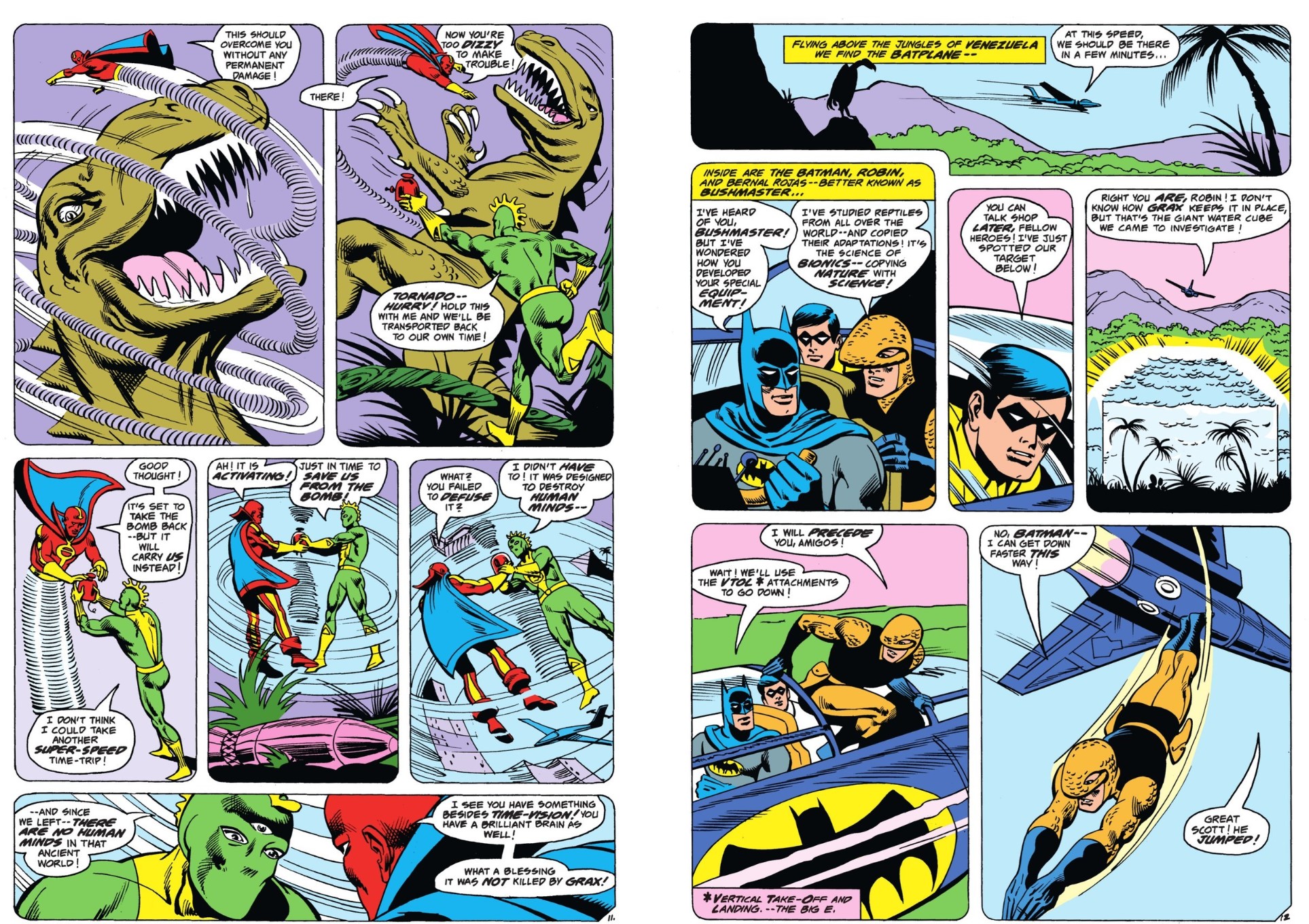
In New Zealand, time-scanning Tuatara tips off Red Tornado to the position of a bomb cached in the distant past whilst Venezuela’s doom is diverted through a team-up of Batman, Robin and reptile-themed champion Bushmaster. And in Taiwan a melding of sonic superpowers possessed by Black Canary and the astounding Thunderlord harmoniously saves the day…

The saga soars to a classic climax with ‘Three Ways to Kill a World!’ in which the final phases of Grax’s scheme fail thanks to Green Arrow & Tasmanian Devil in Australia, with Aquaman & Little Mermaid sorting out the embattled seas off Denmark and Wonder Woman & The Olympian preserving modern Greece.

Or at least, they would have if the Hellenic heroes had found the right foe. Sadly, their triumph against Wrong-Place, Right-Time terrorist Colonel Conquest almost upsets everything. Thankfully, the quick thinking hero-students send an army of defenders to Antarctica where Norwegian novice Icemaiden dismantles the ultimate booby-trap bomb.  However, whilst the adult champions are engaged, Grax invades the Hall of Justice seeking revenge on the pesky whistleblowing Exorian kids. He’s completely unprepared for and overwhelmed by Wendy, Marvin & Wonderdog, who categorically prove they’re ready to graduate to the big leagues…

Thus with Zan & Jayna enrolled as latest heroes-in-training, Super Friends #10 details their adoption by Batman’s old associate – and eccentric time travel theoretician – Professor Carter Nichols, just before a legion of alien horrors arrive on Earth to teach the kids that appearances can be lethally deceiving in ‘The Monster Menace!’ In #11, ‘Kingslayer’ pits the heroes against criminal mastermind Overlord who has contracted the world’s greatest hitman to murder more than one hundred leaders at one sitting…

Another deep dive into DC’s past resurrected Golden Age titans T.N.T and Dan, the Dyna-Mite in ‘The Atomic Twosome!’ These 1940s mystery men had been under government wraps ever since their radioactive powers began to melt down, but when an underground catastrophe ruptures their individual lead-lined vaults, the Super Friends are called in to prevent potential nuclear nightmare. Then the subterranean reason for the near tragedy is tracked to a monstrous mole creature, and leads to the introduction of eternal mystic Doctor Mist, who reveals the secret history of civilisation and begs help to halt ‘The Mindless Immortal!’ before its random burrowing shatters mankind’s cities. From here, Bridwell would build a fascinating new team concept that would support decades of future continuity…

Super Friends #14 opens with ‘Elementary!’; introducing four ordinary mortals forever changed when possessed by ancient sprits. Tasked by Overlord with plundering the world, Undine, Salamander, Sylph & Gnome are defeated by our heroes yet retain their powers and so become crimefighting team The Elementals. Also on view is a short back-up illustrated by Kurt Schaffenberger & Bob Smith. ‘The Origin of the Wondertwins’ at last reveals they are Exorian genetic throwbacks (despised outcasts on their homeworld) who fled from a circus of freaks and uncovered Grax’s plot before taking that fateful voyage to Earth.

Big surprises come in ‘The Overlord Goes Under!’ (Fradon & Smith) as the Elementals begin battling evil by joining the Super Friends in crushing the crook. All those superheroes are blithely unaware that they are merely clearing the way for a far more cunning and subtle mastermind to take Overlord’s place…

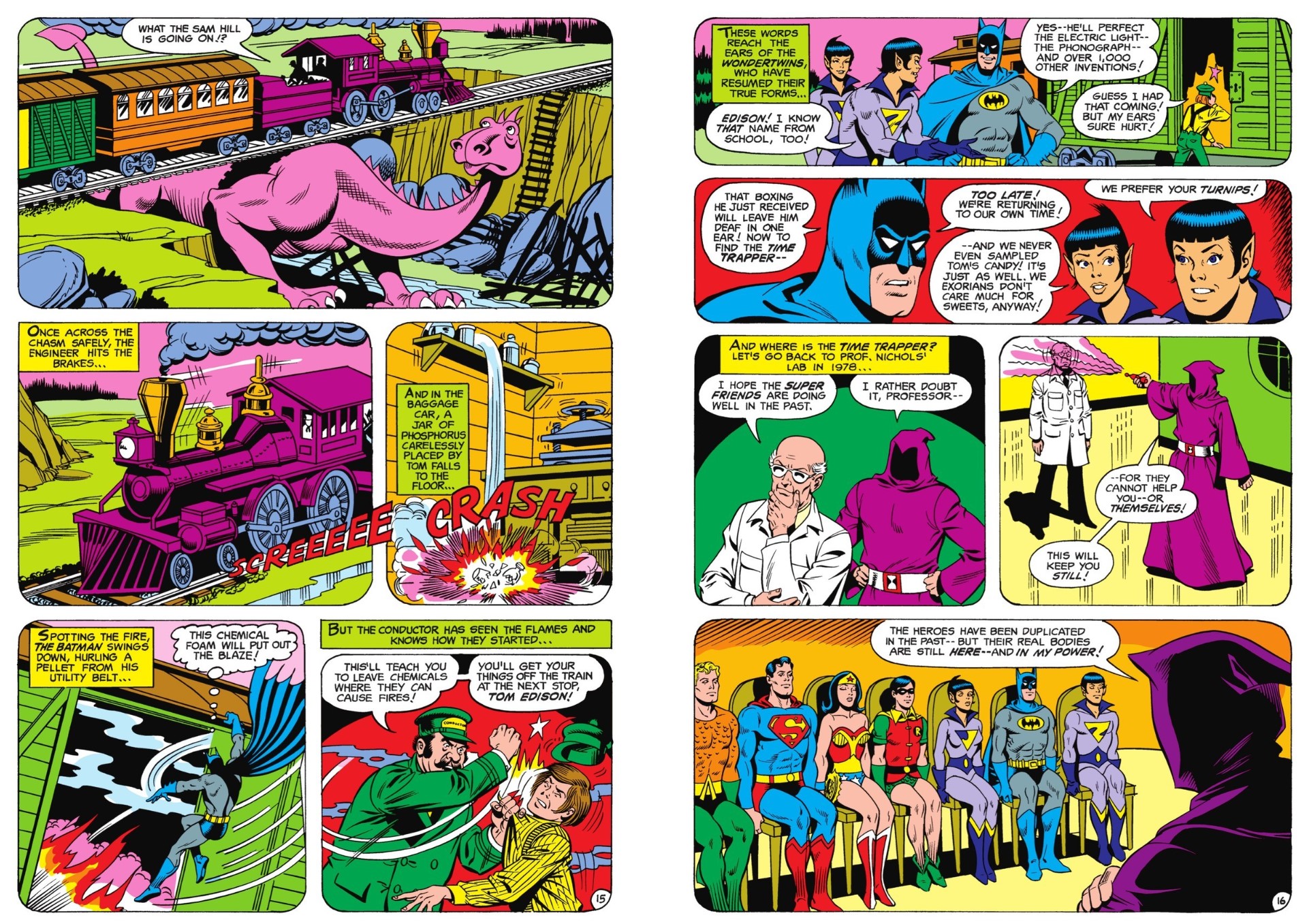
‘The People Who Stole the Sky!’ in SF #16 is a grand, old-fashioned alien invasion yarn, foiled by the team and the increasingly adept Wonder Twins whilst ‘Trapped in Two Times!’ has Zan & Jayna used by the insidious Time Trapper to lure their adult mentors into deadly peril on Krypton in the days before it detonated, and future water world Neryla in the hours before it’s swallowed by its critically expanding red sun. After rescuing the kids – thanks largely to Superman’s legendary lost love Lyla Ler-Rol – the Super Friends employ Tuatara’s temporal insight and Professor Nichol’s obscure chronal methodologies to hunt the Trapper in a riotous yet educational ‘Manhunt in Time!’ (art by Schaffenberger & Smith), by way of Atlantis before it sank, medieval Spain and Michigan in 1860CE: all to thwart a triple-strength scheme to derail history and end Earth civilisation…

SF #19 sees an encore for Menagerie Man in ‘The Mystery of the Missing Monkey!’ (Fradon & Smith) as the animal exploiter appropriates Gleek: intent on turning his elastic-tailed talents into a perfect pickpocketing tool, before Denny O’Neil (as Sergius O’Shaugnessy) teams with Schaffenberger & Smith for a more jocular turn. Here, chaos and comedy ensue when the team tackles vegetable monsters unleashed after self-obsessed shlock-movie director Frownin’ Fritz Frazzle uses Merlin’s actually magical Magic Lantern to make a “masterpiece” on the cheap in ‘Revenge of the Leafy Monsters!’

Bridwell & Fradon bounce back in #21 where ‘Battle Against the Super Fiends!’ has the heroes travelling to Exor to combat super-criminals who can duplicate their power-sets, after which ‘It’s Never Too Late!’ (#22, O’Shaugnessy, Fradon & Smith) reveals how time bandit Chronos subjects the Super Friends to a chronal-delay treatment rendering them perennially too late to stop him… but only until Batman and the Wonder Twins out-think him.

The Mirror Master divides and banishes teachers from students in #23 but is ultimately unable to prevent an ‘SOS from Nowhere!’ (Bridwell, Fradon & Smith) to the Flash. This episode also spends time fleshing out the Wonder Twins’ earthly alter egos as Gotham Central highschoolers John & Joanna Fleming

With O’Shaugnessy scripting, ‘Past, Present and Danger!’ sees Zan & Jayna’s faces found engraved on a recently-unearthed Egyptian pyramid. Upon investigation inside the edifice, the heroes awaken two ancient exiles who resemble the kids, but who are in truth criminals who fled Exorian justice thousands of years previously. How lucky, then, that the kids are perfect doubles that the villains can send back with the robot cops surrounding the pyramid – once they’ve got rid of all those busybody Earthling heroes…

Enjoying promotion through treachery, habitually harassed Underling has seized power at last in Bridwell’s ‘Puppets of the Overlord’, and then employs forbidden technology to mind-control adult and junior heroes. Happily, international champions Green Fury (later Fire), Wonder Woman’s sister Nubia, Tasmanian Devil and Seraph can join Green Lantern and Queen Mera of Atlantis in delivering a liberating solution, after which this splendid selection of super thrills pauses with SF #26 as Bridwell, Fradon & Smith bring back some old friends and enemies for ‘The Wondertwins’ Battle of Wits!’ when a scheming former Bat-foe enacts an infallibly murderous plot…

Rounding out the frenetic fun is a features section that includes the Alex Toth cover from Limited Collectors’ Edition #C-41  and new material from sequel C-46. These include a comic strip collaboration with Bridwell on introductory tale ‘Super Friends’ which was a star-studded framing sequence for a big reprint issue of Justice League classics. The wonders are further augmented by Toth’s comprehensive pictorial essay on creating ‘TV Cartoons’ (with contributions from Bob Foster), plus his ‘The JLA on TV’ model sheets, and designs of ‘The Hall of Justice’ by Terry Austin. As you of course know, comics legend Toth was lead designer on the characters’ transition to TV animation…

The extras include mini-comic Aquateers Meet the Super Friends – a 1979 promotional giveaway included with every purchase of Super Friends Swim Goggles. An uncredited framing sequence (which looks like a Continuity Associates project that Dick Giordano & Frank McLoughlin had a hand in) segues into ‘The Greatest Show on Water’ – an Aquaman short by Fradon originally published in Adventure Comics #219, (December 1955).

The bumper fun wraps with Alex Ross’ painted cover from 2001 book collection Super Friends!

With covers by Fradon, Smith, Schaffenberger, Colletta, Ernie Chan and more, this hopefully initial compendium is superbly entertaining, masterfully crafted and utterly engaging. It offers stories of pure comics gold to delight children and adults in equal proportion. Truly generational in appeal, they are probably the closest thing to an American answer to the magic of Tintin or Asterix and no family home should be without this tome.

Sadly, this masterful mystery megamix is not yet available digitally, but we live in hope. In the meantime, if you prefer your cartoon crimebustng computer collated you could access 2020’s Super-Friends: Saturday Morning Comics volume 1.
© 1976, 1977, 1978, 1979, 2001, 2025 DC Comics, Inc. All Rights Reserved.

Today in 1697, Willam Hogarth was born. Notionally adding to the comics lustre and significance, in 1918, Howard Purcell was also added to the planet’s roster, as was Neil Gaiman in 1960. In the exit column for today, in 1993 we lost astounding illustrator Alberto Breccia, and in 2006 immortal sci fi writer Jack Williamson. All those other guys you can find in old posts here, but I particularly recommend Beyond Mars – The Complete Series 1952-1955.

Moomin volume Ten – The Complete Lars Jansson Comic Strip


By Lasse Lars Jansson (Drawn & Quarterly)
ISBN: 978-1-77046-202-1 (HB) eISBN: 978-1-77046-557-2

Win’s Christmas Gift Recommendation: the Personification of Good Will at Every Season… 9/10

Tove Jansson was one of the greatest literary innovators and narrative pioneers of the 20th century: equally adept at shaping words and images to create worlds of wonder. She was especially expressive with basic components like pen & ink, manipulating economical lines and patterns into sublime realms of fascination, whilst her dexterity made simple forms into incredibly expressive and potent symbols. So was her brother…

Tove Marika Jansson was born into an artistic, intellectual and rather bohemian Swedish family in Helsinki, Finland on August 9th 1914. Patriarch Viktor was a sculptor and mother Signe Hammarsten-Jansson a successful illustrator, graphic designer and commercial artist. Tove’s brothers Lars AKA “Lasse” and Per Olov became – respectively – an author and cartoonist, and an art photographer. The family and its close intellectual, eccentric circle of friends seems to have been cast rather than born, with a witty play or challenging sitcom as the piece they were all destined to inhabit. After extensive and intensive study (from 1930-1938 at the University College of Arts, Crafts and Design, Stockholm, Graphic School of the Finnish Academy of Fine Arts and L’Ecole d’Adrien Holy and L’Ecole des Beaux-Arts, Paris), she became a successful exhibiting artist through the troubled years of WWII.

Brilliantly creative across many fields, she published her first Moomins fable in 1945. Småtrollen och den stora översvämningen (The Little Trolls and the Great Flood – latterly and more euphoniously The Moomins and the Great Flood) was a whimsical epic of gentle, inclusive, accepting, understanding, bohemian misfit trolls and their strange friends…

The term “Moomin” came from maternal uncle Einar Hammarsten who tried to stop Tove pilfering food when she visited by warning that a Moomintroll guarded the kitchen, creeping up on trespassers and breathing cold air down their necks… you can check out our other reviews such as Christmas Comes to Moominvalley for how the critter made a mega franchise and proto-mythology. Here and now, let’s discuss how Lars got involved…

Exponentially more popular with each successive book, global fame loomed. In 1952 Finn Family Moomintroll/The Happy Moomins was translated into English to great acclaim, prompting British publishing giant Associated Press to commission a daily newspaper strip starring the seductively sweet & sensibly surreal creations. Jansson had no misgivings or prejudices about strip cartoons as she had already adapted Comet in Moominland for Swedish/Finnish paper Ny Tid.

Mumintrollet och jordens undergäng/Moomintrolls and the End of the World was hugely popular and she welcomed the chance to extend her eclectic family’s range. In 1953, The London Evening News began the first of 21 Moomin strip sagas which captivated readers of all ages. Tove Jansson’s involvement in the cartoon ended in 1959, a casualty of its own success and the punishing publication schedule. So great was the strain that she had already recruited brother Lars to help. He quietly took over, continuing the feature until its close in 1975. His tenure as sole creator officially began with the sixth collection in this series and reaches its penultimate volume here…

Liberated from cartooning pressures, Tove returned to painting, writing and other pursuits: generating plays, murals, public art, stage designs, costumes for dramas and ballets, a Moomin opera and 9 more Moomin-related picture-books and novels, as well as 13 books and short-story collections strictly for grown-ups. She died on June 27th 2001, with awards too numerous to mention, and her face on the national currency…

Lars Fredrik Jansson (October 8th 1926 – July 31st 2000) was almost as amazing as his sister. Born into that astounding overachieving clan 12 years after Tove, at 16 he started writing – and selling – his own novels (nine in all). He also taught himself English as there weren’t enough Swedish-language translations of books available for his voracious reading appetite. In 1956 at his sister’s request he began co-scripting the Moomin strip: injecting his own witty whimsicality to ‘Moomin Goes Wild West’. He had been Tove’s English language translator and sense-reader from the start, seamlessly converting her Swedish into text and balloons even the British could grasp. In 1959, when her contract with The London Evening News expired, Lars officially took over, having spent the interim period learning to draw and perfectly mimic his sister’s art style. He had done so in secret, assisted and tutored by their mother Signe Hammarsten-Jansson. From 1961 to strip’s end in 1974, Lars was sole steersman of trollish tabloid tails (I fear that could be much misconstrued these days…).

“Lasse” was a man of many parts. Other careers included aerial photographer, professional gold miner, writer and translator. He was basis and model for ultimate cool kid Snufkin and his Moomins exploits were subtly sharper than his sister’s version: far more closely in tune with the quirky British sense of humour. Nevertheless, his whimsically wry sense of wonder was every bit as compelling. In 1990, long after the original series, Lasse began a new career, working with Dennis Livson (designer of Finland’s acclaimed Moomin World theme park) as producers of anime series The Moomins and, with daughter Sophia Jansson in 1993, on new Moomin strips…

Moomintrolls are easy-going free spirits: polite modern bohemians untroubled by hidebound domestic mores but under Lars, increasingly diverted and distracted by societal pressures. Moominmama is warm, kindly tolerant and capable, if perhaps overly concerned with propriety and appearances, whilst her devoted spouse Moominpappa spends most of his time trying to rekindle his adventurous youth or dreaming of fantastic journeys. Doting, darling son Moomintroll is a meek, dreamy boy with a big imagination and confusing ambitions who adores – and so moons over – permanent houseguest the Snorkmaiden. That impressionable, flighty gamin prefers to play things slowly whilst awaiting somebody potentially better…

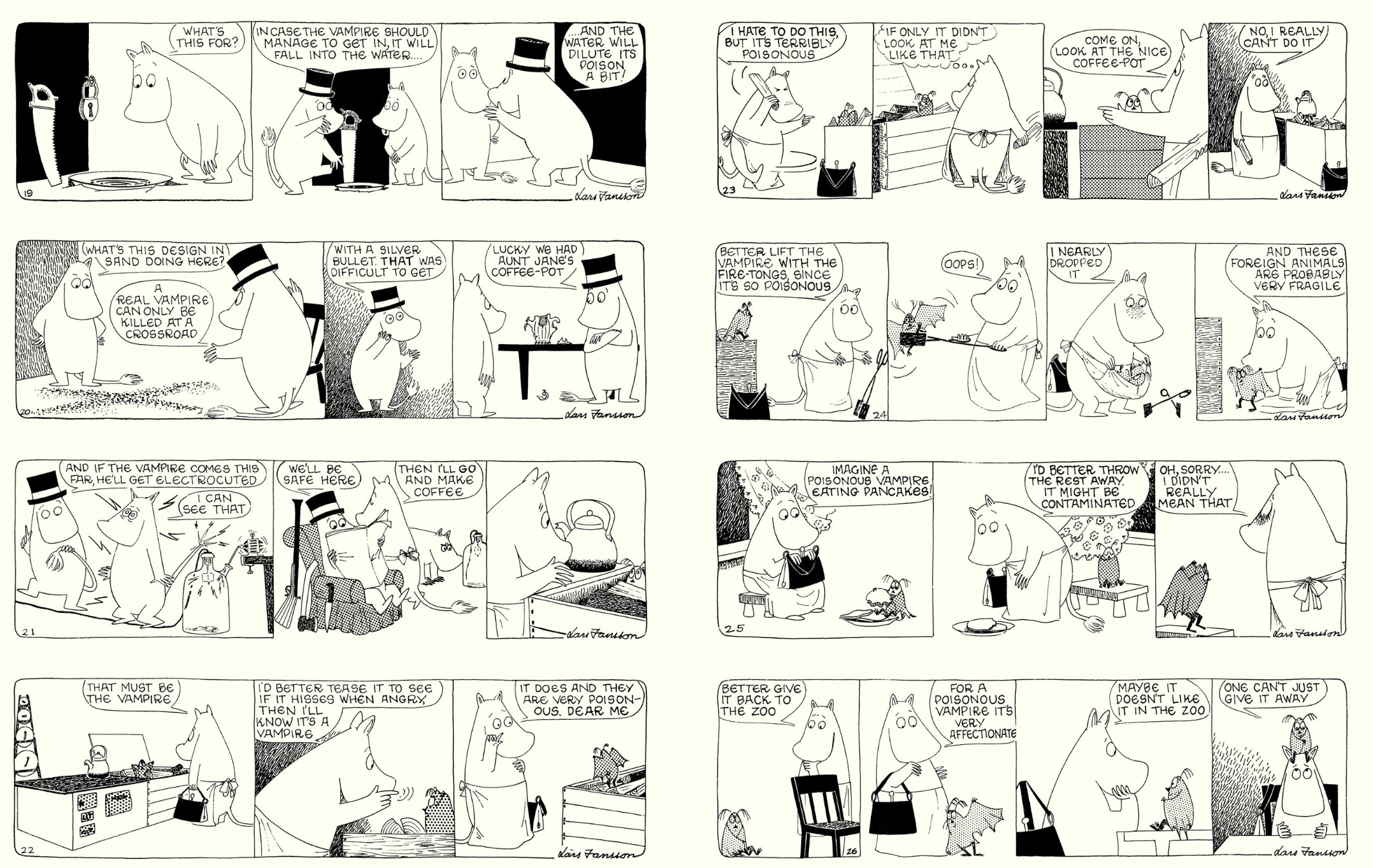
A wonderfully whimsy driven affair, this 10th and final monochrome moon melange delivers serial strip sagas #38 to 41, and commences with Lars still totally in charge as panic grips the sheltered valley-dwelling community. This is thanks to something supernally sinister and quite unknown pops by for the mass mess deemed ‘Moomin and the Vampire’

The parable on uncontrolled hysteria sees the dozy denizens driven mad by an assumed monster in their midst and begins following a normal day of big game hunting in the small Scandinavian valley. When rumour of an undead horror haunting the fir forests and charming cottages, the usual miscommunications and madnesses leave everyone in a tizzy, tracking or hiding from the unseen doom. All poor placid Moominmama sees is a tiny fuzzy flying creature in need of a feed and a place to rest, but it probably best not to share the secret of her new guest with all her excitable neighbours…

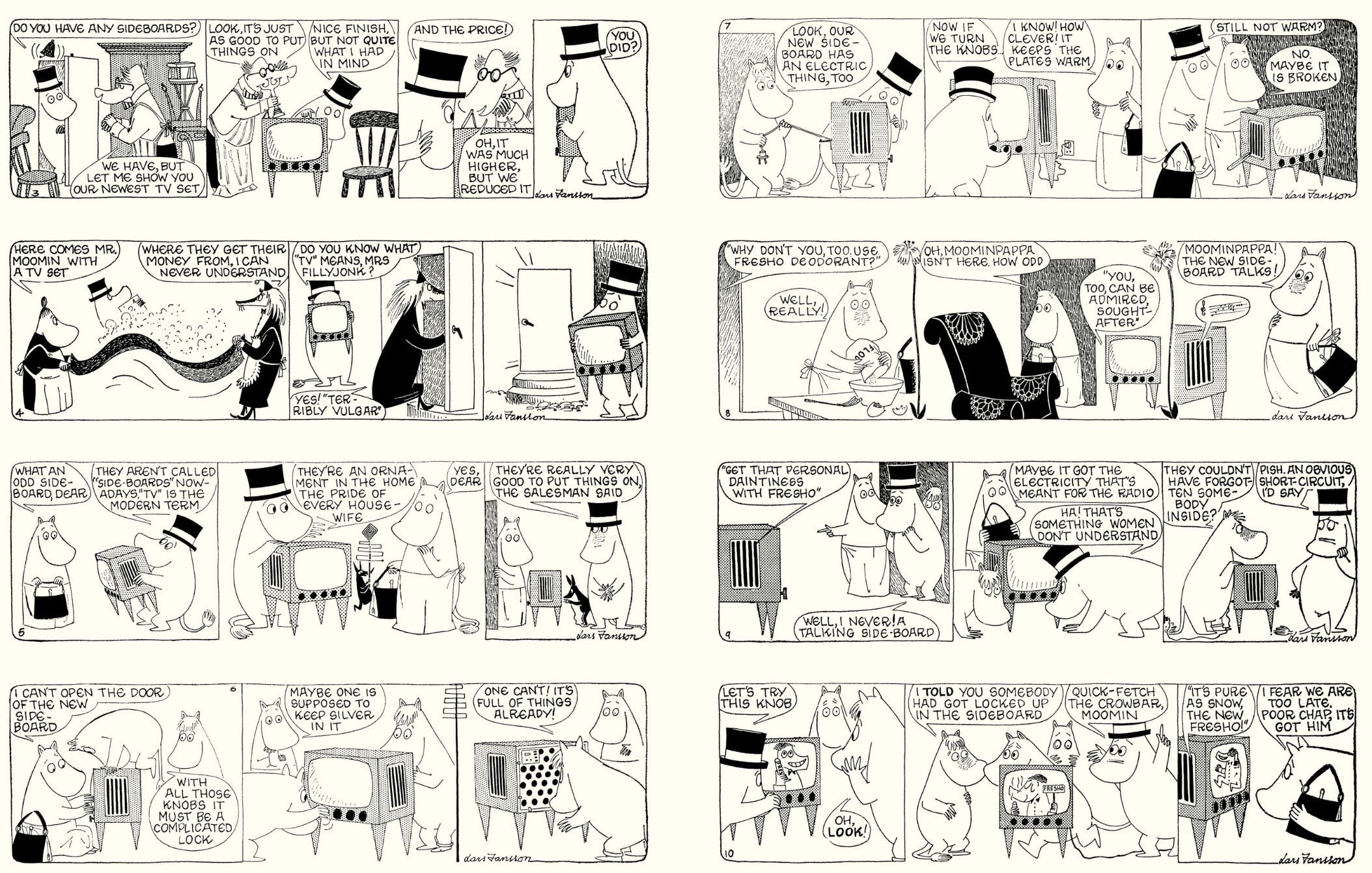
Up next and a swingeing assault on popular cultures comes ‘Moomin and the TV’, as the reclusive Moomins go shopping for anew sideboard and are pressured into purchasing a top of the line television set…

Despite initial resistance and treating the box as a giant wooded chest, eventually the family succumb to the shows and ads perpetually erupting from it, but that’s as nothing to the chaos caused as the friendly visits from everyone else in Moominvalley – even passing strangers! -threaten to overwhelm even Moominpapa’s legendary hospitality and deplete the mythic capacity of ‘Mama’s larder and pantry…

And my gosh, the rubbish they all watch!

A delicious poke at town planning, social crusaders, local politics and property developers follows as ‘The Underdeveloped Moomins’ finds the big white darlings helping a dedicated but unemployed and under-appreciated Assessor of Under-Developed Areas feel fulfilled. She knows her gifts, specialisms and training can readily bring these primitive, happy valley-folk into the top echelon of progressive go-getting modern citizens, and the Moomins are happy to help, no matter how miserable all these new-fangled ideas, gadgets and schemes make everyone…

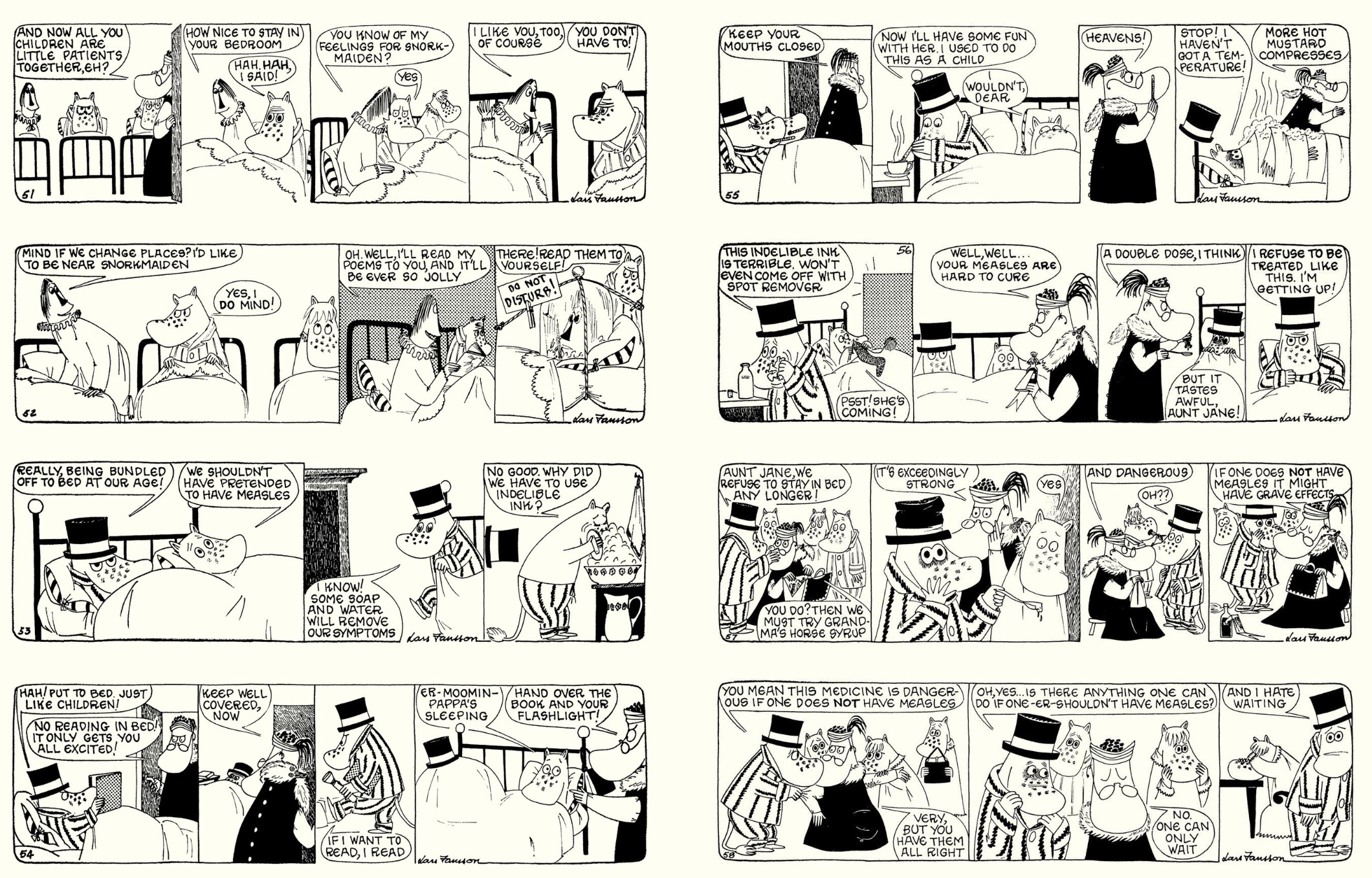
The wonderment comes to a close with a whiff of prognostication and prophecy as winter draws on in ‘Moomin and Aunt Jane’. When glamourous but generally useless Romantic poet Wispy moves in next door, he accidentally and then intentionally beguiles flirtatious dreamer Snorkmaiden, just as a little old lady haunts the chilly community. Perpetually predicting frozen doom and deadly privation, she starts to snaffle any potentially useful kit – other people’s blankets, firewood, food, skis, stores. As young Moomin and the maiden again perform their standard jealousy dance, ‘Pappa finally listens to the busy biddy and is convinced the extremely cold end of days is coming. As he begins his own excessive doomsday-prepper precautions, Wispy and Snorkmaiden elope with Moomin in cold pursuit, and the crisis goes into overdrive as prim, officious Moomin Aunt Jane invites herself to stay. Not even faking deadly illness can deter this dowager do-gooding know-it-all and she has no time for silly biddies, puling poets, vacuous romance or any sort of nonsense..

Finishing the fabulous Finnish saga in a cloud of confusion with a domestic dramedy in the best Ealing Comedy traditions of anything with Dame Magaret Rutheford in it, this is the ideal end to a cartoon era…

This compilation again closes with a closer look at the creator in ‘Lars Jansson: Roll Up Your Sleeves and Get to Work’ courtesy of family biographer Juhani Tolvanen, extolling his many worthy attributes…

These are utterly, adorably barbed tales for the young, laced with that devastating observation and razor-sharp wit which enhances and elevates only the greatest kids’ stories into classics of literature. These tomes – both Tove & Lars’ – are an international treasure trove no fan of the medium – or carbon-based lifeform with even a hint of heart and soul – can afford to be without.
© 2015 Solo/Bulls, except “Lars Jansson: Roll Up Your Sleeves and Get to Work” © 2011/2015 Juhani Tolvanen. All rights reserved.

Today in 1921, Heart of Juliet Jones & Blondie artist Stan Drake was born. Why not treat yourself to a rarer delight such as Kelly Green volume 1: The Go-Between? In 1951, Bill Mantlo was born, and in 1964, Brant Parker & Johnny Hart’s Wizard of Id strip debuted. Three years later in France, Jean-Claude Mézières & Pierre Christin’s Valérian and Laureline began utterly revolutionising sci fi. In 1993 star penciller/ editor Ross Andru died. All of the above make multiple appears in Now Read This! so just go wild in that search box…

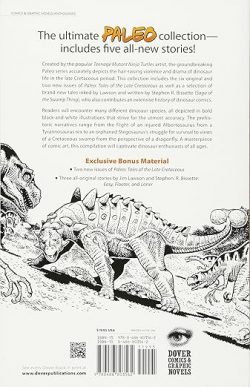
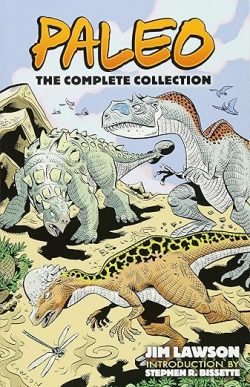
Paleo: the Complete Collection


By Jim Lawson, with Stephen R. Bissette, Peter Laird & various (Dover Comics & Graphic Novels)
ISBN: 978-0-486-80356-2 (TPB/Digital edition)

It’s a rare hominid who hates dinosaurs. Sure, an occasional chimpanzee might prefer a nice kitten or peanut, but most of us soft, hairy two-leggers can’t get enough of our antediluvian predecessors. Apart from the cool way they look and the marvellous variety they came in, it’s pretty clear they concentrated on eating their surroundings and/or each other and never once tried fixing organised sports, or to appropriate more deckchairs than they could use, or wreck the planet.

Seriously though, there’s an irresistible, nigh-visceral appeal to all manner of saurians; small or super-sized. Most of us variously and haphazardly evolved hairless apes seem obsessively drawn to all forms of education and entertainment featuring monster lizards from our primordial past. That’s especially true of comics.

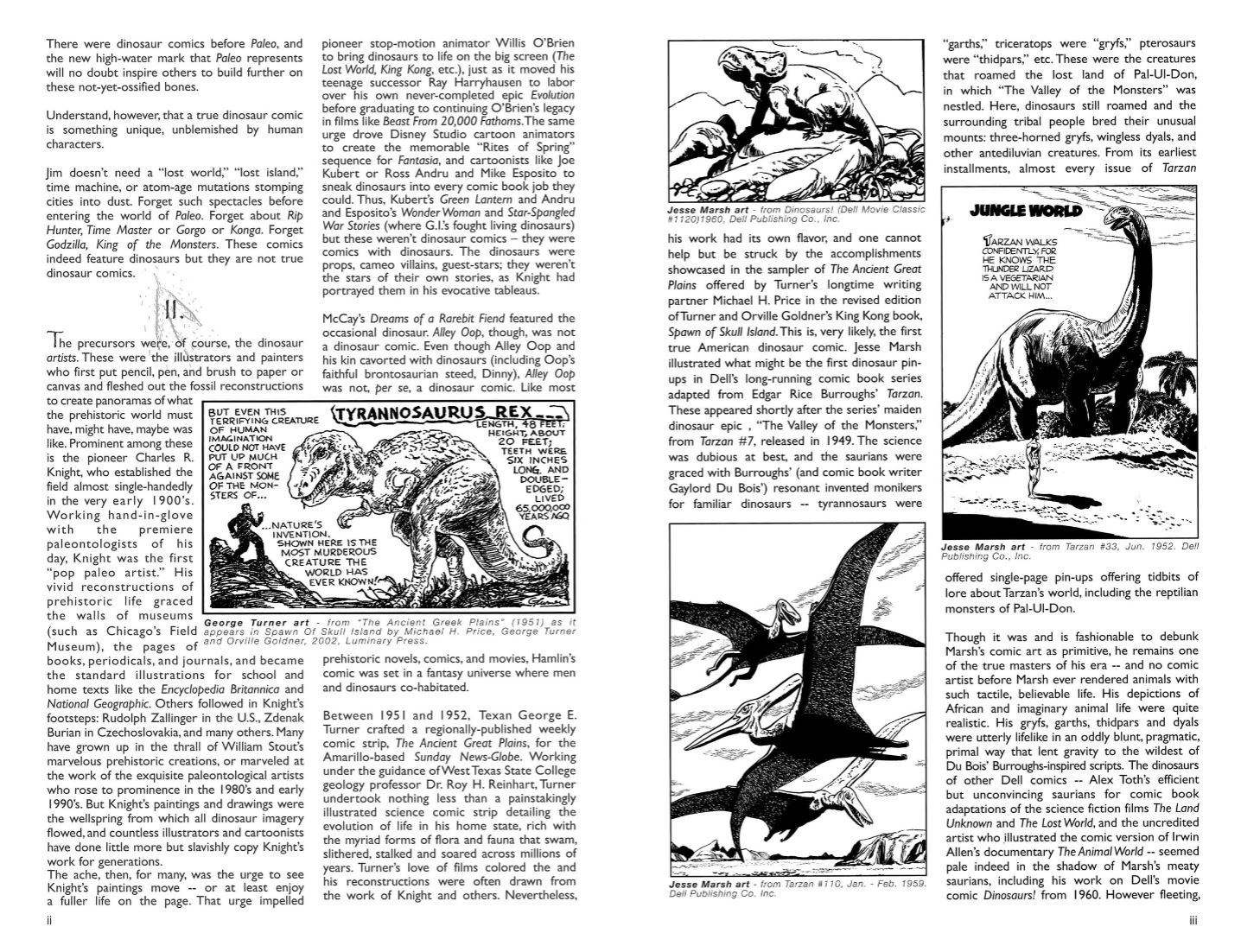
Most nations and many languages have packed countless pages with illustrated stories featuring cretaceous cameos and lizardly line-ups, but the USA has proudly gone one stage further than most by evolving a true sub-genre. As eruditely and so very lovingly explained by Stephen R. Bissette in his scholarly overview and Introduction ‘The Paleo Path: Paleo and the History of Dinosaur Comics’, terrifying thunder lizards have been visitors and antagonists in literature and the arts for decades but it was comics – specifically a minor back-up feature in Turok, Son of Stone #8 (August 1957, by Paul S. Newman & Rex Maxon) – which finally gave them a voice of their own.

What’s a Dinosaur Comic? One set in the creatures’ own times and scenarios, with no human intrusion or overblown authorial invention. These are scientifically credible tales about animals living and dying on their own terms and in their own context: no cavemen, aliens, time machines or human heroes. All Then, All Lizard, All the Time…

There have been precious few – and Bissette lists them all, including his own wonderful Tyrant – but for we devotees, paramount amongst them is the far-too occasional Paleo: Tales of the Late Cretaceous by Jim Lawson. Since 2001 the exceptionally gifted, prolific and apparently tireless Lawson has relaxed from his day jobs (most impressive of which are thousands of pages of Teenage Mutant Ninja Turtles he has written and drawn for over two decades) to craft a string of 8 monochrome comics of fictionalised natural history and daily dramas of the big beasts.

Here, Dover republished Lawson’s 2003 graphic novel compilation, with the added attraction of two more unpublished issues: three all-new stories produced in collaboration with Bissette, Peter Laird and other equally dedicated devotees.

In case the name still seems familiar, Lawson’s other interests include motorcycles – one day I’ll review his outrageous debut series Bade Bike and Orson – and fantastic fantasy. Other of his cartoon forays include Rat King, Planet Racers (with TMNT co-originator Laird) and in Dragonfly.

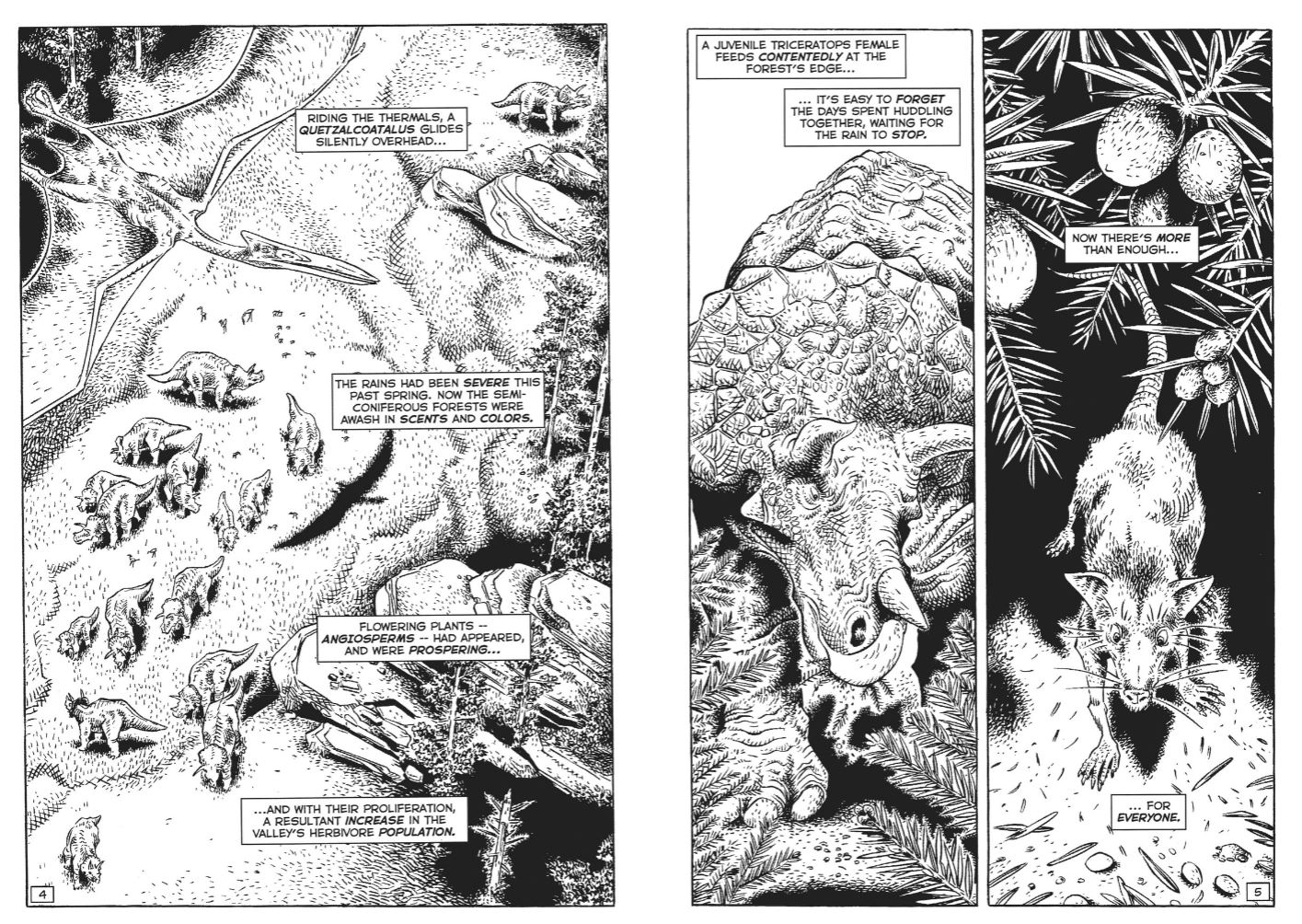
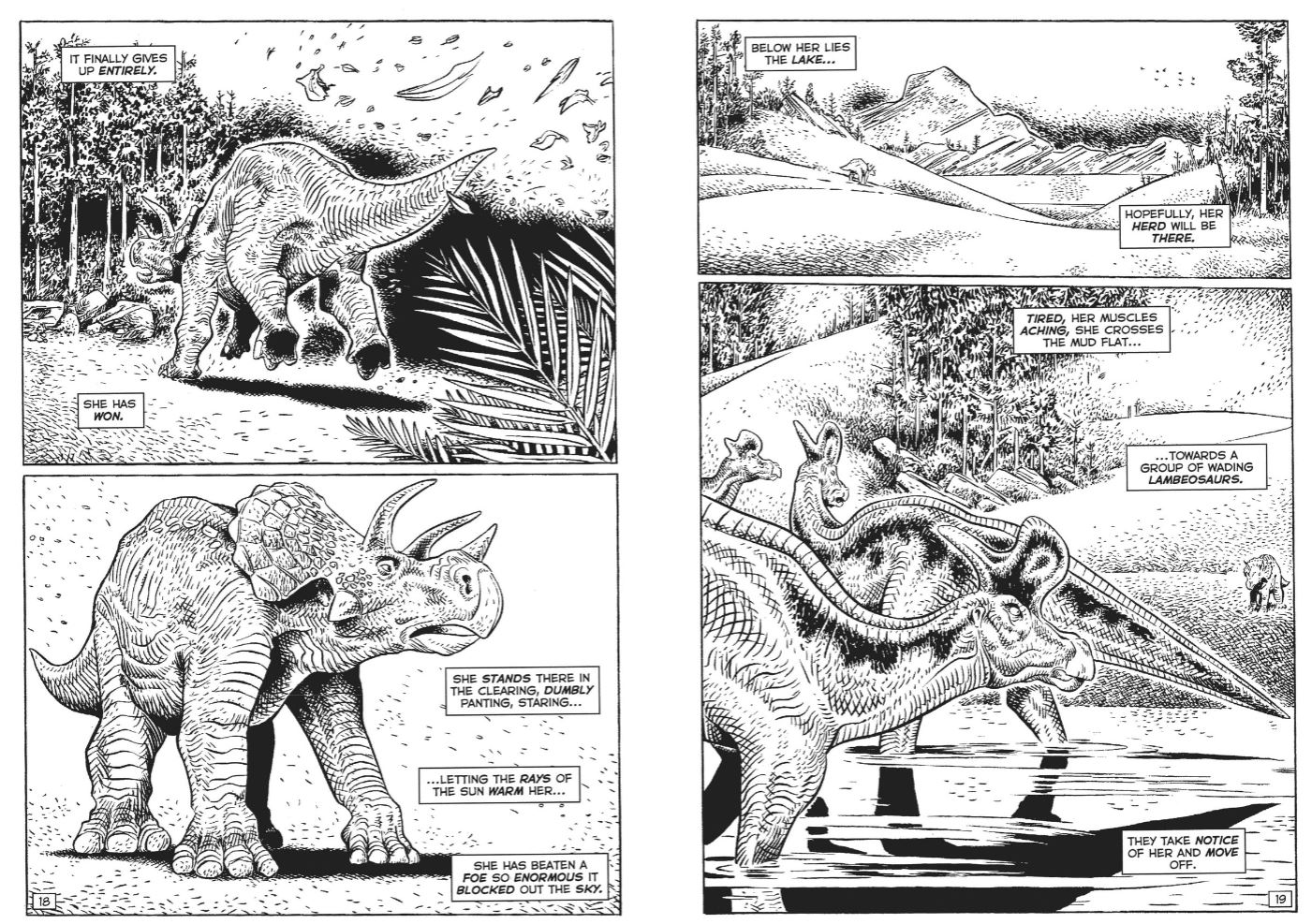
This mammoth man-free collection begins with that aforementioned Introduction before quickly thundering on to the meat we all crave, opening with Book One (inked & lettered by Laird) focusing attention on a key moment in the life of a Triceratops 70 million years from now, but in the other direction…

These “ from the Late Cretaceous” are all delivered with earnest veracity and unsentimental authenticity, as of a show on Animal Planet, or perhaps the better Disney wildlife films of the 1960s & 1970s. Spectacular, eye-popping narrative takes the form of informed observation as a young, leathery, three-horned cow interacts with or avoids Quetzalcoatalus, egg-stealing proto-rodents and voracious Daspletosaurs, getting into a fix which nearly ends her young life. Nearly…

Lawson inked his own pencils on Book Two where an alpha male Dromeosaur deals with a pushy young male in the female-heavy pack. Status quo re-established, the hunters collaboratively take down a massive Tsintaosaurus, but when an apex predator Albertosaur claims the kill, the pack’s hierarchy again becomes an issue of survival…

This issue was supplemented with ‘Gratitude… A Paleo Short Story’ wherein the most experienced pack female examines her precarious place in the world…

Book Three examines a strange case of maternal transference as a baby Stegoceras loses one mother and believes a roosting Quetzalcoatalus might be a likely substitute, whilst Book Four reviews ‘A Busy Day in the life of a Plotosaurus’ with the colossal sea lizard coming in-shore to scavenge from Aublysodons before making the kill of a lifetime in deep water after boldly attacking a much larger Thallassomedon Plesiosaur

It’s a time of snow and deadly cold in Book Five as an aging Albertosaurus takes a bad wound from the Styracosaur he’d planned on eating. As the world slowly turns white, hunter finds himself regarded as prey…

There’s a shift in focus and look at the true top killers in Book Six as a herd of feeding Corythosaurs idly watch a dragonfly pass. The insect – the epoch’s most efficient hunter – then makes a mistake for the ages when it lands on the wrong tree at the right moment…

Lawson is at his dramatic best depicting a night hunt in ‘A Paleo Short Story’: a stark, wordless, dramatically chiaroscuric duel to the death in the dark…

Book Seven offers layers of passionate empathy as a Tyrannosaurus Rex battles a host of lesser beasts taking advantage of her seeming defeat by an unconquerable enemy – viscous mud flats – before Book Eight lingers lovingly on the lives of the era’s biggest beasts after a brace of Alamosaurs provide smaller herbivores such as Lambeosaurs & Edmontosaurs safe, sheltering, mobile feeding environments. But what happens when one disappears and the other is no longer passive?

The lengthy new material begins with ‘Easy’ (story by Bissette, art Lawson & lettered by Thomas Mauer) as a healthy young male meat eater succumbs to pressures of the breeding impulse, heedless of the deadly consequences. The same creative team craft ‘Floater’ with a baffled tyrannosaur unable to tear himself away from a tantalising carcass in the river. She’s long dead. She should just be food, but why is her belly still heaving and moving?

This catalogue of carnosaur carnage and herbivore history closes with all-Lawson affair ‘Loner’ – as an adolescent Tyrannosaur is driven away by his mother and sisters and learns the cost of being alone. Why then would such a solitary survivor after years alone adopt another rejected young male at the risk of his life?

This book superbly opens a window onto distant eons of saurian dominance and provides a profound panorama that focuses on a number of everyday experiences which simply have to be exactly how it was, way back then…

As in all these tales, astoundingly rendered and realised scenery and environment are as much characters in the drama as any meat and muscle protagonists, and all other opportunistic scavengers and hangers-on that prowl the peripheries of the war, ever eager to take momentary advantage of every opportunity in a simple battle for survival…

Lawson’s love for his subject, sublime feel for spectacle and an unmatchable gift for pace, coupled to a deft hand which imbues the vast range and cast with instantly recognisable individual looks and characters, always means the reader knows exactly who is doing what.This is book no lover of lizards and comics fan should miss.
© 2003, 2016 Jim Lawson. All rights reserved.

Today in 1932 prolific Tony DeZuñiga was born. Just scroll and wonder…

To Hell You Ride


By Lance Henriksen, Joseph Maddrey, Tom Mandrake & various (Dark Horse Books)
ISBN: 978-1-61655-2893 (HB) eISBN: 978-1-62115-870-7

This book contains Discriminatory Content included for dramatic effect.

With all the chaos and kerfuffle besetting the world, it’s undoubtedly therapeutic to dip into fantasy and experience disaster that we can control to some extent. In that spirit, here’s a good old-fashioned horror yarn to curl your toes in these eco-geopolitical end times…

Originally released as a 5-part miniseries between December 2012 & July 2013, To Hell You Ride was a lifelong dream project for actor Lance Henriksen (Aliens, Millennium, Near Dark) and one inspired by a visit to the town of Telluride, Colorado way in the 1970s.

He saw his idea as a movie, but eventually, after working with screenwriter/documentarian Joseph Maddrey (Nightmares in Red, White and Blue), shifted his notions to sequential narrative, enlisting comic book horror veteran Tom Mandrake (Swamp Thing, Grimjack, Martian Manhunter, Batman) to render the project into stunning creepy visuals. Finishing the package were colourists Cris Peter & Mat Lopes and letterer Nate Piekos of Blambot®.

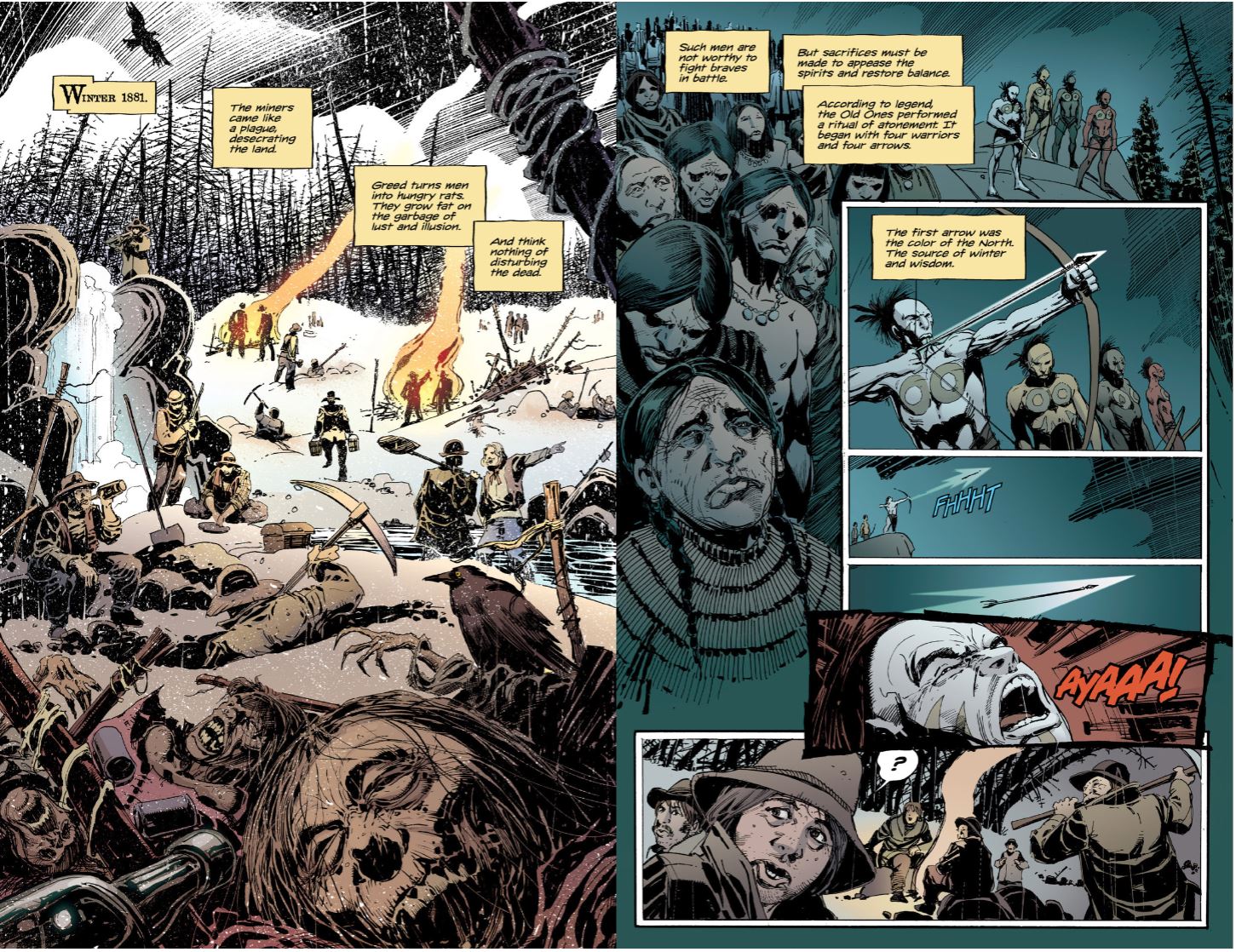
Told in parallel time periods and trenchant flashbacks, the drama begins in the snow-swamped Colorado Mountains of 1880 where a greedy trapper plunders Indian graves and finds gold. A year later, the sacred ground is utterly defiled, turned into a pit of depravity by dozens of prospectors ripping up the terrain in search of yellow metal.

The tribe’s only response is to begin a ritual of atonement. However, undertaken by their holiest warriors – “the Old Ones” – even this act of pious desperation is despoiled. Interrupted by miners, four celebrant warriors are killed, Thus, their derailed devotions slowly poison the environment, becoming a curse for future generations and another prime example of ‘White Man’s Guilt’. That is, of course, none at all…

Unfortunately, the ritual is not done, and continues unfolding at its own pace…

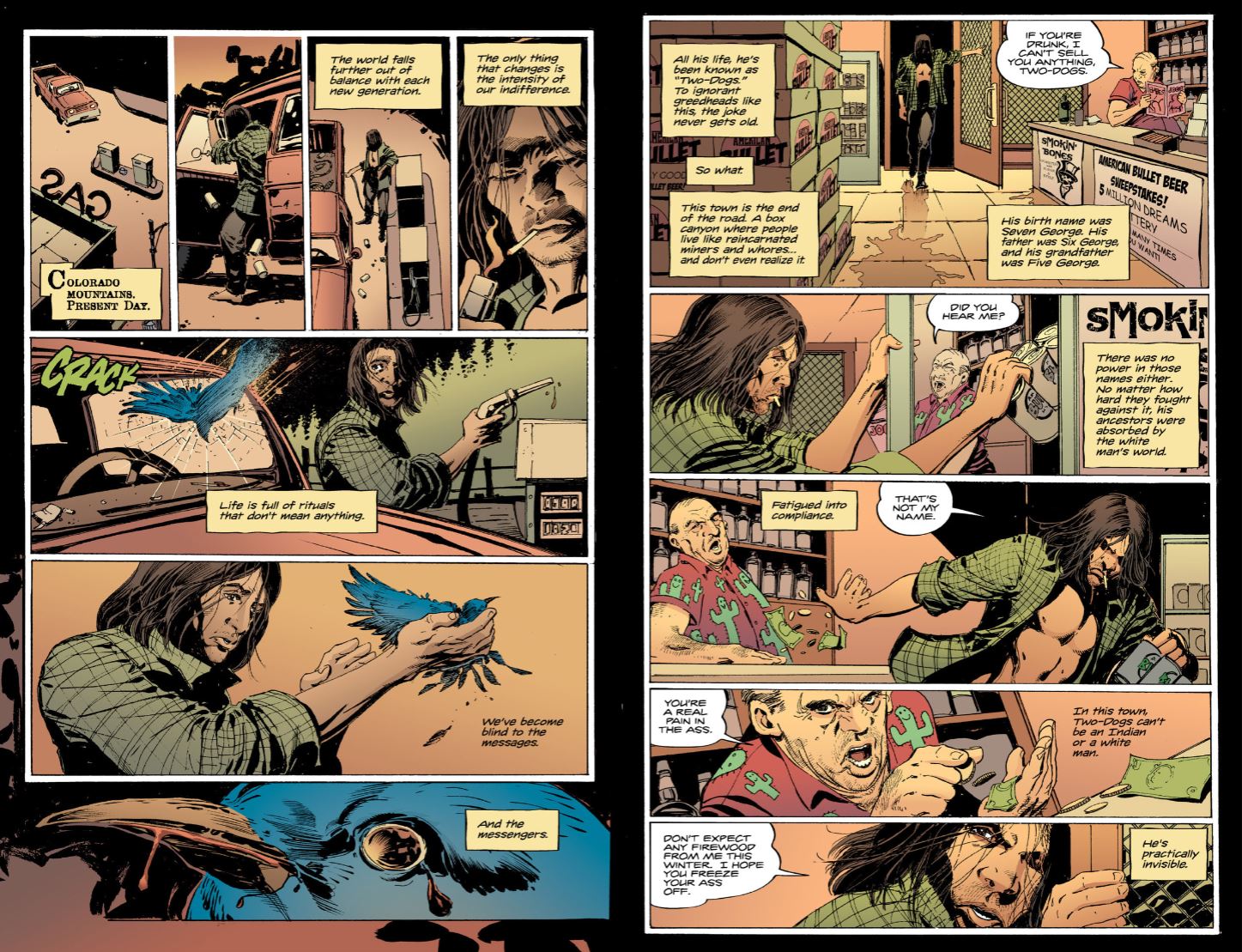
More than a century later, drunk, lost and perpetually angry Native American Seven George (his true name is Two Dogs…) continues being a pain in the ass to everybody. Yet again, sheriff Jim Shipps gives the kid a pass, but by the time the young man reaches his desolate, dilapidated shack, he’s become aware that something’s changed: an unnatural alteration that’s killing all the birds. Thankfully, he knows the history and takes steps to protect himself from an interrupted ritual that’s coming back and coming to a close…

The never-ending wounds to the region had affected both his grandfather Five George and dad Six George in their own times, bringing trouble and death to those who could least risk it, and now, as Two Dogs sits in a jail cell at Christmas waiting for his own fate to unfold, the unnatural takes over. Soon the mountain town is buried in a wall of white, courtesy of ‘The Alchemy of Snow’ but greedy town officials like Cubby Boyer only see another way to make money. Snow tourists flood in, but the joy and profits freeze once this year’s visitors start dying: victims of a bloody, explosive ‘Metamorphosis’

All of the region’s wildlife is frightened and aware of a big change coming. With chaos growing and a news blackout exacerbating the crisis, Two Dogs and Shipps must work together, but certainly never with the same ends in mind…

As the death toll mounts government spooks move in, setting up a quarantine line to keep America safe from “plague carriers” and “contaminated snow”… And they’re not really genuine Feds either…

Although the land’s original occupiers feel their time is returning, they can’t quite hold a solid front, and are divided into factions based on ancient spirits. With the Spider and the Trickster apparently walking the land, somehow, only Two Dogs knows what’s really needed. He begins his personal ‘Ghost Dance’ to the ever-present Watchers from the Spirit World, seeking to save who he can of the terrified human beings but, ultimately all that’s left is to accept fate and ready himself for his ‘Death Song’

Perhaps here is the solution he’s been searching for?

Deftly blending contemporary horror themes with judiciously cherrypicked – or just plain cod – First Nations mythology, To Hell You Ride is not as spiritually astute as it would like, but is far more fun than you can possibly imagine: a superbly chilling race against doom with epic undertones and potent symbology.

Adding to the experience is text feature ‘Origins’, detailing how the story evolved over decades, all stoutly supplemented with character studies, commentary, notes & developmental drawings of Two Dogs, The Watchers, Jim Shipps, Mary Ambrose, Cubby Boyer & the Town, The Spider, The Trickster, Smokin’ Bones, and recurring key image The Appeal to the Great Spirit (as derived from Cyrus E. Dallin’s sculpture of the same name).

Sheer, unalloyed spooky delight, this is a magical yarn that truly would make a magnificent moody movie. So why hasn’t anybody thought of it?

To Hell You Ride™ & © 2012, 2013 Lance Henriksen, Joseph Maddrey & Tom Mandrake. All rights reserved.

Today in 1902 US cartoon stalwart Ed Dodd was born. You probably haven’t seen his Mark Trail comics, but you should if you can.

In 1963 Pilote debuted Greg’s Gallic action ace Achile Talon. As soon as anyone translates that stuff we’ll be right in there. Three years later Vince Locke (Deadworld, A History of Violence, Judge Dredd) was born. In 1991 Finnish cartoon eroticist Tom of Finland died. We haven’t done any of his books yet but keep your eyes peeled (ooh, kinky…)

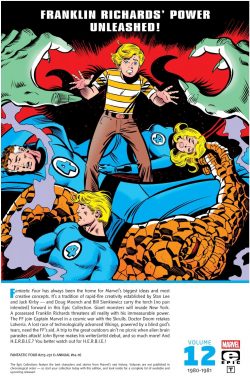
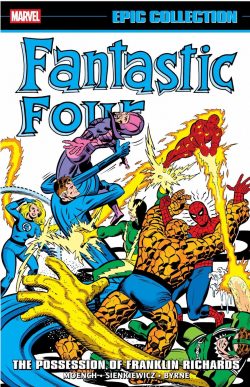
Fantastic Four Epic Collection volume 12: The Possession of Franklin Richards


By Marv Wolfman, Bill Mantlo, John Byrne, Ed Hannigan, George Pérez, Peter B. Gillis, Roger Stern, Doug Moench & Bill Sienkiewicz, Steve Ditko, Tom Sutton, Keith Pollard, Al Milgrom, Joe Sinnott, Pablo Marcos, Bruce Patterson, Chic Stone, Jon D’Agostino, Mike Esposito, Jerome Moore, Frank Giacoia & various (MARVEL)
ISBN: 978-1-3029-6056-8 (TPB/Digital edition)

This book includes Discriminatory Content produced in less enlightened times.

Win’s Christmas Gift Recommendation: Fantastic Fun for Comics Addicts… 8/10

It’s a been a big year for the fabulous FF. Here’s another titanic tome to add to your seasonal swag list…

For Marvel everything started with The Fantastic Four.

Monolithic modern Marvel truly began with eccentric monster ‘n’ alien filled adventures of a compact superteam as much squabbling family as coolly capable costumed champions. All that Modern Marvel is, company and brand, stems from that quirky quartet and the inspired, inspirational, groundbreaking efforts of Stan Lee & Jack Kirby…

Cautiously bi-monthly and cover-dated November 1961, Fantastic Four #1 – by Stan, Jack, George Klein and/or Christopher Rule – was raw and crude even by its ailing publisher’s steadily plunging standards. However, it seethed with rough, passionate, uncontrolled excitement and thrill-hungry kids pounced on its dynamic storytelling. The series caught a wave of change beginning to build in America, and every succeeding issue changed comics a little bit more… and forever. Revealed in that premier, maverick scientist Reed Richards, fiancée Sue Storm, close friend Ben Grimm and Sue’s bratty teenaged brother survived an ill-starred private spaceshot after cosmic rays penetrated their ship’s inadequate shielding.

All permanently mutated: Richards’ body became elastic, diffident Sue became (even more) invisible, Johnny Storm burst into living flame and tragic Ben shockingly devolved into a shambling, rocky freak. After the initial revulsion and trauma passed, they solemnly agreed to use their abilities to benefit mankind. Thus was born The Fantastic Four – you can add your own fanfare and timpani here if you wish…

Throughout the 1960s it was the key title and most consistently groundbreaking series of Marvel’s ever-unfolding web of cosmic creation: a forge for new concepts and characters. Jack Kirby was approaching his creative peak: unleashing his vast imagination on plot after spectacular plot, and intense, incredible new characters whilst Lee scripted some of the most passionate superhero sagas ever seen. Both were on an unstoppable roll, at the height of their powers and full of the confidence only success brings, with The King particularly eager to see how far the genre and the medium could be pushed… which is rather ironic since it was the company’s reticence to give the artist more creative freedom that led to Kirby’s moving to National/DC in the 1970s.

Without Kirby’s soaring imagination the rollercoaster of mindbending High Concepts lost out to traditional tales of characters in conflict, with soap opera leanings and supervillain-heavy Fights ‘n’ Tights forays abounding. With Lee & Kirby long gone but their mark very much still stamped onto every page of the still-prestigious title, this full-colour compendium represents Fantastic Four #215-231 and Annuals #14-16, spanning Fall 1979 to June 1981.

What You Should Know: After being rejuvenated and repowered in an extended space-spanning saga, the Family FF are getting used to being back on Earth even with supervillains all over the place. Now Read On…
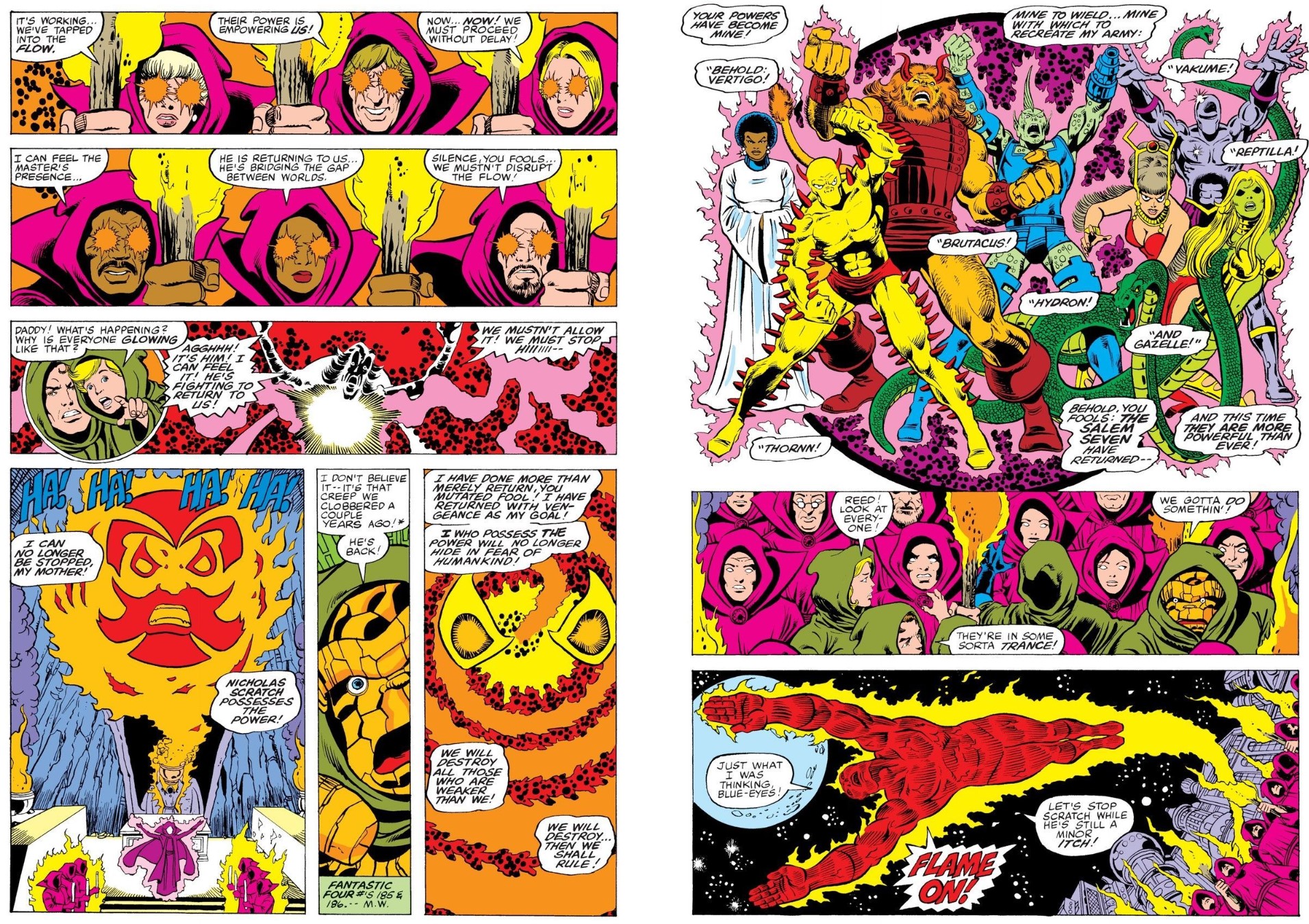
The revived, excessively rejuvenated team are in full fine fettle for Fantastic Four Annual #14 wherin Marv Wolfman, George Pérez & Pablo Marcos put firstborn Franklin Richards and his sorcerous nanny Agatha Harkness in the spotlight for ‘Cats-Paw!’ When magical cult Salem’s Seven abduct and brainwash the adult FF in hopes of resurrecting their macabre master Nicholas Scratch, even the Avengers are helpless to stop the carnage unleashed. Thankfully, the extra-dimensional voyage of the kid and the crone is enough to set everything right…

The arcane account is augmented by ‘A Gallery of the Fantastic Four’s Most Famous Foes!’ by Keith Pollard & Marcos, giving the lowdown on late-debuting villains and ne’er-do-wells including Invincible Man, Attuma, Gideon, Dragon Man, The Frightful Four and Quasimodo. Monthly FF #215 then finds Wolfman, John Byrne & Joe Sinnott reintroducing Negative Zone terror tyrant ‘Blastaar!’ who somehow escapes the antimatter universe to take over the Baxter Building just as a reinvigorated Reed Richards is distracted by former colleague Professor Randolph James who has hyper-evolved himself to offset an otherwise fatal beating by street thugs. Sadly, his accelerator device has not advanced James’ ethical outlook, and after taking vengeance on his attackers, the future man proves that ‘Where There Be Gods!’ there be trouble too, as the mental marvel aligns with Blastaar only to fall before a far greater power… angry cosmic child Franklin…

Bill Mantlo scripts #217 for Byrne & Sinnott, as ‘Masquerade!’ at last exposes the viper in the team’s midst: an inimical force responsible for most of the recent setbacks and accidents, and almost the deaths of the heroes and Johnny’s new intended girlfriend Dazzler

No spoilers here this time, but back then we all just knew who the hidden villain actually was… that acursed robot!

Infernal gadget H.E.R.B.I.E. was imposed on the series due to concerns by producers of the current Fantasic Four cartoon show. Rejecting fire hazard Johnny for a cutely telegenic robot, Wolfman cheekily made that commercial compromise in-world canon, dividing fans forever after. The bleeping bot – a Humanoid Experimental Robot, B-type, Integrated Electronics (latterly, Highly Engineered Robot Built for Interdimensional Exploration; don’cha just love nominative deterministic acronymics?) – is pure Marmite in most readers eyes…
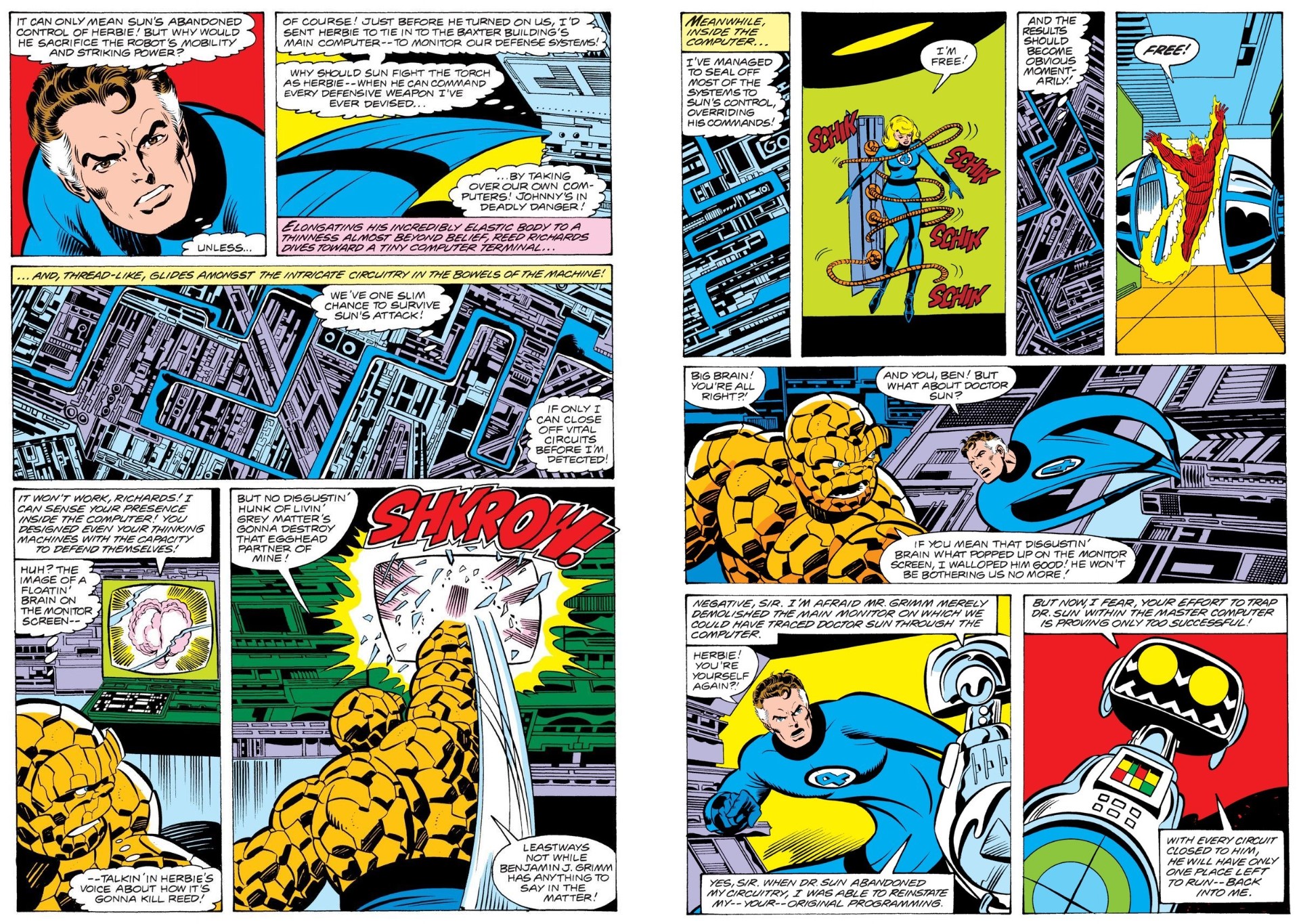
Next is the last half of an old-school saga that, for completeness, means you need to read Peter Parker, the Sensational Spider-Man #42 before enjoying the contents of FF #218. What’s not here is how ESU student Peter Parker goes on a class jaunt and is lured into a trap by the Frightful Four (in ‘Give Me Liberty or Give Me Death’ by Mantlo, Mike Zeck & Jim Mooney if you were wondering). The villains broadsided the wallcrawler after new recruit Electro impersonated the Human Torch there…

Now for ‘When a Spider-Man Comes Calling!’ (cover-dated May 1980 by Mantlo, Byrne & Sinnott), Trapster repeats the tactic to ambush the comfortably at home quartet, allowing his comrades The Wizard and Sandman to take over the heroes’ Baxter Building citadel… at least until a fighting-mad webspinner breaks free for an unstoppable counterattack…

Penciller John Byrne, having served out his first term on the series he was to soon make his alone, was officially only temporarily replaced for FF #219. Ably augmented by Sinnott, stalwart “Guest-Team” Doug Moench & Bill Sienkiewicz were parachuted in for monster mash-up ‘Leviathans’ due to the huge success and acclaim generated by their vigilante thriller Moon Knight. They brought with them a whole new look and sensibility, as well as far faster pace to the stories. Here, modern day pirate Cap’n Barracuda steals the fabled Horn of Proteus from Atlantis to unleash a wave of giant monsters on New York City. Thankfully, this is a subject the mighty Sub-Mariner and Mr. Fantastic can agree on, and their combined forces soon stomp the beasties to stop a piratical plunder ploy without peer…

Byrne bounced back writing & pencilling in #220 as ‘…And the Lights Went Out All Over the World!’ sees the Avengers call Reed and Co. when all Earth suffers a catastrophic power-outage. Science! sends the explorers to the arctic to encounter an astounding and unbelievable obelisk being constructed by beings of utterly alien appearance…

The story includes an updated origin for the quartet and guest shot for Canada’s finest (that’s Vindicator of Alpha Flight in case you were wondering) as the tale halts for a pinup by inker Sinnott (the Torch battling a flaming Skrull) prior to #221’s concluding chapter ‘Tower of Glass… Dreams of Glass!’ Following the usual misconceptions and rash clashes it is revealed that three aliens shipwrecked for half a million years just need their myriad mobile mechanisms to reverse the planet’s magnetic poles so they can return home at last. Happily, Reed has a less end-of-human-civilisation-y solution leaving everyone involved happy and safe; and back where they belong…

Now officially the regular creative team, Moench & Sienkiewicz prep for Halloween in FF #222’s ‘The Possession of Franklin Richards!’ as the cosmic ray kid is again targeted from beyond the unknown by exiled soul Nicholas Scratch. The son of Agatha Harkness is the kind of warlock who gives witchcraft a bad name. and, having made the boy his conduit back to reality, Scratch goes on to terrorise and torture his hated enemies. With Doctor Strange unavailable, they enlist the dubious gifts of self-doubting failed horror hero Gabriel the Devil Hunter and his morally ambiguous familiar Desadia (from Marvel’s monochrome magazine line titles Haunt of Horror and Monsters Unleashed)…

Apparently acquiescing, the team agree to liberate the dead diabolist’s minions of magical mayhem and Salem’s Seven toil ‘That a Child May Live…’ Of course, their instant assaults on humanity are an acceptable risk and consequence in Reed’s plan: setting the worlds to rights for all but the defeated devil…

Fantastic Four Annual #15 swiftly follows, wherein Moench & Pérez, abetted by Chic Stone, Jon D’Agostino & Mike Esposito, renew hostilities between the FF and Skrull empire as the shapeshifters target the supergenius’ latest energy-casting breakthrough in ‘Time for the Prime Ten!’ Infiltrating the Baxter Building, negating his valiant teammates and almost banishing Mr. Fantastic to the tender mercies of Annihilus in the Negative Zone, the sneaky killers are actually seeking to end their millennial war against stellar rivals The Kree, but have underestimated Reed’s brilliance, his family’s tenacity and the cosmic awareness of Earth-loving Kree Exile Captain Mar-Vell

A back-up tale by Moench & Tom Sutton takes us to recently liberated Latveria for the opening of proposed series ‘The Return of Doctor Doom!’ Only episode ‘The Power of the People!’ shows how restored monarch King Zorba fails to live up to his democratic promises and discover how excessive taxation really upsets voters, at around the same moment crazed, catatonic Victor von Doom goes missing from the most secure dungeon in Doomstadt…

Sadly, the impending crisis never materialised and was only addressed by Byrne in Fantastic Four #247…

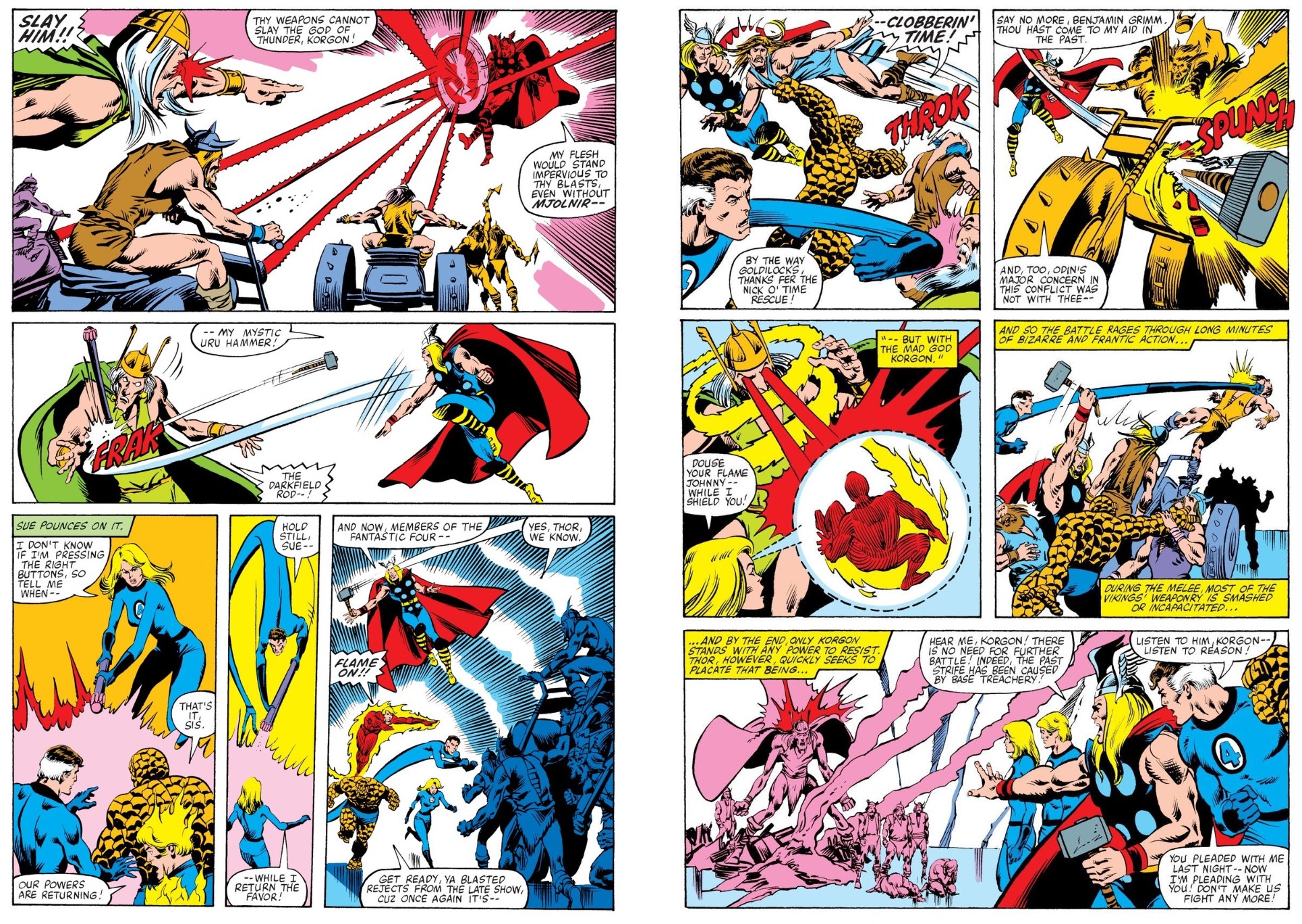
Over in FF #224 & 225, fresh calamity unfolds in ‘The Darkfield Illumination’ (Moench, Sienkiewicz & Pablo Marcos) as radioactive red mist blankets Manhattan and plays hob with the team’s powers. Tracing the cloud’s origin point to an icy dome in the Arctic, the FF find a lost colony of technologically advanced Vikings utterly dependent upon a mutated immortal giant. ‘The Blind God’s Tears’ supply heat, light, food materials from the outside world and immortality, but now Korgon is dying and demands the explorers save him and the people who worship him. Always eager to help, the FF strive and succeed in saving the God, only to see him betrayed by his most trusted ally. As Korgon rages madly in response, the crisis escalates as Mighty Thor arrives to investigate worshippers who have abandoned their true god for a false one…
Bruce Patterson joins Marcos inking Sienkiewicz when Moench next brings closure to fans of his Shogun Warriors series. In their own title the former pilots of monster-fighting mega-mecha Dangard Ace, Raydeen and Combatra had been recruited by an ancient order to defend humanity, but retired when their machines were destroyed. That epic sacrifice had come when evil enemy Maur-Kon targeted the Fantastic Four and attempted to kill Reed. Now a new giant mecha rampages and robs, so the teams reunite with Ilongo Savage, Richard Carson and Genji Odashu aiding the fight against ‘The Samurai Destroyer’ and the unworthy soul exploiting its power for profit….

Movie-toned terror in the heartland follows as a meteor crashes in rural Pennsylvania resort Lost Lake just as the FF head out to the Boonies for a break. Their encounter with ‘The Brain Parasites’ reverting hosts to earlier evolutionary forms is by-the-books horror fun from Moench, Sienkiewicz & Patterson, and readily fixed by little Franklin’s increasingly unreliable powers. This sets the scene for the next – Sinnott inked – issue where further tests by professional head shrinkers and brain benders unleash uncontrollable chaos, possessed bystanders and an adult super-powered version of the lad. Thankfully, loving parents and uncles allow Franklin to exorcise his deadly ‘Ego-Spawn’.

The experiment in alternative tale-telling ends with a 3-part saga opening on #229’s ‘The Thing From the Black Hole’. When it homes in on Reed’s latest invention, Earth totters on the edge of destruction as a sentient singularity made of antimatter disrupts physical laws. Desperate Richards makes contact with its cosmic equivalent and uncovers a tale of love lost in service to scientific exploration. The wandering extinction event was once a living being whose love for a fellow astronaut turned them both into creatures of uncanny forces. Thankfully, ‘Firefrost and the Ebon Seeker’ now reach an understanding that saves Earth, but as a consequence a section of Manhattan – including the Baxter Building – is left inside the Negative Zone.

With panic amongst the abducted New Yorkers barely suppressed, the FF seek a solution ‘In All the Gathered Gloom!’ (Moench & Roger Stern, Sienkienwisz, Jerome Moore, Sinnott, & Frank Giacoia) even as new antimatter menace Stygorr zeroes in on the intruding enclave. The last thing the FF need is bullying big business plutocrat Lew Shiner telling everyone his money puts him in charge. After his posturing triggers a riot, tragedy is guaranteed, and the heroes barely beat the alien invader in time to return everyone surviving back home…
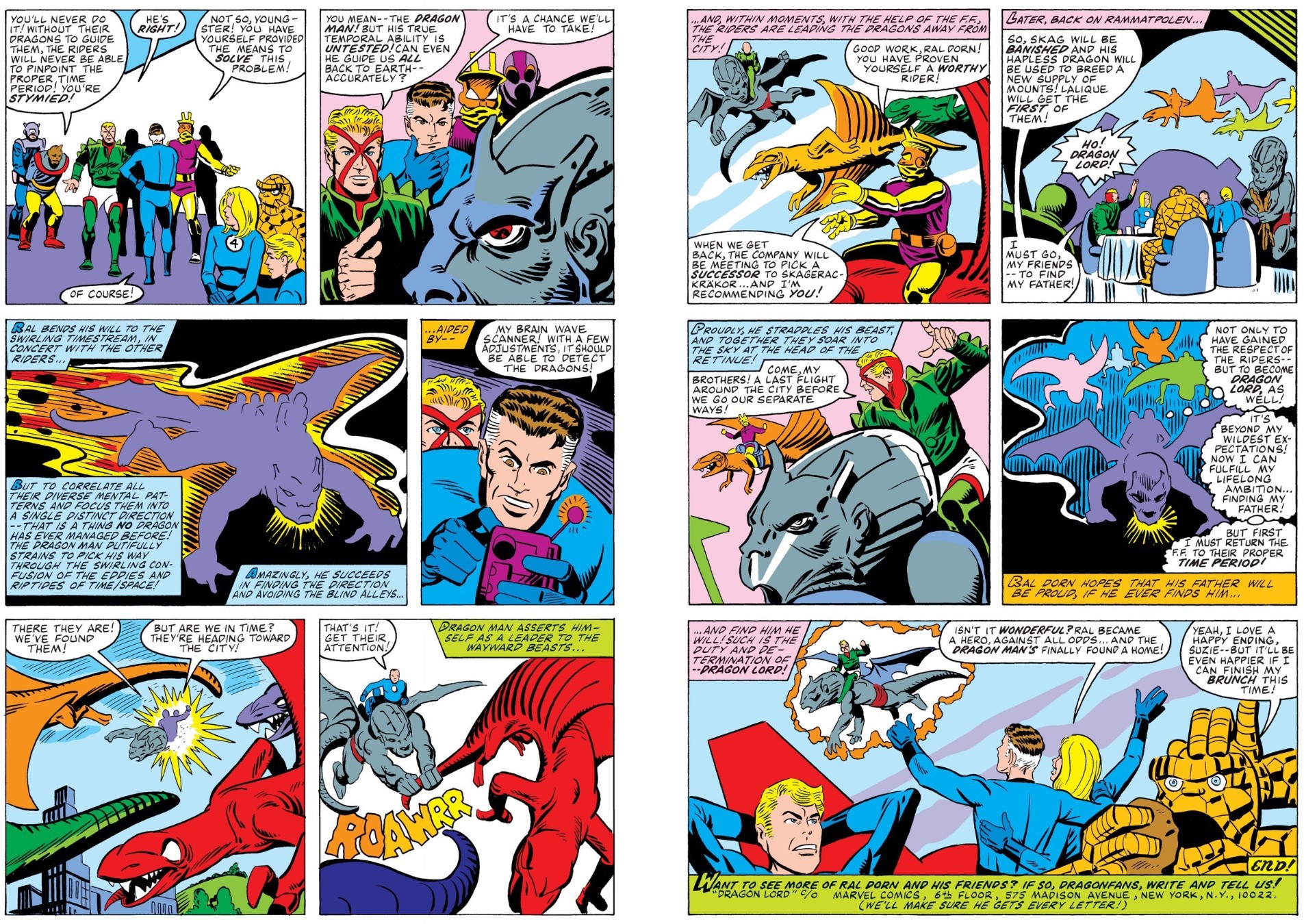
This foray into the fantastic finishes on a “soft pilot episode” as Fantastic Four Annual #16 embraces the contemporary fantasy market with ‘The Coming of… Dragon Lord!’ by Ed Hannigan & Steve Ditko. When trainee Ral Dorn is framed for killing a sacred beast and hunted by former fellows in the puissant extradimensional Dragon Rider organisation, the chase ends up with him wounded. His flight, employing a multi-powered Dragon Staff, leads to a collision with an off-duty quirky quartet, celebrating a reunion on the college campus where they first encountered astouding android Dragon Man,. but the coincidence escapes everybody and the heroes leave the mystery man to the medics.

Days later the fugitive breaks into their skyscraper home and with the Staff holding the FF at bay explains his predicament. A novice lawkeeper, his dream of bonding with a dragon has been shattered by the death of his destined beast-partner, and accusations that he’s responsible. The wild story is inadvertantly backed up by a posse of Dragon Riders seeking to stop him and the intervention of Ral’s bizarre former ally Lalique. When they are driven away, it is clear to the human heroes that something is not kosher and they determine to help him. It’s obvious to Ral that his boss Dragon Lord Skagerackäkor is behind the plot but without a bonded beast what can he do? That’s why he was on campus. He had learned of former FF foe Dragon Man and decided that needs must when the devil drives…

The classic plot left all the goodies rewarded amd baddies punished and was claearly an attempt to launch a series, but…

With covers by Sinnott, Ron Wilson, Josef Rubinstein, Rich Buckler, Al Milgrom, Byrne, Pollard, Sienkienwicz, Bob McLeod & Ditko the extras here include Sinnott pinups of the whole team and Thing pinup from FF #218 & 219: Sienkievich’s rejected cover-turned-pinup as printed in #224; the entries for January in the Marvel Comics 20th Anniversary Calandar 1981 (Sienkienwicz & Sinnott) plus original art pages/covers from Byrne, Sinnott, Sienkienwicz, Marcos and Patterson, as well as original colour-guides painted by George Roussos.

Although never quite returning to the stratospheric heights of the Kirby era, this truly different collection represents a closing of the First Act for the “World’s Greatest Comics Magazine”, and palate-cleansing preparation for the second groundbreaking run by John Byrne. These extremely capable efforts are probably most welcome to dedicated superhero fans and continuity freaks like me, but will still thrill and delight casual browsers looking for an undemanding slice of graphic narrative excitement.
© 2025 MARVEL.

Today in 1858, French cartoonist Emmanuel Poiré was born. He annoyed all the right people as Caran d’Ache… and plenty of the wrong ones too. Far less controversial were Fred Harmon and screenwriter/ scripter Stephen Slesinger who launched epic cowboy strip Red Ryder this day in 1938.

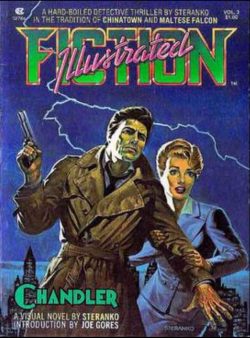
Chandler


By Steranko (Byron Preiss Visual Publications Inc/Pyramid Books)
ISBN: 978-0-515-04241-2 (Pyramid Books)

This book contains Discriminatory Content produced during less enlightened times.

Jim Steranko was born today in 1938. Can you guess what time it is?
Steranko is an artist with many strings to his bow. Whether as publisher, typographer, graphic designer, artist, writer, storyteller, historian, or musical performer he has always excelled. As magician & escapologist he found celebrity, inspiring new friend Jack Kirby to create Super Escape Artist Mister Miracle, but it’s as a comics creator the man of many talents has most memorably succeeded.
At the peak of Marvel’s first creative flowering he revolutionised the telling of graphic stories with Nick Fury, Agent of S.H.I.E.L.D. His retro-revisionist take on Captain America is reverently remembered, as is his brief meddling with mutant outriders The X-Men.

Decades after his experimental forays in Marvel’s horror and romance titles, the results are remembered – and now finally in print – as high-points in style and cinematic design.

Steranko left Marvel to pursue other interests and began publication of pop culture mainstay Mediascene Prevue, only rarely returning to the comics medium. If you’ve never seen his strip work you’ll know him by his film production concept art for blockbusters like Raiders of the Lost Ark and Bram Stoker’s Dracula. In the mid-1970s he linked up with comics Svengali Byron Preiss to create this fabulous experimental precursor of the graphic novel: a dynamic and vivid tribute to the hard-boiled detective and film noir genres, and something which perhaps not altogether to the tastes of fans at the time is certainly now very much in the bailiwick of contemporary comics consumers.

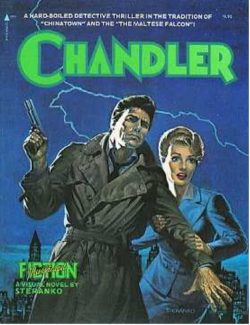
Alternatively entitled FICTION ILLUSTRATED VOLUME 3 in its pocket digest sized paperback iteration (as well as proper full-sized graphic novel Chandler: Red Tide), it still packs a potent visual and narrative punch.

Chandler is a private eye, in the iconic myth-country of 1940’s New York City. One night a desperate man comes looking for someone to track down his inescapable killer. Bramson Todd witnessed a mob hit and has somehow been poisoned because of it. With 72 hours to live, the walking corpse wants proactive revenge, and as well as a vast amount of money, he offers Chandler the chance to save three other witnesses from the same fate or worse…

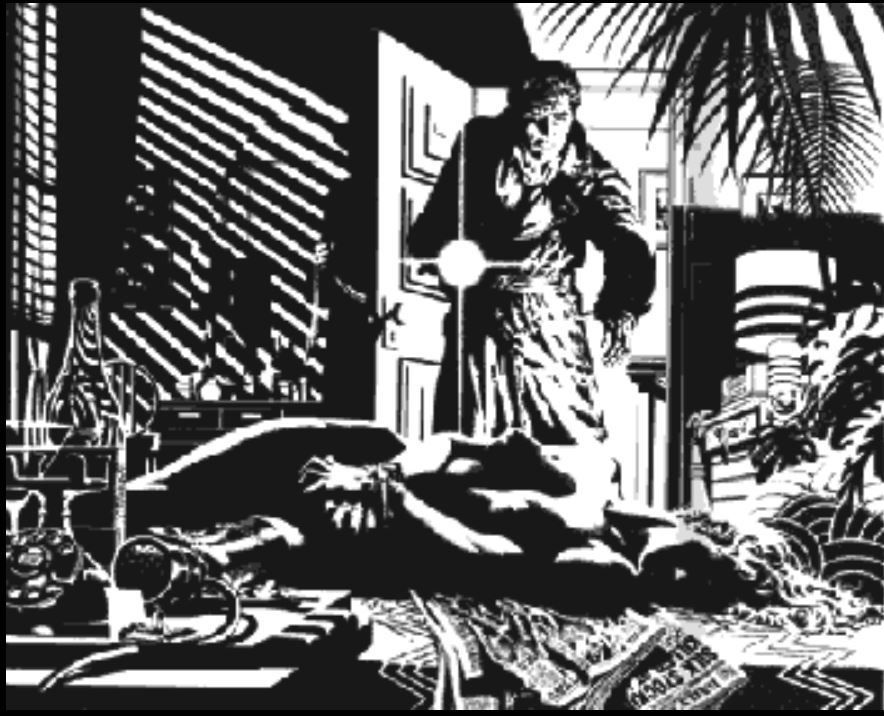
The familiar iconography of a seedy, noble gumshoe is augmented by two-fisted action, flying bullets, sundry thugs and scoundrels, memorable, glamorous women and a ticking clock, all working to make this loving and effective pastiche a minor masterpiece…

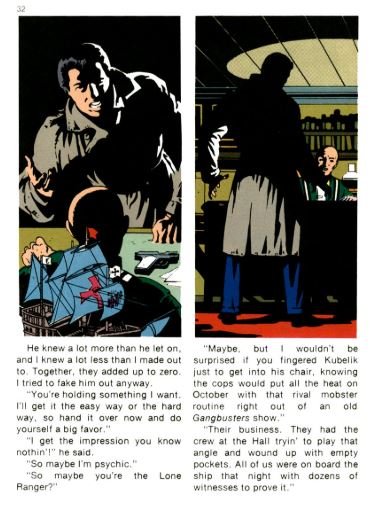
Back then, however, a major stumbling block for many readers was the unconventional format of the book. Each folio is divided into two columns – in the manner of classic pulp prose page layouts – with each column comprising an illustration above a block of accompanying text.

Despite Steranko’s superb draughtsmanship and design skill (some spreads form extended visual continuities with 4-single frames becoming one large illustration), there is an element of separation between prose & picture that can take a little adapting to. But you should try. It’s worth it.

This is still a powerful tale, well told and worth any extra effort necessary to enjoy it. Another contender for immediate reissue, I think…

© 1976 Byron Preiss Visual Publications Inc. The character Chandler © 1976 James Steranko.

Today in 1977 René Goscinny died. You must by now know where to look for him. Two years later Li’l Abner’s Al Capp passed on too, in 2007 unsung star Paul Norris died. He’s most renowned for co-creating DC’s Sea King as most recently seen in Aquaman: 80 Years of the King of the Seven Seas – the Deluxe Edition.

Death in Trieste


By Jason (Fantagraphics Books)
ISBN: 979-8-8750-0125-3 (HB/digital edition)

Win’s Christmas Gift Recommendation: Absurdly Enchanting Comics Capers… 9/10

This book includes Discriminatory Content included for dramatic, comedic and ironic effect.

Born in 1965 in Molde, Norway, John Arne Sæterøy is known by enigmatic, utilitarian nom de plume Jason. The shy & retiring auteur first took the path to cartoon superstardom in 1995, once debut graphic novel Lomma full ay regn (Pocket Full of Rain) won Norway’s biggest comics prize: the Sproing Award. From 1987 he had contributed to alternate/indie magazine KonK while studying graphic design and illustration at Oslo’s Art Academy.

From there he took on Norway’s National School of Arts and, on graduating in 1994, founded his own comic book Mjau Mjau. Constantly refining his style into a potent form of meaning-mined anthropomorphic minimalism, Jason cited Lewis Trondheim, Jim Woodring & Tex Avery as primary influences. He moved to Copenhagen, working at Studio Gimle alongside Ole Comoll Christensen (Excreta, Mar Mysteriet Surn/Mayday Mysteries, Den Anden Praesident, Det Tredje Ojet) & Peter Snejbjerg (Den skjulte protocol/The Hidden Protocol, World War X, Tarzan, Books of Magic, Batman: Detective 27). Jason’s efforts were internationally noticed, making waves in France, The Netherlands, Slovenia, Spain, Germany and other Scandinavian countries as well as the Americas. He won another Sproing in 2001 – for self-published series Mjau Mjau – and in 2002 turned nigh-exclusively to producing graphic novels. He won even more major awards.

His breadth of interest is wide & deep: comics, movies, animated cartoons, music, literature art history and pulp fiction all feature equally with no sense of rank or hierarchy. Jason’s puckish, egalitarian mixing & matching of inspirational sources always and inevitably produces picture-treatises well worth a reader’s time. Over a succession of tales he has built and re-employed a repertory company of stock characters to explore deceptively simplistic milieux based on classic archetypes distilled from movies, childhood yarns, historical and literary favourites. These all role-play in deliciously absurd and surreal sagas centred on his preferred themes of relationships and loneliness. Latterly, Jason returned to such “found” players as he built his own highly esoteric universe, and even has a whole bizarre bunch of them “team-up” or clash…

As always, visual/verbal bon mots unfold in beguiling, sparse-dialogued, or even as here silently pantomimic progressions, with compellingly formal page layouts rendered in a pared back stripped-down interpretation of Hergé’s Claire Ligne style: solid blacks, thick outlines dominating settings of seductive monochrome simplicity augmented by a beguiling palette of stark pastels and muted primary colours.

A master of short-form illustrated tales, many Jason yarns have been released as snappy little albums perfect for later inclusion in longer anthology collections like this one which gathers a trio of his very best. The majority of tales brim with bleak isolation, swamped by a signature surreality. They are largely populated with cinematically-inspired, darkly comic, charmingly macabre animal people ruminating on inescapable concerns whilst re-enacting bizarrely cast, bestial movie tributes. That’s a style that has never been more apropos than right here, as the more modern Art Forms bow before the onslaught and tirade of organised anti-art philosophers and socially intellectual terrorists…

Linked by theme and character, it begins with ‘The Magritte Affair’ as dapper masked men haunt Paris, surreptitiously substituting domestic pictures (like David Bowie as Aladdin Sane) for knock-off Surrealist masterpieces. When seen by affronted householders the images can have mesmeric effects and even spark nervous breakdowns…

Incidences increase and before long special operatives Miss Mira Bell & Mr Bob Delon are assigned the case, but a break only comes after aging painter Victor Dubois is abducted. He proves to be only the latest of many…

After a violent but inconclusive clash with the bowler hat brigade, solid research takes the daring duo to Brussels and the Magritte Museum just as the incidents hit fever pitch. With oddly dressed zombies quoting surrealist doggerel in the streets Bell & Delon uncover the mastermind and motive to close the case… but not for long…

The delicious spoof of Steed & Peel’s Avengers gives way to darker espionage larks as ‘Death in Trieste’ opens on the much-protracted murder of Grigori Rasputin before switching time and place to Berlin in 1925 where a Dadaist convention welcomes time-lost David Bowie. Sadly, he’s more interested in compelling performer Marlene Dietrich, and not paying enough attention to the Nosferatu stalking rooftops and bedrooms…

Nobody is paying attention to Rasputin’s skull and what it’s accurately predicting will befall Germany in the next twenty years…

As doomed lives converge and the Dadaists run riot, the chaos brings forth an immortal hero as undying musketeers Athos pops in for a quick look…

The warped wonderment sidles to a full stop with ‘Sweet Dreams’ as stone heads on Easter Island give musician Bono advance warning of doom. When an asteroid changes direction in the void and heads right for Earth, converging signs and portents trigger artists, musicians and madmen everywhere. As the dead rise in museums and elsewhere, only new romantic pop stars are ready and willing to unite and use their extraordinary abilities to combat an oncoming apocalypse. With Major Tom now in orbit for one final countdown, can hip sounds possibly succeed where science and magic have both failed?

A delightful tip of the hat to spy shows, pop rock and horror movies disguised as an adventure in art history, Death in Trieste confirms the cosmic truth that Jason remains a taste instantly acquired: a creator any fan of the medium should move to the top of their “Must-Have” list.
All characters, stories, and artwork © 2019 Jason. This edition © Fantagraphics Books, Inc. All rights reserved.

Today in 1916 Lo Hartog van Banda was born. You only need to scroll back a bit to see him at work, whilst in 1948 Carl Thomas Anderson died. We dealt with him as much as possible in Henry Speaks for Himself.

Today in 1830 gloriously anti-monarchist satirical French weekly La Caricature began, and ran until 1843. Can you remember when Private Eye wasn’t the only cartoon voice of dissent and outraged injustice?

Osama Tezuka’s Astro Boy volume 10


By Osamu Tezuka, translated by Frederik L. Schodt (Dark Horse Manga)
ISBN: 978-1-56971-793-1 (tank?bon PB/Digital edition)

This book contains Discriminatory Content produced during less enlightened times.

From beginning his professional career in the late 1940s until his death in 1989, Osamu Tezuka generated an incomprehensible volume of quality work which transformed the world of manga and how it was perceived in his own country and, ultimately, across the globe. Devoted to Walt Disney’s creations, he also performed similar sterling service with Japan’s fledgling animation industry. Look what that led to…

The earliest stories were intended for children but right from the start Tezuka’s expansive fairy tale stylisations harboured more mature themes, holding hidden pleasures for older readers and the legion of fans growing up with the Mankaga’s manga masterworks…

The “God of Comics” was born in Osaka Prefecture on November 3rd 1928, and as a child suffered from severe illness. The doctor who cured him inspired the lad to study medicine, and although Osamu began drawing professionally whilst at university in 1946, he persevered with college and qualified as a medical practitioner too. Then, as he faced a career crossroads, his mother advised him to do the thing which made him happiest.

He never practiced as a healer but the world was gifted such masterpieces as Kimba the White Lion, Buddha, Black Jack and so many other graphic narratives. Working ceaselessly over decades, Tezuka and his creations inevitably matured, but he was always able to speak to the hearts and minds of young and old equally. His creations ranged from the childishly charming to the distinctly disturbing such as The Book of Human Insects or Tomorrow the Birds.

Tezuka died on February 9th 1989, having produced more than 150,000 pages of timeless comics; reinvented the Japanese anime industry and popularised a uniquely Japanese graphic narrative style which has become a fixture of global culture.

These monochrome digest volumes (173 x 113 mm in the physical world and any size you like if you read them digitally) present – in non-linear order – early exploits of his signature character, with the emphasis firmly on fantastic fun and family entertainment…

Tetsuwan Atomu (literally “Mighty Atom” but known universally as Astro Boy due to its dissemination around the world as an animated TV cartoon and one of post-war Japan’s better exports) is a spectacular, riotous, rollicking sci fi action-adventure starring a young boy who also happens to be one of the mightiest robots on Earth.

The series began in 1952 in Sh?nen Kobunsha and ran until March 12th 1968 – although Tezuka often added to the canon in later years, both in comics but in also in other media such as newspaper strips and in magazines. Throughout that period, the plucky robot lad spawned the aforementioned global TV cartoon boom, starred in comic book specials and featured in games, toys, collectibles, movies and the undying devotion of generations of ardent fans.

Tezuka frequently drew himself into his tales as a commentator, and in his later revisions and introductions often mentioned how he found the restrictions of Sh?nen comics stifling; specifically, having to periodically pause a plot to placate the demands of his audience by providing a blockbusting fight every episode. That’s his prerogative: most of us avid aficionados have no complaints and one upheld in abundance in the early tales included here…

Tezuka and his production team were never as wedded to close continuity as fans are. They constantly revised stories and artwork for later collections, so if you’re a purist you are just plain out of luck. Such tweaking and modifying is the reason these editions seemingly skip up and down publishing chronology. The intent is to entertain at all times so stories aren’t treated as gospel and order is not immutable or inviolate. It’s just comics, guys, and in case you came in late, here’s a little background to set you up.

In a forthcoming world where robots are ubiquitous and have won (limited) human rights, brilliant Dr. Tenma lost his son Tobio in a traffic accident. Grief-stricken, the tormented genius used his position as head of Japan’s Ministry of Science to have his team build a replacement. The android created was one of the most groundbreaking constructs in history, and for a while Tenma was content. However, as his mind re-stabilised, Tenma realised this unchanging humanoid was not Tobio and, with cruel clarity, no longer accepted a substitute. Ultimately, the savant removed the insult to his real boy by selling the robot to a shady dealer…

One day, independent researcher Professor Ochanomizu was in the audience at a robot circus and realised diminutive performer Astro was unlike the other acts – or indeed, any artificial being he’d ever encountered. Convincing the circus owners to part with the little robot, the boffin closely studied the unique creation and realised just what a miracle had come into his hands…

Part of Ochanomizu’s socialization process for Astro included placing him in a family environment and having him attend school just like a real boy. As well as providing friends and admirers the familiar environment turned up other foils and occasional assistants such as the bellicose Elementary School teacher Higeoyaji (AKA Mr. Mustachio) and a robot little sister dubbed Uran

The wiry, widgety wonder’s astonishing exploits resume here after the now traditional ‘A Note to Readers’ – explaining why one thing that hasn’t been altered is the depictions of various racial types in the stories. Since the author was keen to combine all aspects of his creation into one overarching continuity, this volume (at last) incorporates classic 1950s material as well as the masterful Sixties sagas and following an intimate chat with the cartoonist opens with masterful monster mash -up ‘Astro vs Garon’ which was originally serialised in Sh?nen Magazine from October 1962 to February 1963. Here a sequence of wild weather events precedes the arrival of a bizarre object from space. As scientists gather, prod and poke about, they determine the package is some sort of cosmic flat-pack parcel. Sadly, once they put all the pieces together, what they have is a planet-restructuring autonomous entity…

Thanks to Ochanomizu and his little robot companion, a packing note is translated, revealing the power and purpose of the construct, and – crucially – that it has arrived on the WRONG PLANET!

Sent to the Superintendent of Megalopa by the King of Planet Yura, the package has been despatched to “kill Plasta” and “modify” planets, so the sagacious observers are perfectly happy to leave it alone from now on if they can’t find a way to destroy it. Sadly, they aren’t quick enough and lightning awakens “the Garon”, which goes on a catastrophic rampage that all Earth’s military might and valiant Astro Boy can barely handle.

Thinking the crisis over, the handmade hero is called back into action when inert Garon is stolen by sleazy Professor Amagawa and a conglomerate of greedy capitalists and gangsters, Transported to the South Pacific the monster is then deliberately unleashed and all hell inevitably breaks loose. Able to convert the atmosphere and alter gravity, Garon goes wild and the astonishingly outpowered robot kid seems unable to pull off a second miracle.

Thankful for an old fable he once heard, Astro Boy devises a way to outsmart and banish the beast he cannot kill…

Japanese kids were editorially and parentally sheltered in different ways to us in the West, and second saga ‘Yellow Horse’ (Sh?nen, October 1955 – February 1956) might be a little shocking to some. It deals with diabolical drug dealers and sees Astro seconded by Police Inspector Nakamura to crack a ruthless smuggling gang with a hideout that is literally out of this world. To defeat them, the boy ‘bot goes undercover posing as a young user and eventually junkie/recruit, having to allow his hero Mr. Mustachio to be attacked and nearly killed and Professor Ochanomizu to be tortured and turned into an addict…

Eventually however, the plan gels and a calamitous battle reveals another shocking secret before the case can be closed…

Next, from Sh?nen magazine March to April 1967, ‘The 100 Million Year Old Crime’ sees a gang of French mutant juvenile delinquents run amok, endangering all of society with their unchecked mental powers. Called in to help, Professor O and Astro are crushed and defeated by the teens after they steal unstoppable robot superweapon Karabusu

As the professor is cruelly enslaved by the mutant kids, the wrecked scraps of Astro are found by ancient aliens. These “water ghosts” have been on/in Earth for 100,000,000 years and the father one is mired in guilt for committing an utterly unpardonable act. His daughter Parma is, however, enchanted by the robot remains and rebuilds him, triggering a cycle of redemption. Repaired and curious, Astro learns that heinous antediluvian crime was meddling with earth creatures’ genetic and creating humanity. All their historical atrocities and planetary harms are the alien’s fault and now he will wipe out his mistake. Desperate, Astro debates with the despondent progenitor and a deadly deal is struck, one involving reforming those mutant kids who seem to be the very worst the species can offer…

Sadly, the morbid maker has no intention of honouring it and Astro has to resort to the kind of tactics he despises for the good of all…

This outing to the orient of cartoon yore ends with a cunning crime caper and contemporary spoof saga as ‘Astro’s Been Stolen!’ (June to September in Tetsuwan Atom Kurabu AKA Mighty Atom Club) sees the mecha mite and his loving (equally mechanical) family distraught following a message from Professor O. This explains that the boy, his sister and they all need to grow for their mental health. That means transferring their processors and personalities into new, appropriately aged bodies every ten years…

Tragically, Ochanomizu has been targeted by diabolical twinned Doctors Rukarike. He’s actually a singular supervillain called Gettrich who cons the well-meaning savant into switching Astro Boy’s electro-brain into an adult replacement frame just so he can steal the junior version and place a hench-minion’s mind in it. The purpose is to gain admittance to the top-secret base containing super artefact the Neo-pyramid, but the fiend has not reckoned with Astro’s resilience and determination, nor the timely interference of British agent James Itch Dnob…

Breathtaking pace, outrageous invention, slapstick comedy, heart-wrenching sentiment and frenetic action are hallmarks of these captivating comics constructions: all ideal examples of Tezuka’s uncanny storytelling gifts. These still deliver a potent punch and instil wide-eyed wonder on a variety of intellectual levels and our melange of mecha-marvels is further enhanced an older, more sophisticated tone via the material’s constant revision, confirming Astro Boy as a genuine delight for all ages.
Tetsuwan Atom by Osama Tezuka © 2002 by Tezuka Productions. All rights reserved. Astro Boy is a registered trademark of Tezuka Productions Co., Ltd., Tokyo Japan. Unedited translation © 2002 Frederik L. Schodt.

Today in 1998 Batman co-creator Bob Kane died. Coincidentally, way back in 1927 letterer Milt Snappin was born on this same date. Milt put the words in Batman & Robin’s bubbles – as well as Superman, Superboy and other DC World’s Finest stars throughout the post Golden and Silver Age period.